


 Francais
 Deutsch
 Italiano
Refine Your Search
+"Europe" +1945 stock footage and images
- Showing 25 to 30 of 527 results more
more Hide
Hide
The end of WWII and U.S. President Harry Truman's role in immediate postwar actions
Opening scene shows some German infantry surrendering with hands raised. Next scene shows people thronging Times Square in Manhattan, New York City, celebrating VE Day, or Victory in Europe Day, on May 8, 1945, when Germany surrendered to end World War II, in Europe. Image of the first atomic explosion (Trinity) on July 16, 1945, in New Mexico, United States. Scene shifts to deck of the U.S. Battleship, USS Missouri, where Japanese foreign minister, Mamoru Shigemitsu, is seated and signing the instrument of surrender., on September 2, 1945. Closeup profile of General Douglas MacArthur. Another glimpse of Mamoru Shigemitsu signing. Next, MacArthur is seen signing the document. He turns and presents the pen to Lieutenant General Jonathan M. Wainwright , who is standing behind him alongside British Lieutenant-General Arthur Ernest Percival. Brief glimpse of the San Francisco War Memorial and Performing Arts Center with flag appearing to be at half staff and a long awning extending from its entrance to the sidewalk. View of representatives at the first United Nations meeting there . Views of audience in auditorium shows many notables. Closeups of Soviet Ambassador, Andrey Gromyko and Soviet Foreign Minister, Vyacheslav Molotov.. Next, President Harry S. Truman is seen broadcasting a greeting to the delegates, from the Capitol, Washington, DC, on April 25, 1945. The delegates are seen listening to the broadcast and then applauding.
Images of signed affidavits by U.S. military personnel verifying authenticity of images of German Concentration camp scenes
Camera shows close up of two certificates of affidavit signed by Lieutenant Colonel George Stevens and Lieutenant Kellogg. The first affidavit by U.S. Army Signal Corps Colonel Stevens cites Stevens' work from 1 March 1945 to 8 May 1945 photographing concentration camps and prison camps liberated by Allied forces. It is read aloud by George Stevens (or by a narrator reading the text of the affadavit). The second affidavit, signed by U.S. Navy Lieutenant E.R. Kellogg, and witnessed by Captain John Ford, is also read aloud. It cites Kellogg's expertise in motion picture and photographic techniques through his employment with Twentieth Century Fox Studios in California from 1929 to 1941. He attests that he has thoroughly examined the concentration camp liberation films of the Army Signal Corps and found them to be unaltered, genuine, and true copies of the originals in the U.S. Army Signal Corps vaults. A map shows the location of concentration camps in Germany and other parts of occupied Europe under Nazi control. (World War II period).
President Harry S. Truman of United States travels to Berlin, for Peace Conference, after World War II in Europe
A film titled 'Berlin conference 1945' shows United States President Harry S. Truman and Secretary of State James F. Byrnes aboard the Cruiser USS Augusta (CA-31) while on their way to Germany for Three-Power Berlin Peace Conference. Several views of President Truman aboard the USS Augusta. He salutes with hand over heart as U.S. Navy warships pass in review. Truman and Secretary of State, Byrnes, descend a stair on the ship. They are seated on deck and President Truman waves his hat at people on the shore, as the Augusta enters port at Antwerp, Belgium. Senior Allied officers come aboard to greet the President and his party. President Truman walks down the gangplank to the pier, followed by Secretary Byrnes. Truman and Byrnes in back seat of an open car, accompanied by Secret Service agents, waves to spectators as they drive off the pier. Later, a motorcade is seen passing parked airplanes. Truman greets Officers of the U.S. Army 35th Division. He boards Air Force One, the "Sacred Cow," a VC-54C aircraft (tail number: 2107451) at Brussels Airport, Belgium. The Air Force One seen in flight above clouds and then parking at airfield in Germany. Presidential motorcade in Berlin, on Unter Den Linden, and passing through the Brandenburg Gate. Portraits of Truman, Stalin, and Churchill, on stone pillars. Inserted scenes of Hitler in motorcade and speaking in Berlin. President Truman speaking in an outdoor venue, with General Omar Bradley and other high ranking American officers standing behind him. His remarks are broadcast and people shown listening in America
French POWs and repatriated civilians arriving at Le Bourget Airport in Paris, France, near end of World War II in Europe
Repatriation of French war prisoners and civilians in Paris, France toward the end of World War Two. Three U.S. C-47aircraft in flight approaching the Le Bourget airport. A fleet of U.S.Army Air Forces C-47 aircraft parked on the ramp and some taxiing. Ambulances and vehicles are positioned on the ramp as repatriated French soldiers deplane. Soldiers with their belongings moving in loose formation along the ramp. A C-47 taxiing. Its tail number is 42-24174, belonging to the 34th Troop Carrier Squadron, 315th Troop Carrier Group, of the U.S. 9th Air Force. An Air France JU-52 passenger aircraft is parked on the ramp, and civilians deplane, including Marcel Bloch, a French aircraft builder,who had been imprisoned in the Buchenwald Concentration Camp, until April 11, 1945. (He later changes his name to Dassault, which will also become the name of his aircraft company, after the war). Also among the passengers is Marcel Rene, director of the French paper 'Resistance.' Several views of the aircraft's pilot and the civilian passengers.
Mob uprisings against Fascists in Europe, during the end of World War II. The Third Moscow Conference of the Allied occupying powers. The Belsen trials.
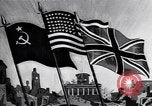
A mob, seeking revenge against Fascist leaders, fills a city square. They pound on steel gates of a government building. Soldiers and police attempt to protect various persons from the mobs. Others are unprotected and suffer beatings and death. Bodies of Benito Mussolini and his Mistress Clara Petacci are seen hung upside down by Italian Partisans in Milan, Italy, on 28 April 1945. Scene shifts to image of postwar occupying powers, United States, Soviet Union, and Great Britain, whose flags are displayed in the center of a conference table during the Third Moscow Conference. Principals signing agreements, in November, 1943, providing, among other things, for lawful and orderly trials of war criminals, following World War 2. Seen signing are: Soviet Foreign Minister Vyacheslav Mikhailovich Molotov; U.S. Secretary of State, Cordell Hull; and British foreign Secretary, Sir Anthony Eden. View of General Dwight D. Eisenhower, leading a contingent of American wartime Generals on a mission to document Nazi atrocities at liberated German concentration camps. Closeup of a man directing local German citizens who were forced to observe the horrors of the camp. Closeup of an oven used to dispose of bodies of victims. Dead bodies of concentration camp victims strewn in a heap. A room filled with documentary evidence to be analyzed and used in war crimes trials. the body of German General Admiral Hans-Georg von Friedeburg , and of Heinrich Himmler, both of whom committed suicide. A hand holding cyanide capsules. Body of Leipzig City Council deputy mayor Dr. Ernst Kurt Lisso slumped over his desk, following suicide. Body of his daughter, Regina Lisso also a suicide victim. Nazi war criminals being rounded up by Allied military.One being carried on a stretcher. Another, a German officer, is taken into custody. Next, Josef Kramer, the Commandant of Bergen-Belsen concentration camp is seen under guard by a British soldier. British soldiers guarding the court room of the second Belsen trial, convened by the Allied occupational forces, in the Gymnasium building of Luneburg. View of the courtroom with defendants wearing numbers. Closeup of numbers 1 and 2, Josef Kramer, and Fritz Klein, respectively. View of Allied military officers sitting in judgment. Closeups of women defendants, including Irma Grese (number 9) and Elisabeth Volkenrath (number 11). Camera pans around the courtroom.
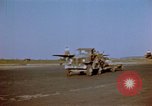
A ground crew loads bombs on a B-26 bomber of the USAAF 323rd Bombardment Group near the end of World War II in Europe.
Film opens showing armorers riding atop bombs being towed by an M6 Bomb Service Truck, at Denain-Prouvy Airdrome, France (A-83) in March, 1945. The truck drives slowly along the field, past parked Martin B-26 Marauder medium bombers of the 323rd Bombardment Group. One of the airmen plays a harmonica as he rides along. After a while the truck turns to a parked B-26, tail number 41-34942, where the armorers climb down and begin loading bombs on the aircraft.