


 Francais
 Deutsch
 Italiano
Refine Your Search
+"Europe" +1945 stock footage and images
- Showing 31 to 36 of 527 results more
more Hide
Hide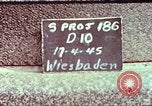
Views of Wiesbaden and Mainz, Germany, at end of World War II in Europe. German soldiers being relocated.
Opening slate reads April 17, 1945, Wiesbaden, Germany. A brick building in Wiesbaden with large arrow pointing downstairs, labeled "LSR", meaning Luftschutzraum (Air-raid room). Signpost in front of a building with damaged roof reads, "Radfahr-weg" (bicycle path). Below it an American army sign reads "WP-Water Point." U.S. soldier directs military vehicles, carrying surrendered German soldiers, as they cross the Rhein (Rhine) river, from Wiesbaden to Mainz on a pontoon bridge. The dome of Christuskirche (Christ Church) across the river, dominates the skyline
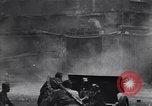
Soviet combat film of the Battle of Berlin during final phases of World War II in Europe
Soviet troops firing field artillery in streets of Berlin, Germany, late in 1945, during World War 2. Closeup glimpse of a Soviet woman tank crew member. Glimpse of Russian tank firing at building. Glimpse through window of building as tank fires across the street. View downward of Soviet infantry running through street below. Another tank firing. Soviet infantry soldier advancing through fire and smoke. A tank crew member carrying a wounded comrade over his shoulder, past several T-34 tanks parked in the background. A tank burning. Medic tends head wound of the injured tank crewman. More views of infantry running through the rubble filled streets. Animated map showing the pincer movements of Soviet forces closing in from outskirts of Berlin toward its center. Glimpse of Soviet soldier scanning across the city with optical equipment. Camera pans across smoke filled city showing the ruins of the Reichstag Building and anther large damaged building. More views of artillery firing in street. A knocked out tank. Huge smoke clouds billow from a shelled building. Infantry scramble over rubble. German civilians hiding in a garden. A Soviet soldier helps a very old German man out of the remains of a building. Soviet machine guns rake the front of a building, causing pieces of it to fall to the ground. An old German woman wanders along a city street. A Soviet ROKS flamethrower is fired from the window of a building creating fire on a building across the street. Infantry run past the burning building. During a pause in fighting, a Soviet female soldier washes the face of a male soldier. An artillery field piece firing in the street. A wounded Soviet soldier with bandaged head, fires a captured German Panzerfaust anti tank weapon. Four Soviet soldiers carrying a wounded on a litter, run through past the camera.
History of Berlin before and after World War II showing zones of occupation and poor living conditions post-war.
Nazi soldiers at attention with guns drawn in Berlin during World War 2. U.S. soldiers on watch from damaged Berlin building. Man watching the Brandenburger Tor with binoculars while sitting in car. Pan American passenger airplane in flight after the war. Pan American passenger reading Time and other magazines onboard. Aerial view of Berlin early 1960s. Pan American plane landing at Tempelhof Airport. Pan American passengers descending to tarmac under sign that reads, "Today Pan American has completed 93153 Transatlantic Crossings". West German immigration officer inspects passport of tourist in Tempelhof Airport’s passport control. Brandenburg Gate from West Berlin during the early 1960s. A man observing the Brandenburger Tor from the Straße des 17. Juni street in West Berlin. Sign saying “Achtung! Sie verlassen jetzt West-Berlin” (“Warning! You are now leaving West-Berlin” in German). View of Berlin in 1920s and 1930 decades. Drive through Brandenburg Gate in the 1920s. Point of view shot driving through Berlin in the 1920s. Various street signs in Berlin showing “Unter Den Linden” and “Friedrichstraße”. Tourist bus flying American flag departs in Berlin 1920s. Humboldt University of Berlin (Humboldt-Universität zu Berlin) along the Unter den Linden boulevard during the 1920s. View of the Berlin Cathedral dome. View of the Gendarmenmarkt square showing the Konzerthaus and the French Church. Pedestrians in Friedrichstraße. Berliners in Lustgarten park on Museum Island. Early Nazis driving in Berlin streets in 1930s. Hitler saluting parade. Hitler addressing Germans. Berlin in ruins in Spring 1945 as occupying Allied tanks pass in front of Brandenburg Gate. Old starving woman walks on streets of Berlin amid ruins in 1945. Ruins of Berlin include Reichstag Building during 1945 Battle of Berlin. Women and children emerging from underground Berlin bunker in 1945, to a scene of devastation and rubble in the city. Ground view of the Kaiser Wilhelm Memorial Church (Kaiser-Wilhelm-Gedächtniskirche) after being bombed. Interior of ruined Reichstag Building. Potsdam Conference 1945, Map of WWII Europe. Berlin map, including official Berlin map with signatures showing Zones of Occupation. Germany allied control authority gathering including American, British, and Soviet representatives. French, American, Soviet flags in Germany. Rebuilding of Berlin mostly by women clearing rubble, using shovels, buckets, wheelbarrows and cleaning old bricks for reuse. Over-crowded train in Germany post-WWII filled with German civilian refugees abandoning the cities and heading to the countryside of Germany to resettle.
Early allied victories in Europe during World War II are challenged by German counter attacks in late 1944
Elements of U.S. Army arriving in a town in France, in August, 1944, during World War 2. Local people line the sides of the roads to welcome them. Young French women reach up to American soldiers in the back of an open stake truck and later mingle with them on the ground. Some of them kiss the soldiers. Some American flags are displayed by people in the crowd of well-wishers. One American soldier holds up a souvenir Nazi flag.Large crowds of French people gathered in a square to welcome the Americans. Many display the "V for Victory" sign with their hands. Film fades to a brief glimpse of a fallen soldier, and new slate reads: "Counterattack." Next, U.S. Medical Corpsmen are seen carrying American wounded to ambulances in the field in December, 1944.Several views of medics attending to American wounded soldiers. American infantrymen advancing across a field beside a Pershing T26E3 tank. (Note: It has 6 bogey wheels. Not designated M26 until 1945.) American infantry advancing into area of burning buildings and then into built up part of town, where they take up defensive positions inside a building. A U.S. soldier firing out a building window. Other U.S. soldiers firing from positions behind a wall. One is next to a mortar. Buildings burning and destroyed all around them. Close-up of American soldiers firing M1 Garand rifles from behind the wall. Infantrymen hunkered down behind a stone wall with light snow atop it. An explosion from a hand grenade raises smoke. A medical Corpsman checks a fallen American soldier for sign of life. Next, a Chaplain is seen reading from a small bible or prayer book, as he stoops over the fallen soldier. Fallen and wounded soldiers are carried to a truck, from the battlefield, on stretchers. Scene shifts abruptly to captured German film depicting two junior officers conversing in the field and then to German Field Marshal Erwin Rommel conversing with an artillery assault gun officer. Rommel holds a pair of eyeglasses in his right hand. The gun officer wears binoculars around his neck. A war torn city. German Volkssturm (People's Militia) parading. Some carry panzerfaust anti-tank weapons over their shoulders. A field full of German King Tiger II Ausf. B Heavy Tanks. One being driven out of the field. A German SdKfz 251 halftrack maneuvering in woods. it is covered with foliage for camouflage. German soldier in an open single seat courier car. It and he are spattered with mud. Close-ups of the mud-spattered driver smoking an cigar. German infantry moving across a field and moving along a road, in the mist. German infantry moving along a muddy road near a forest. A German V-1 Buzz bomb seen overhead with engine running. It flames out. Next an explosion and rising smoke is seen inside a town.
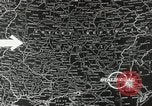
Post-World War II scenes in Communist occupied areas of Europe and Asia
Animated map shows thrust of German forces during invasion of Soviet Russia in World War 2. Stalingrad is highlighted as a turning point. Another animated map shows Soviet territorial gains at the end of the war, as narrator discusses the disposition of those places and their respective populations, as in Latvia, Lithuania, and Estonia. He also discusses Soviet zones of occupation. Animated map shows "Iron Curtain." Soviet troops on parade. Soviet ZSU-57-2 self-propelled anti-aircraft guns (SPAAG) on display during a parade in 1945. A stadium filled with people in Soviet-occupied East Germany, in 1949. Friedrich Wilhelm Reinhold Pieck, the first President of the German Democratic Republic, is seen in the stands. Young East German women parade in traditional costumes, clapping their hands, in the stadium. Waterfront scenes show Soviet trade activities with post-war occupied entities. Scenes of conflict as Chinese communist forces expel Chiang Kai-shek's Nationalist Chinese forces (ROC) from mainland China to Formosa (Taiwan), in 1949. A litter-borne casualty and a refugee mother and small girl are seen as they evacuate.
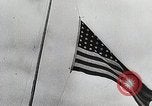
United States and Soviet soldiers meet at the Elbe River during World War II.
U.S. flag being lowered as bugler sounds and narrator alludes to the death of U.S. President Franklin D. Roosevelt, near the end of World War II. American troops and tanks rolling through German cities identified by narrator as Madeburg, Nuremberg and Leipzig, at end of World War 2 in Europe. U.S. troops cleaning out last vestiges of resistance in street fighting. Numerous German citizens lining sidewalks in city and waving white flags. On April 25, 1945, U.S. Army Second Lieutenant William Robertson with soldiers Frank Huff, James McDonnell and Paul Staub, meet Soviet Lieutenant Alexander Silvashko and several Soviet soldiers on the remnants of the Elbe bridge of Torgau. A U.S. Army Brigadier General mingling with Soviet officers. On April 26,1945, Major General Emil F. Reinhardt Commander of the U.S. 69th Infantry Division, walks with Soviet Major General Ruskovof the Soviet 58th Guards Rifle Division near Torgau. They are accompanied by other U.S. and Soviet officers. U.S. and Soviet officers exchange mutual salutes. U.S. and Soviet soldiers mingle, as a Soviet soldier plays accordian and some drink toasts, smoke cigarettes, and pose together. View of the Nazi party rally grounds in Nuremberg where a U.S. soldier is seen near the huge Swastika atop the Zeppelin Grandstand. Flashback views of Nazi rally there. Heinrich Himmler, Adolf Hitler and Viktor Lutze at the rally. Three American soldiers walking along the same walkway in the rally grounds. Explosion seen as the Nazi swastika symbol atop the Zeppelinfeld grandstand in Nuremberg is blown up by American troops.