


 Francais
 Deutsch
 Italiano
Refine Your Search
+"Europe" +1945 stock footage and images
- Showing 301 to 306 of 527 results more
more Hide
Hide
United States Army destroys the IG Farben plant in Ebenhausen, Germany.
The huge IG Farben plant is blown up in Ebenhausen, Germany, 7 months after the end of World War 2 in Europe. The German war production plant produced tons of nitrocellulose daily for the German war. United States Army soldiers seated in a group. The Commanding Officer, Lt. General Lucian Truscott, discusses with another U.S. Army officer. A sign board reads: 'Schwaben Control Office'. Lt General Truscott activates the handle to trigger the explosive charge, and the plant is blasted by 200 tons of TNT. Army personnel examine the rubble and wrecked parts of the plant and its machinery.
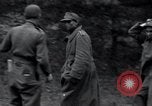
Released U.S. prisoners wave at U.S. soldiers of 117th Infantry Regiment, 30th Infantry Division Grasleben in Germany.
Released American Prisoners of War (POW) kick and throw objects at a German prisoner of war at Grasleben in Germany, near the end of World War 2 in Europe. The released U.S. POWs wave at the American soldiers of 117th Infantry Regiment, 30th Infantry Division passing in trucks and jeeps. They gather around a jeep and converse with soldiers of the 117th Infantry.
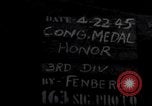
U.S. Lieutenant General Alexander M Patch awards Medal of Honor to U.S. officers at Zeppelinfeld in Nuremberg, Germany.
United States soldiers of the 3rd Infantry Division raise a large U.S. flag to cover a German Swastika emblem on top of the Tribune at Zeppelinfeld in Nurnberg,Germany, near end of World War 2 in Europe. Commander of the U.S. 7th Army Lieutenant General Alexander M Patch, Major General John W O'Daniel and other officers review the troops from the speaker's platform of the Nuremberg Zeppelin Field. At a ceremony General Patch awards Congressional Medal of Honor to Lieutenant Colonel Keith Ware, Lieutenant John J. Tominac,Sergeant Russell E Dunham,Sergeant Lucian Adams and Private Wilburn K. Ross.
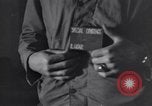
U.S. Army soldiers explore Obersalzberg, Hitler's bunker and air raid shelter tunnels, Berchtesgaden, Bavaria, Germany
Two weeks after its capture by the U.S.3rd Infantry Division, 7th Infantry Regiment, at the end of World war 2, in Europe, U.S. soldiers explore Obersalzberg air raid shelter tunnels connecting Hotel zum Turken and Hitler's residence at the Berghof, Berchtesgaden, Bavaria, Germany. U.S. Army soldier browses through Adolf Hitler's sacked offices and musical recording collection. Major General Maxwell Taylor, Commanding General, 101st Airborne Division, is seen descending a long stairway into the tunnel complex that was one of Hitler's bunkers.
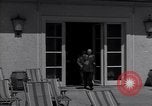
German General Albert Kesselring detained following surrender, and U.S. General Maxwell Taylor in Berchtesgaden, Germany (WW2)
The capture of German General Albert Kesselring in Berchtesgaden, Germany during World War II. General Kesselring and two aides enter the terrace of the Berchtesgadener Hof hotel (present location is now the Haus der Berge, Hanielstraße 7, 83471 Berchtesgaden, Germany) in Berchtesgaden, Germany, where U.S. General Maxwell D. Taylor had arranged for them to stay following surrender at the end of World War 2, in Europe. They sit together at a table and review documents. United States Army General Maxwell D. Taylor and Colonel Ned D. Moore of the 101st Airborne Division leave a building with a 101st Airborne emblem on the doorway and meet Colonel Charles H. Chase.
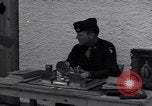
U.S. Captain Harry Anderson recording Hermann Goring's art collection in Berchtesgaden, Germany
U.S. Army Captain Harry Anderson sits at a desk in Berchtesgaden, Germany just after end of World War II in Europe. Walther Andreas Hofer, Art Director for Hermann Goering, brings in some papers found in a freight car. Anderson, who has been cataloging Nazi stolen art in Goering's collection, holds a receipt from Dr Galerie W A Luz. Goring's solid gold blotter and ink stand set on Anderson's desk. A painting in the background on the ground, leaning against a wall. Scene changes to town: Street sign: "Berchtesgaden Postamt" (Post office). German people wait in line outside a food shop. Sign reads "Off Limits - This building is not to be entered or used for any Military Purpose." German citizens wait in line at the food shop.