


 Francais
 Deutsch
 Italiano
Refine Your Search
+"Europe" +1945 stock footage and images
- Showing 307 to 312 of 527 results more
more Hide
Hide
Role of American women in the military; WACS, nurses, and other military roles for women in World War 1 and World War 2
The role of women in the armed forces in the United States. A U.S. Army sniper fires a 1903 Springfield rifle on the Korean front during the Korean War. A woman in the Women's Army Corps (WAC) inspecting such a rifle in the U.S. Several Patton Tanks moving up a hilly road in Korean War. A WAC testing the turret of a Patton tank. U.S. Army women at desks as they work with Army men in an office. Picture depicts Molly Pitcher, wife of a fallen U.S. Revolutionary War artilleryman. Depiction of George Washington at desk. Depiction of Clara Barton, an American nurse with a wounded soldier. Reenactment of Clara Barton working with another women. A man holds the flag of the American red cross. Actual footage of a Wright Brothers aircraft in flight. Women in long dresses pushing an early model of car. A group of American soldiers in World War I running on a battlefield.. U.S. Army troops wearing gas masks and firing rifles from trench in World War I. American women war production workers assembling belts of machine gun bullets during World War I in a munitions factory in the United States. A nurse tending a wounded soldier. A woman nurse helping place a wounded soldiers into an ambulance in Europe, in World War I. Nurses in an operating theater in a hospital during World War I. Women march in victory parade at end of World War I. Women's suffrage demonstration by suffragists (sometimes called suffragettes) in front of the White House and then women and men entering a polling place to vote around time of of 19th amendment giving women the right to vote in 1920. Aviatrix Amelia Earhart climbing down from an airplane. Swimmer Gertrude Ederle on an award stand. U.S. Navy Vought SB2U-2 planes in flight as they drop bombs. Scene of Pearl Harbor attack by Japanese during World War 2. Army nurses look out from deck of ship in World War II. Soldiers fire artillery. View of mountains and scenes of combat on islands in the Pacific during WWII. General Mark Clark awards nurse Silver Star medal. Repatriated Army nurses, who were prisoners, are loaded onto an aircraft by means of a fork lift. In 1942, President Franklin D. Roosevelt signs legislation establishing the Women's Army Auxiliary Corps (WAAC). Secretary of State George Marshall and others witness the signing. Depiction of Godess Athena. Women volunteering for WAAC move in a line carrying bags. American women in military uniform marching. WAAC volunteers being processed. Women receive physical exams and receive inoculations. WAAC personnel being trained: working on X rays, in medical pharmacy laboratories, food service, and radio work. Women on board warships in World War 2.
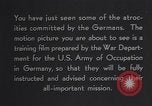
Training film for U.S. troops with the Army of occupation in Germany after world War II
Opens with bell tolling Victory against Germany in World War II. Next, a slate reads: "Victory Leads to Peace," and a farmer is seen with cattle pulling a plow. But narrator says "the problem now is future peace," and a map of Germany is shown overlaid with "Your Job in Germany." A cartoon of a soldier is superimposed on the map, along with one of a World War 1 American soldier and a figure of possible future soldier with similar mission. Camera focuses on parts of German aircraft in a jumbled heap. Closeups of weary defeated German soldiers at end ot World War II. Glimpse of Adolf Hitler speaking and haranguing an audience from a podium in an animated and forceful way. Swastika flags displayed from houses in a quaint German town. Joseph Goebbels, Nazi Reich Minister of Propaganda, at a microphone. Glimpse of a German concentration camp. But as they appear, each of the Nazi elements promptly disappears, showing the scenes without such Nazi symbols and persons. Skeleton remains of bombed buildings. Flower displays. Bucolic German rural countryside and quaint old villages in peaceful settings. Camera focuses on a book titled "German History." Chapter I, titled "Blood and Iron," shows Image of Otto von Bismarck. German troops march in a parade. Narrator states that "under Bismarck, the German empire was built." (He formed the German Empire in 1871, unifying Germany with himself as Imperial Chancellor, while retaining control of Prussia at the same time.) The film shows mounted German lancers as it alludes to Bismarck's campaigns against Denmark in 1867; Austria in 1866; and France, in 1870. Germany's leaders celebrating its status, in 1871, as the mightiest power in Europe. Troops marching and girls dancing nearby. Farmers plowing field with a horse and cow. Classic peaceful rural alpine scenes with local people in agricultural pursuits. A group of local German musicians playing folk music as village people dance outdoors. Back to the book, Kaiser Wilhelm II is shown on Chapter 2, entitled: "Deutschland über Alles." Gathering of German soldiers in Pickelhaube (spiked helmets). A German Big Bertha howitzer firing. German troops marching against Serbia; Russia; and France (with view of war damaged French cathedral). German invasion of Belgium in 1940 (with view of clock tower resting in rubble). German troops seen in Italy, walking past battle-damaged buildings. German Zeppelin dropping bombs on British targets and view of bombed out London neighborhood. Next scene shows a capsized ship with survivors running across its hull. Film slate labels the scene as United States, as if it is a U.S. ship attacked by Germany. (Actually, it is the Austro-Hungarian Battleship, SMS Szent Istvan, torpedoed, by Italian torpedo boats, during World War I.) Next, American soldiers in trench are seen going "over the top" and into "no man's land" on the western front of World War 1. Glimpse through a window of Kaiser Wilhelm II, after defeat of Germany, in 1918. View of Germans in a Beer Garden. Picturesque view of German town. A German orchestra performing. American soldiers marching out of Germany, with flags waving. Back to the history book,as chapter III is revealed, entitled "Today Germany, tomorrow, the world," and featuring Adolf Hitler. German troops invading Austria (where a civilian lies dead on the ground). German troops entering Czechoslovakia (where local people in tears render the Nazi salute). They march into Poland (where a girl weeps over someone, not seen, on the ground). They march into France (where a wounded, bandaged child cries in a bed). Next, is a scene from England, where a British child victim of bombing lies dead in the remains of a shelter. German troops invading Norway, Holland, Denmark, Belgium, Luxembourg and Russia (where a woman tries to rouse a dead woman). They invade Yugoslavia (where women sit near coffins of children) and Greece (where a woman rescues a naked child). A U.S. merchant ship explodes after being torpedoed by a German submarine (unseen). Scenes of destruction with people plucking dead victims from rubble of buildings. American troops invading Normandy, France on D-day, June 6, 1944. Several American soldiers fall to German gunfire on the beach. Wounded American soldiers being transported in jeeps on the battlefield and being placed on landing craft for evacuation. Americans walking past huge piles of destroyed aircraft parts. A landing craft filled with wounded American soldiers. American wounded and dead on a battlefield. Sailors abandoning a burning American ship by jumping into the sea. A sailor picked up in a life boat. A wounded American soldier being dragged from the beachhead at Normandy. Various wounds being treated by U.S. Medical Corps personnel. More scenes of American wounded being moved on stretchers. Scene shifts abruptly to German people folk dancing. Film concludes with question marks about the future.
Film juxtaposing German defeat in World War 1, with its defeat in World War II, and comparative postwar impacts.
Film begins stressing the historic aggressive military traditions of Germany. A brief view of thousands of Adolf Hitler's Nazi troopers assembled in dramatic formation at the Nazi party rally grounds in Nuremberg, Germany. Explosion of the Nazi eagle, with swastika symbol, atop the Zeppelintribüne grandstand at Zeppelinfeld in Nuremberg, being blown up by U.S. Army soldiers at the end of World War 2 in Europe. Germans celebrating the armistice ending World War One. German soldiers captured, in unconditional surrender, ending World War Two. Huge open field filled with defeated German soldiers in the second world war. German armies parading through Berlin at the end of World War One. American troops occupying the entire country of Germany after the second world war. A Nazi eagle being destroyed on a German government building at end of the second world war. Old photograph of the German general staff, led by Helmuth von Moltke the Younger, that was still intact, after World War I. In contrast, after World War 2, the entire Nazi military was held and subject to trials at Nuremberg. Großadmiral Erich Raeder seen being taken in custody. Closeup of Field Marshal Wilhelm Keitel. German industry unimpaired by World War I, contrasted with utter destruction in the second world war. American officer coordinating resumed operation of of a postwar plant. View of German diplomats remaining in office after WWI. Proclamation barring Nazi party members from all offices after WWII. German Kaiser Wilhelm II in peaceful exile in Holland after the first world war. A Nazi officer war criminal, is taken in custody by American Military Policemen, and executed by a firing squad. World War 1 did not affect German schools and curriculums. After World War 2 all Nazi doctrines were destroyed. New text books and curriculums were prepared by the Allies for German use. Map shows small area of post World War 1 occupation, in contrast the the entire Germany after WWII. Weimar Republic government, post WWI is contrasted with post World War 2 government by the Allied military powers. British Marshal Bernard Montgomery, American General Dwight D. Eisenhower, Soviet Marshal Zhukov, and French General Charles de Gaulle, are shown. Views of American soldiers interacting with German citizens during their occupation of Germany. Images of Germans: Frederick the Great, Otto von Bismarck, and Kaiser Wilhelm. Views of German farmer sowing seed, postman delivering mail, policemen escorting children. Normal activities resumed in Germany, in areas of culture such as orchestral concerts, etc.
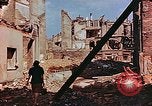
Piled rubble, demolished buildings and damaged buildings after United States Army enters Leipzig at end of World War 2
United States Army cameraman views of the city of Leipzig in Germany at the end of World War II in Europe. Ruins of buildings destroyed during bombardment and artillery firing during the war. Scattered wastes of demolished buildings, bricks and dust in stack block the roads. A woman walks from nearby a ruined building. Pedestrians walking amid rubble. Elevator of a building stands even after rest of building is demolished.
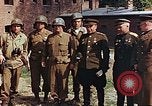
American and Russian military officials meeting at Torgau, Germany at end of World War 2
American and Russian military officials meeting at Torgau Germany at close of World War II in Europe; an event sometimes referred to as East Meets West. Forces of U.S. Major General Emil F. Reinhardt, Commander of the U.S. 69th Infantry Division and Russian officer Major General Rusakov, Commander of the 58th Guard Division meet. Officers stand in front of a building damaged due to bombing. They shake hands and talk to each other.
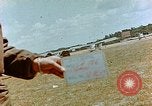
Aerial view of damaged and destroyed buildings,and houses in Braunschweig, Germany, resulting from bombing by Allied forces in World War II
Aerial views from an airplane flying over the ruins of Braunschweig Germany, right after the end of World War 2, in Europe. Whole city blocks of buildings have been reduced to empty spaces and skeletons of buildings remain elsewhere. At first glance, a large building surrounded by trees seems undamaged, but closer examination shows it roof completely destroyed. However another large building in those woods does appear undamaged. Roadways and some areas appear cleared of debris. Almost all buildings have been destroyed. Aircraft films from higher altitude, showing miles of territory surrounding the city. Closer view at lower altitude shows the scenic river, Oker, bounded by trees and nearby houses with all windows and most roofs gone. At TC: 02:07 the Brunswick Cathedral is seen near the few other relatively undamaged buildings.