


 Francais
 Deutsch
 Italiano

Refine Your Search
+"Europe" +1945 stock footage and images
- Showing 43 to 48 of 530 results more
 Hide
Trials of war criminals in Germany after World War Two. Belsen local trial.
"The Guilty." Animation depicts person being hanged. View of an angry crowd on a road. People beat captured German soldiers and collaborationists. Mob of Italian partisans in Italy raising dead bodies of Mussolini and others up to hang from their heels in public after their execution. Foreign Minister Vyacheslav Molotov and British Foreign Secretary Sir Anthony Eden signing the Moscow Declaration in November, 1943. The declaration is signed to preserve the authority of law in Europe and to ensure fair and orderly trials for war criminals. Next scene shows Allied soldiers at a liberated Concentration Camp near the end of World War 2 in Europe. Military jeeps in the background. Military photographer takes pictures as officials arrive to tour the concentration camp. Man opens a crematorium oven, revealing bones of a corpse inside. Pile of dead victims of a concentration camp. Elevated view of a room full of documents that are in review for war trials. Officials search documents to identify war criminal suspects. Nazi officers and officials who committed suicide are shown, including a German admiral, the body of Heinrich Himmler, and the bodies of the Mayor of Leipzig and his wife. War criminals being summoned for the various war crime trials. Scenes from the Belsen Trial in September 1945, held in a Lüneburg gymnasium, to decide the fate of German guards and SS officials from the Auschwitz and Bergen-Belsen concentration camps. A defendant being brought to trial on a stretcher. Soldiers guard the court room. View of defendants including many women SS-Gefolge members. German Commandant Josef Kramer during his trial, and German doctor Fritz Klein beside him. The court trial underway for the war criminals. Guilty war criminal brought to the gallows to be hanged, black cover placed over his head and he is hanged. View of dead bodies of concentration camp victims. View of a crowd amassed at a hanging execution of several German officers, possibly in the Soviet Union.
Tripartite Pact signed by Germany, Italy and Japan in Berlin, Germany. Ensuing attacks by Germany and Japan in World War II
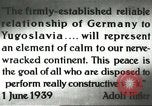
This film is a scattering montage of World War 2 scenes from 1939 through 1945. Part of an agreement between Nazi Germany and Yugoslavia is shown in English. It is dated June 1, 1939 and ostensibly signed by Adolf Hitler. Next, German Ju 87, Stuka dive bomber aircraft are shown peeling off from formation, on April 6, 1941, to attack Yugoslavia. Bombs bursting on the ground. Closeup of a Stuka airplane in a dive, making its characteristic whine, and dropping bombs. Bombs exploding just outside some concrete walls. German infantry running along railroad tracks and entering backyard of house in a village. German soldiers observing from overlooking hill; climbing over rubble; and marching along a road toward a village. Animated map showing German invasion areas early in World War II, extending through most of Europe and into Norway, by 1941. Animated map shows further invasions into France, Belgium, low countries, the Balkans, and Eastern front towards the Soviet Union. Map highlights Tokyo, Rome, and Berlin. Delegations walking in hall of Reich Chancellery in Berlin, to sign Tripartite pact, on September 27, 1940. The group is led by by Count Galeazzo Ciano (Italian Foreign Minister, and Mussolini's son-in-law); Joachim von Ribbentrop, Germany's Foreign Minister and Japan’s Ambassador Saburō Kurusu. The diplomats are seen, next, standing near a table as Adolf Hitler enters rendering Nazi salute. He shakes hands with Count Ciano and Ambassador Kurusu. Hitler is seated to watch the proceedings. Von Ribbontrop is seen signing for Germany. Next scenes show German armored units heading East in Operation Barbarossa (June of 1941). A sign identifies the town of Eydtkau (Eydtkuhnen) on the German-Lithuanian border. German armor and artillery moving eastward. German troops destroying international crossing barriers. German troops firing siege guns. Montage with glimpses of German battle scenes showing tanks, guns, rockets in action with attendant explosions, fires, and destruction. Formations of German warplanes in flight, including Junkers Ju-52s that carry troops, including paratroops. View from above of Junkers Ju-87 Stuka dive bombers in formation. Battle of Britain scenes, with view of St. Paul's Cathedral in London, England (which miraculously survived the Blitz). The Tower Bridge in London, seen through a haze following blitzkrieg. German Junkers 87 Stuka dive bombers peeling off from formation to attack. British anti-aircraft searchlights shining beams skyward. Diving bombers illuminated by the lights. Anti-aircraft guns firing. Nighttime scenes showing gunfire flashes, explosions, tracer bullets and fires in London. British fire brigades fighting fires in London buildings as some collapse from the German bombing during the so-called "Blitz." Scene shifts to Pearl Harbor, December 7, 1941, as a Japanese bomb explodes on a U.S. Navy warship. The USS Arizona billowing smoke and listing as it succumbs to Japanese bombing. Another view of the Arizona sinking. Smoke rising from Battleship Row, at Pearl Harbor. Glimpse of postwar Nuremberg trial.
Atomic bomb scenes WWII; atomic testing at U.S. Army atomic experiment station 'Camp Desert Rock' in Nevada, United States
Episode of "The Big Picture", a U.S. Army series of news release programs. U.S. Army cameraman recording Nike missile launch. Atomic cannon fires shell creating atomic explosion and classic mushroom cloud.. Army troops spill out of Sikorsky YH-19 helicopters. U.S. Army infantry soldiers ascend hill firing their rifles. Atomic experiments at Camp Desert Rock in Nevada, United States. U.S. Army Master Sergeant Stuart Queen seated at a desk in his office. He speaks about a series of atomic experiments ("Desert Rock 6") held in barren lands of Nevada at Camp Desert Rock. Celebrating victory in Europe, during World War 2, American troops parade down the Champs Elysees in Paris, France, with the Arc de Triomphe behind them. Happy Parisians watch the parade. War scenes in Japan: footage of explosion and mushroom cloud rising after atomic bomb blast over Nagasaki on August 9, 1945. Barren land on the ground in Hiroshima after the August 6, 1945 atomic blast there . B-29 bombers in flight. Atomic bomb test detonation. Atomic artillery gun M65, also called the Atomic Cannon or Atomic Annie, fires and creates nuclear explosion on distant target.Viking missile launch. U.S. soldiers on parade. Headquarters sign at U.S. Army atomic experiment station at Camp Desert Rock, Nevada, displaying 6-pointed star with "A" in center.. Several atomic test explosions. Soldiers on hillside witness a non-nuclear explosion. Buses carry troops along a road past a sign warning of radiation hazard. Army captain, instructor, briefing troops before the start of atomic maneuvers.. Maps of planned maneuvers. Engineer surveyors lay out ground zero target. View of the ground zero area which is the target area for testing. Signal men lay communication lines to receive and transmit teletype messages. Men operate machinery and dig trenches in which troops will take cover. Other men cover them with sand. [Note: According to the U.S. Department of State, Office of the Historian, from February 18 to May 15, 1955, the United States conducted Operation Teapot, a nuclear test series at Yucca Flat and Frenchman Flat on the Nevada Test Site in the continental United States. During the test period 14 nuclear shots and 1 non-nuclear shot were detonated. Several thousand scientific, military (army, air force, navy, marines), and civilian contract personnel participated in the organization, planning, and execution of the test series. Military exercises undertaken during and following the shots took place under the name Desert Rock 6.]
Brutalities against prisoners, officials gathered in 1949 in Palace of Nations for Third Geneva Convention; discussion of Geneva Conventions.
Film from 1965 shows scenes that span from early 1940s through mid 1960s. Film opens showing armed conflict in Laos and South America. Soldiers firing rifles in jungle areas. Armed men running across a field and in a town in Cyprus. Heavy armor engaged in conflict and buildings burning in undisclosed location. Riots in Congo with a crowd of men beating another man. Armed Republic of South Vietnam soldiers (ARVN) moving through jungle in Vietnam War. A Viet Cong fighter shot as ARVN troops attack a hut. People fleeing in streets of Cuba as government soldiers engage armed revolutionaries under Castro. A civilian woman suffering a seizure as Red Cross workers attempt to carry her. Burned body of dead tank crew soldier atop a tank. Medical corps persons moving wounded on a stretcher. Various views of ARVN with captured Viet Cong in Vietnam. Narrator discussion about Geneva Conventions and Counterinsurgency. View of the Palace of Nations building in Geneva Switzerland. Scene shifts to inside, in 1949, where delegates of 59 nations are gathered to develop new rules expanding the original 1929 Geneva Conventions, in order to better protect prisoners of war, wounded prisoners, noncombatants and others caught up such internal conflicts. View from ground of German paratroopers during World War 2, jumping from Junkers Ju-52 trimotor transport planes. Closeup of German soldiers leaping from a plane and descending in parachutes. Japanese soldiers surrendering to Americans on a Pacific Island in World War 2. Several scenes of massacre victims lying on the ground, victims of Nazi German brutality in Europe during World War II. Survivors of a Nazi concentration camp near the time of its liberation in 1945. A U.S. Army medical corpsmen help one to a stretcher. Executed prisoners of war. Courtroom of the Nuremberg trials. Seen in the front row of Nazi leaders are: Hermann Göring, Rudolf Hess, Joachim von Ribbentrop, Wilhelm Keitel, Ernst Kaltenbrunner, Alfred Rosenberg, Hans Frank, Wilhelm Frick, and Julius Streicher. Seated behind them are: Karl Dönitz, Erich Raeder, Baldur von Schirach, Fritz Sauckel, Alfred Jodl, Franz von Papen, Arthur Seyss-Inquart, Albert Speer, and Konstantin von Neurath. Scene shifts to the postwar trial of Japanese Lieutenant General Masaharu Homma, in the Philippines. Prisoners with hands bound, in an unidentified Asian conflict, being herded into an open truck. Views of the document constituting the 3rd Geneva Convention of 1949, addressing treatment of prisoners and of parts directed to "conflicts not of an international character." Views of a traumatized civilian driver wounded and a female passenger killed in in his car (appears to be in Cuba or Latin America). Armed gunmen have the man leave the car. A man lays the body of the woman beside the car. Scene shifts to a group of surrendered Vietcong fighters with their weapons stacked. Wounded combatants being carried on stretchers. American survivors of a Japanese prison camp receiving a good meal after being rescued - this is possibly in the Philippines in 1945. Many of the American prisoners are gaunt and emaciated and malnourished. Narrator recites list of activities prohibited by Geneva conventions, as images show these activities: A ditch filled with victims of massacre. Hostages being taken in an internal conflict in an African country. Prisoners being beaten by non-uniformed civilians in and humiliated in public. A recently liberated prison with a former prisoner in striped uniform beating a man as a group is marched away (likely a World War 2 concentration camp with a liberated prisoner beating a former Nazi guard). Death sentences being rendered without due process. A court in Cuba. A boy pointing at a lineup of prisoners. A prisoner shot.
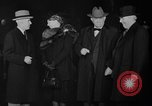
Activities of Eleanor Roosevelt in post-World War II period
December, 1945, former First Lady, Eleanor Roosevelt, now appointed by President Truman, as a delegate to the United Nations, is seen with other members of the U.S. Delegation. She is seen speaking while serving as chairman of the UN Committee Three, dealing with human rights. She recognizes the delegate from the Soviet Union, as the committee addresses issues of refugees. (The USSR insists that displaced persons be returned to their original homelands.) As chairman, Mrs. Roosevelt, rules a USSR proposal out of order, causing the USSR representatives to leave the room. A glimpse of Eleanor Roosevelt at a microphone during debate over the issue with the USSR, before the full General Assembly, where she successfully argues to allow refugees to make their own decisions about repratriation. She is seen sitting next to delegate,Senator Arthur Vandenburg, at the forum. Eleanor Roosevelt being greeted by U.S. Army officers as she steps from an airplane in Europe. She is seen mingling with persons in Europe, displaced by World War II. Back in the UN forum, she extols the International Declaration of Human Rights as an "International Magna Carta of men everywhere," and goes on to compare it with similar charters of history. She is seen at a Pan American World Airways terminal, preparing to board a flying boat (unseen). Several scenes show Eleanor Roosevelt visiting with people in various parts of the world, with particular attention to children. She speaks of her candid nature in a broadcast.
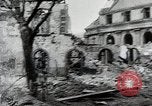
End of World War 2 in Germany, with Allied forces advancing in Germany; destruction of German areas and German forces surrender
American Troops occupying Germany in 1945, near the end of World War II in Europe. Ruins of German cities. White flags displayed from windows. German civilians distraught over destruction of their homes and towns. Towns ablaze in the night with ambulances passing through. Scenes of utter destruction in Basel, and Wurtzburg. Destruction of Essen, Germany, including the Krupp munitions works. German ME-109 plane by the roadside.A truck passes by. Abandoned Marder II Panzerjaeger in the woods. Bombed columns of German soldiers, with equipment and dead German soldiers along roadways. Massive groups of German soldiers surrendering under guard of Allied forces.