


 Francais
 Deutsch
 Italiano
Refine Your Search
+"FRance" +1918 stock footage and images
- Showing 73 to 78 of 1022 results more
more Hide
Hide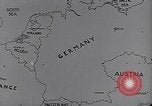
Human Liberty Bell; WWI leaders British General Haig, French General Petain, Italian General Diaz and King Albert of Belgium
Map showing Germany and nearby regions after conclusion of World War I. Writing indicates areas on map including Battle Line at End of Hostilities, Line to Which Germans Must Retreat, and Neutral Zone (between the two areas). Slate indicates that German Kaiser Wilhelm II had just abdicated (28 November, 1918) and shows footage of Kaiser Wilhelm II on horseback at a formal event. Next scene shows a massive human formation of soldiers in the shape of the Liberty Bell known as "The Human Liberty Bell", formed by 25,000 officers and men at Camp Dix, New Jersey to celebrate the armistice in World War 1 and the abdication of German Kaiser Wilhelm II. Camera pans upward to show the human bell from base to top. Next scenes show key Allied military leaders in World War I: British General Haig reviewing troops; France General Philippe Petain emerging from a building; Group of French soldiers marching; Italian General Diaz together with French officers reviewing troops; and King Albert of Belgium exiting a building outside Paris during World War 1 and entering a waiting horse-drawn carriage. View of United States President Woodrow Wilson reading newspaper and seated in a chair. (World War I; World War 1; WWI; WW1)
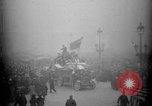
Armistice Day celebrations in Paris. Crowded streets, street lamps , flags everywhere.
Celebrations in Paris marking the signing of Armistice ending conflict in World War I, November 11, 1918. Open bus is packed to capacity with celebrants. Jubilant crowds are jammed together, waving flags, and shouting for joy. Man erects huge banner reading: "LArmistice est signe, La Guerre est gegnee, Vive La France, Vivent Les Allies!" Huge American flag is waved from center of crowd. Flags of the Allies are waved by people on balcony of building with lettering identifying it as "Mme Georgette".French sailors, in crowd, sing and wave flags. French Boy Scouts, in uniforms, run down the street towards the camera, followed by people of every age, size, and sort, all celebrating the end of war. Several French officers stand by as an impromptu parade begins.
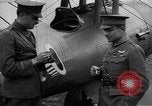
Major John W.F.M. Huffer and Major Raoul Lufbery beside a Nieuport 28c.1 airplane, during World War I
United States Army Air Service 94th Fighter Squadron in Toul, France during World War 1. Commanding Officer 94th Aero Pursuit Squadron Major John W.F.M. Huffer and Major Raoul Lufbery (French and American fighter pilot) standing beside a Nieuport 28c.1 fighter in late April 1918. "Hat in Ring" insignia painted on the side of the aircraft. Maj. Huffer lights Major Lufbery's cigarette. Major Huffer smokes a cigarette. (WWI,WW1, World War One, First World War)
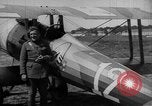
Pilots of the U.S. Army Air Service 94th Aero Squadron standing near airplanes displaying their Squadron insignia, in World War I
United States Army Air Service 94th Fighter Squadron near Toul, Meurthe-et-Moselie, France, April 30, 1918, during World War 1. Captain Ken Marr standing beside the cockpit of #12 Nieuport 28c.1 airplane. He starts walking. "Hat in Ring" insignia seen on the side of the airplane. Captain Eddie Rickenbacker standing beside "Hat in Ring" insignia on side of Nieuport 28c.1. Others photographed individually at various times, posing by airplanes all displaying their "Hat in Ring" insignia, include: Lieutenant Allan F. Winslow; Captain J. A. Meissner; Captain D. M. Peterson; Captain J.N.Hall; 1st Lieutenant Douglas Campbell; and Captain Ken Marr.
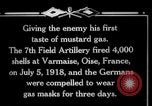
Combat in World War I. U.S. Army 7th Field Artillery troops firing mustard gas shells. American soldiers fighting while under gas attack.
American gunners of the 7th Field Artllery fire mustard gas shells from a French 75 field piece in a sandbagged revetment at Varmaise in Oise, France, on July 5, 1918. As they rapid fire, traces of mustard gas emerge from their gun, so they all don their personal gas masks, and continue firing the gas shells. Change of scene shows American troops at a trench in a field, donning gas masks when warned of a German gas attack. With gas masks in place, they commence firing a trench mortar. A string of explosions is seen in the distance, presumably from a number of mortars firing. Scene shifts, again, to troops wearing gas masks, firing their Springfield rifles, from their trench. It appears that they are following a reported World War I practice of loading their magazines to capacity with a 5-round stripper clip, and then firing only single rounds, with the magazine cutoff in "off," to save the reserve for emergencies.
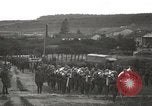
A U.S. band leading a funeral ceremony and clergy leading burial ceremony following Battle of Saint-Mihiel in World War 1.
U.S. soldiers near St. Mihiel, France during World War I. A band of American soldiers leads a funeral procession. A caisson moves across a field towards a graveyard. Houses in the background. Newly dug graves in the graveyard. Closeup view of cross at the grave of Major Harry A. Harvey of the 103rd Field Artillery, who died on September 12, 1918. Clergy and soldiers seen during the funeral ceremony for Major Harry Aloysius Harvey and other soldiers killed in the Battle of St Mihiel.