


 Francais
 Deutsch
 Italiano
Refine Your Search
+"FRance" +1918 stock footage and images
- Showing 85 to 90 of 1022 results more
more Hide
Hide
World War 1 aircraft in flight and views of famous German ace pilot Manfred von Richthofen (the Red Baron)
Heinkel HE-57 amphibian monoplane in flight. Point of view shot from camera behind pilot as plane performs aerial spinning dive. Changing view of ground from cockpit of aircraft. Pilots with parachutes land on field. A model aircraft in flight. At timecode 1:00: Paul von Hindenburg and other German dignitaries present at the December 1925 re-interment of Manfred von Richthofen in Invalid's Cemetery (Invalidenfriedhof Cemetery) in Berlin, Germany. (He was originally buried in France following his 1918 death). At 1:04: Scene from before his death: Manfred Von Richthofen (The Red Baron) smiling and conversing with other German pilots. Clip ends with brief view of Fokker Dr.I Triplane like that flown by Manfred von Richthofen.
Eddie Rickenbacker, President of Eastern Airlines, hosts Cyrus R. Smith, President of American Airlines, after both airlines acquire DC-3 airplanes
Glimpse of U.S. Army gun crew operating a 3-inch M3 Anti Aircraft gun. Glimpse of 1st Lt Joseph H. Eastman and Captain Eddie Rickenbacker standing beside Rickenbacker's SPAD S.XIII #1 parked in front of a hangar at Foucaucourt Aerodrome, France, 1918. Sequence shifts to 1936, and office of Rickenbacker, now President of Eastern Airlines. A poster on the wall contains memorabilia from the 94th Aero Squadron, with which Rickenbacker flew in World War I. Camera pans over photographes bordering the poster. Next, Rickenbacker is seen conversing with his guest, Cyrus R. Smith, President of American Airlines, as they look at a picture of Rickenbacker and his Spad airplane, signed by numerous pilots who also served with the 94th Aero Squadron. A mounted model of a Douglas DC-3 airplane sits atop a table in the foreground. Rickenbacker and C.R. Smith, both hold onto the DC-3 airplane model as they shake hands. Closeup of the DC-3 model as Rickenbacker rotates it before the camera. (Note: Both Smith and Rickenbacker, presidents of their respective airlines, had mutual admiration for the Douglas DC-3 airliner. In 1934,Smith arranged to purchase 20 new DC-3 airplanes from the Douglas Aircraft Company. American's first DC-3 "Flagship Illinois," had its maiden flight on June 25, 1936. Eastern Airlines took delivery of its first DC-3 in December 1936.)

World War 2 film promoting public investment in War Bonds and stamps to aid the war effort and temper inflation
World War 2 era film that also includes some World War 1 scenes. Show girls or chorus girls in follies-like show, costumed as U.S. silver dollars and marching to tune and lyrics alluding to dramatic increase of currency in circulation, over the years. Animation with stacks of coins shows increase in national income from $46 billion,in 1933, to $71 billion, in 1939, and $142 billion in 1943. Back to the "follies dollars," a boy asks why, and then scenes of the Japanese attack on Pearl Harbor,are shown, with U.S. battleships being sunk. Wartime arms plants are shown. An M2A3 Light Tank rolls off a production line. Ships being constructed in a shipyard. B-24 Liberator bombers being built in a factory. Artillery shells being produced. Defense workers receiving their pay. The "follies dollars" group themselves to illustrate the fractions of income devoted to taxes and savings. But other spending is curtailed by wartime shortages. A woman talking with clerk in a drug store. U.S. Army troops crossing a pontoon bridge in open trucks, towing 75mm M1A1 howitzers. Infantry on the march. Animation showing industrial production devoted to war materiel and lots of dollars chasing few civilian goods. A grocery clerk offers to sell a woman customer butter for more than the established price, and she agrees. The "follies" performers then introduce the idea of an "inflationary dollar," and some history of past U.S. inflations. Animated examples of price inflation are shown. Glimpses of World War I scenes are seen, circa 1917 -1918, including: a 12-inch railway gun firing; a huge explosion from shell bursting near the camera; various scenes of United States infantry soldiers and French soldiers in battle action, running to bomb craters for cover and emerging from trenches to go up "over the top" into no-mans land during combat. Meanwhile, singing narration refers to the home front inflation due to competition for limited civilian goods. Map shows Europe and singing narration cites rising prices for food in occupied France and other countries suffering ravages of World War II. Montage of scenes showing needy civilians obtaining food in those countries. Animation shows increases, by 1944, in cost of U.S. civilian goods since the Pearl Harbor attack. "Follies" character called "Double-duty dollar," appears explaining he serves the war and curtails inflation on the home front by being saved through investments in War Bonds and stamps.
United States Army and Red Cross volunteers prepare Camp Kilmer in New Jersey for arrival of Hungarian refugees from the Hungarian Revolution
View of the Statue of Liberty. View of New York City and the Statue of Liberty. Sign saying “Camp Kilmer named in honor of Sgt. Joyce Kilmer Soldier Poet. Born December 6, 1886, New Brunswick, N.J. Killed in action World War I in France June 30, 1918”. A United States military jeep approaches the entrance of Camp Kilmer. Soldier at Camp Kilmer entrance allows Jeep to enter. Soldiers march and then sprint inside Camp Kilmer. Using crane attached to truck, soldiers unload crates containing furniture for incoming Hungarian refugees who will stay in Camp Kilmer. Soldiers carry mattresses into the barracks. Two soldiers carry a crate to a barrack. Soldiers carry a cabinet to the barracks. Inside the Camp Kilmer paint shop, soldiers prepare signs in Hungarian such as “Varás és asztalos munka (sic.)” (“Sewing and Carpentry”) and “fö üzlet” (“main shop”). Camp Kilmer dentists disinfect clinic. Camp Kilmer pharmacists prepare medicine for incoming refugees. An army pharmacist pour medicine into a bottle using a funnel. An army pharmacist grounds with using mortar and pestle. Pharmacists stack medicine such as aspirin in shelves. Army nurse making hospital bed with freshly laundered white bed sheets. Red cross volunteers filling comfort bags containing toiletries for refugees. Soldiers unload piles of second-hand clothes donated by Americans through the Red Cross. Red Cross volunteers organize second-hand clothes by type and size. African American woman Camp Kilmer staff enter the Recreation Center, with sign in English and Hungarian. African American staff at Camp Kilmer hang paintings and arrange furniture in the Recreation Center.
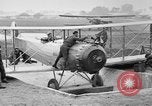
Machine guns being tested on French aircraft during World War I. Brief shot of Eddie Rickenbacker in his Nieuport 28
Opening scene shows a French Salmson 2 aircraft with front wheels chocked in a concrete pit and its tail supported to maintain the aircraft level during test firing of its machine gun. Mechanics surround the plane. Its engine is running. A mechanic leans over the Vickers .303 caliber machine gun installed at the front cockpit. (It is synchronized so as to fire through the propeller while the engine is running, however it is not being fired at this time.) Scene shifts to closeup view from front cockpit of engine with cowling covers removed. Gun sight and a scope are seen. Camera pans down revealing top of the cockpit instrument panel where needle/ball, airspeed, clock, and some engine instruments are visible. Glimpse of a side-mounted Vickers machine gun firing on a French Breguet 14. Next, Lieutenant Eddie Rickenbacker (prior to October, 1918, when he was promoted to Captain) is seen in cockpit of his parked Nieuport 28 aircraft. He manipulates the two Vickers machine guns installed on his plane (but does not fire them). Scene shifts to the French Breguet 14, seen firing machine gun, earlier. It is being towed backwards, up and out of the testing pit. (Minor Note: Rickenbacker's 94th Aero Squadron had their Neuports replaced by Spads in July 1918, so the brief scene showing him was shot before then.
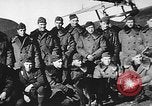
Some of the first American flying squadrons in World War I. The 1st and 103rd Aero Squadrons and their members
During World War 1, in 1918, American Expeditionary Force's 1st Aero Squadron members, including a mascot dog, pose on airfield. Airplanes in the background. Crewman pastes paper iron cross over enemy bullet hole in tail of airplane. Colonel Billy Mitchell decorating a flyer. General Benjamin Foulois in cockpit of a DH-4. United States officers shake hands with Colonel Thomas D. Milling. Colonel Frank Laub talks with a French officer. Members of the Lafayette Escadrille converted to the American 103rd Aero Squadron. July 1918 - Major William Thaw, steps forward and salutes, followed by Lieutenant Gordon D. Larner, Lieutenant Charles I. Merrick, and Lieutenant Edgar G. Tobin. Ace Captain Field Kindley, stands by a Sopwith Camel, supporting a small dog perched on its propeller. Ace Major Raoul Lufbery, smoking a cigarette, poses in front of a Nieuport 28c.1. Ace Captain Elliot Springs, also smoking a cigarette, poses in front of another airplane. Ace of Aces, Captain Eddie Rickenbacker, poses by SPAD S.XIII, number 5 ( its number not seen in this image) with "Hat in Ring" insignia painted on fuselage. (WWI,WW1, World War One, First World War)