


 Francais
 Deutsch
 Italiano
Refine Your Search
+"FRance" +1918 stock footage and images
- Showing 79 to 84 of 1022 results more
more Hide
Hide
U.S. soldiers decontaminate combat vehicles and tanks during training; also flashback WW1 mustard gas aftermath scenes
World War 2 training film teaching U.S. soldiers about decontamination of combat vehicles, at Aberdeen Proving Grounds in Maryland. Soldiers during a decontamination procedure with real mustard gas. The soldiers in armored vehicles. A group of soldiers prepares for the decontamination. An aircraft flying at low height. A stationary U.S. Army Pershing tank. Two soldiers in a jeep. Soldiers wearing gas masks decontaminate a vehicle. Flashback scenes to August 1918 in World War I in France, with many mustard gas attack victims being cared for at a field hospital (which narrator says is Field Hospital number 326). Medic washing eyes and face of a World War 1 gas attack victim. Next view is a soldier in 1942 with mustard gas burns on his hand, being treated by a medic. Next scene returns to World War 1 in 1918, showing mustard gas burns on arms, hands, legs, and feet of U.S. Army soldiers.
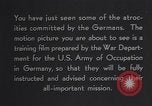
Training film for U.S. troops with the Army of occupation in Germany after world War II
Opens with bell tolling Victory against Germany in World War II. Next, a slate reads: "Victory Leads to Peace," and a farmer is seen with cattle pulling a plow. But narrator says "the problem now is future peace," and a map of Germany is shown overlaid with "Your Job in Germany." A cartoon of a soldier is superimposed on the map, along with one of a World War 1 American soldier and a figure of possible future soldier with similar mission. Camera focuses on parts of German aircraft in a jumbled heap. Closeups of weary defeated German soldiers at end ot World War II. Glimpse of Adolf Hitler speaking and haranguing an audience from a podium in an animated and forceful way. Swastika flags displayed from houses in a quaint German town. Joseph Goebbels, Nazi Reich Minister of Propaganda, at a microphone. Glimpse of a German concentration camp. But as they appear, each of the Nazi elements promptly disappears, showing the scenes without such Nazi symbols and persons. Skeleton remains of bombed buildings. Flower displays. Bucolic German rural countryside and quaint old villages in peaceful settings. Camera focuses on a book titled "German History." Chapter I, titled "Blood and Iron," shows Image of Otto von Bismarck. German troops march in a parade. Narrator states that "under Bismarck, the German empire was built." (He formed the German Empire in 1871, unifying Germany with himself as Imperial Chancellor, while retaining control of Prussia at the same time.) The film shows mounted German lancers as it alludes to Bismarck's campaigns against Denmark in 1867; Austria in 1866; and France, in 1870. Germany's leaders celebrating its status, in 1871, as the mightiest power in Europe. Troops marching and girls dancing nearby. Farmers plowing field with a horse and cow. Classic peaceful rural alpine scenes with local people in agricultural pursuits. A group of local German musicians playing folk music as village people dance outdoors. Back to the book, Kaiser Wilhelm II is shown on Chapter 2, entitled: "Deutschland über Alles." Gathering of German soldiers in Pickelhaube (spiked helmets). A German Big Bertha howitzer firing. German troops marching against Serbia; Russia; and France (with view of war damaged French cathedral). German invasion of Belgium in 1940 (with view of clock tower resting in rubble). German troops seen in Italy, walking past battle-damaged buildings. German Zeppelin dropping bombs on British targets and view of bombed out London neighborhood. Next scene shows a capsized ship with survivors running across its hull. Film slate labels the scene as United States, as if it is a U.S. ship attacked by Germany. (Actually, it is the Austro-Hungarian Battleship, SMS Szent Istvan, torpedoed, by Italian torpedo boats, during World War I.) Next, American soldiers in trench are seen going "over the top" and into "no man's land" on the western front of World War 1. Glimpse through a window of Kaiser Wilhelm II, after defeat of Germany, in 1918. View of Germans in a Beer Garden. Picturesque view of German town. A German orchestra performing. American soldiers marching out of Germany, with flags waving. Back to the history book,as chapter III is revealed, entitled "Today Germany, tomorrow, the world," and featuring Adolf Hitler. German troops invading Austria (where a civilian lies dead on the ground). German troops entering Czechoslovakia (where local people in tears render the Nazi salute). They march into Poland (where a girl weeps over someone, not seen, on the ground). They march into France (where a wounded, bandaged child cries in a bed). Next, is a scene from England, where a British child victim of bombing lies dead in the remains of a shelter. German troops invading Norway, Holland, Denmark, Belgium, Luxembourg and Russia (where a woman tries to rouse a dead woman). They invade Yugoslavia (where women sit near coffins of children) and Greece (where a woman rescues a naked child). A U.S. merchant ship explodes after being torpedoed by a German submarine (unseen). Scenes of destruction with people plucking dead victims from rubble of buildings. American troops invading Normandy, France on D-day, June 6, 1944. Several American soldiers fall to German gunfire on the beach. Wounded American soldiers being transported in jeeps on the battlefield and being placed on landing craft for evacuation. Americans walking past huge piles of destroyed aircraft parts. A landing craft filled with wounded American soldiers. American wounded and dead on a battlefield. Sailors abandoning a burning American ship by jumping into the sea. A sailor picked up in a life boat. A wounded American soldier being dragged from the beachhead at Normandy. Various wounds being treated by U.S. Medical Corps personnel. More scenes of American wounded being moved on stretchers. Scene shifts abruptly to German people folk dancing. Film concludes with question marks about the future.
Dramatization: Private Thomas C. Neibaur's gallantry in facing a German counter attack during World War I
'Dramatization of heroic deed of Private Thomas C. Neibaur: A dramatization about the courage displayed by Private Thomas C Neibaur during a German counter attack near Landreset-St Georges, France in World War I on October 16, 1918, for which Neibaur won the Medal of Honor. Explosions occur at the war front and American soldiers in trenches. Artillery fired and dead lay in the field. German forces launch a counter attack. American soldiers get out of trenches and move across the field. Private Neibour under fire from a German machine gun. dead soldiers. Neibaur hit by a bullet, he crawls across, gets a pistol and captures 11 German soldiers. Prisoners move across the field with their hands up as Neibaur crawls behind them. Private Neibaur and prisoners in a ditch as Neibaur smokes a cigarette.
Dramatization: Lieutenant Hunter J Wickersham's courage to lead his men even after getting injured in World War I.
A dramatization: Heroic deeds of Lieutenant Hunter J Wickersham during World War I. Lieutenant Hunter J Wickersham of 353rd Infantry, 89th division leading his platoon even after getting serious injuries in Limey, France during World War I on September 12th, 1918. It urges people to contribute towards Liberty Loans. Two soldiers eat and talk in a trench. Germans fire artillery and explosions occur. American soldiers in trenches as shells burst. Lieutenant Hunter J Wickersham advances with his platoon. Men crawl to advance. Lieutenant Wickersham and his orderly get serious injuries due to bursting of a shell. He binds up orderly's wounds and get out of the hole and lead his men forward. Shells continue to burst and Lieutenant Wickersham dies in an explosion. Dead soldiers. A soldier removes a cross from a dead German soldier's uniform.
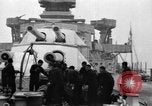
Montage of scenes involving U.S. Battleships in the World War I era
First scene shows foredeck and bridge of USS New York (BB-34) in World War 1. Second scene shows U.S. New Mexico-class Battleship underway. In the next scene, a sailor is signaling with a blinker from the bridge of a battleship ( Pennsylvania or New Mexico). Line of battleships in formation with the USS Texas (BB-35) leading. Quarterdeck view of U.S. Navy Pennsylvania-class battleship. View from deck of the battleship USS Texas or USS New York, looking forward. The final scene is a view from the quarterdeck of the battleship USS Pennsylvania (BB-38) looking out toward the SS George Washington (ID Number 3018) as they travel to France with President Woodrow Wilson on board in December 1918, for the Paris Peace Conference.
Contribution of African American soldiers during the Spanish American War and World War I.
A film about the role of African American soldiers during various wars in the United States. A dramatization shows a black soldier during the Spanish American War. He also talks about his role in Cuba and the construction of the Panama Canal. Footage of the Panama Canal being constructed and ships underway in the canal. United States Army forces including black soldiers boarding troop transport ships bound for Europe during World War 1. A railroad train carries African American soldiers to France during World War I. African American soldier units under General Pershing march in formation with an Army band in France during World War 1. African American soldiers work and fight against the Germans, including the 813th Pioneer Regiment near Marseilles, the 332nd Labor Battalion, and the 808th Pioneer Regiment near Verdun. African American soldiers racing for front lines including the soldiers with the 8th Illinois and the 372nd regiment and the 371st, and the 369th Infantry Regiment (sometimes called the "Harlem Hellfighters") in the Argonne. View from behind soldier as he fires a machine gun, and United States Army infantry firing artillery. African American soldiers of the 369th regiment "Harlem Hellfighters" being decorated and receiving the French Croix de Guerre for their heroic actions in World War I. The African American soldiers march at a parade in New York City following World War I and are greeted by throngs of enthusiastic African American civilians attending the parade. View of Henry Johnson being congratulated by civilians after he and Needham Roberts performed with exceptional heroism and received the Croix de Guerre. Close up view of the Croix de Guerre medal on a uniform. Graves of African American soldiers who lost their lives during World War I at Arlington National Cemetery in Virginia. View of the All-Wars Memorial to Colored Soldiers and Sailors in Logan Square in Philadelphia (Logan Square, SE corner 20th Street & Benjamin Franklin Parkway, Philadelphia, Pennsylvania). View of a stone memorial erected in the Meuse-Argonne region, north of Sechault, as a tribute to the efforts of the African American soldiers of the 371st Infantry Regiment who fought and died there on April 21, 1918 during World War 1.