


 Francais
 Deutsch
 Italiano

Refine Your Search
+"France" +1944 stock footage and images
- Showing 103 to 108 of 1911 results more
 Hide
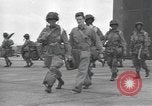
U.S. paratroopers board C-47 airplanes in England for the D Day invasion of Normandy, France in World War 2.
Paratroopers of the U.S. 502nd Parachute Infantry Regiment, 101st Airborne Division, at RAF Station, Greenham Common, proceed, in full battle gear, to board C-47 aircraft for their flight to Normandy, France, on June 5, 1944, during World War 2. Camouflage is seen on their helmets and their faces are blackened. One group is seen boarding C-47, tail number 43-15296. An officer reads briefing notes to them.They don life vests. A Captain and two Sergeants discuss briefing notes.Paratroopers help others who have difficulty climbing aboard the aircraft because of their heavy and ungainly equipment. Ninth Air Force Commander, Lieutenant General Louis H. Brereton speaks to Chaplain, Lieutenant Colonel Louis R. Goodrich, and shakes hands with some of the troopers, wishing them well, as they board C-47 number 42-92847, named, "That's All...Brother."(This was the lead aircraft for the airdrop, just behind the C-47s dropping pathfinders. It was piloted by the commander of the 438th Troop Carrier Group, Colonel John Donalson, and 87th Troop Carrier Squadron Commander, Lieutenant Colonel David Daniel.) The C-47s taxi out for takeoff, as senior officers watch them depart. (Note: There has been confusion about the name of the lead aircraft, C-47, 42-92847, because Colonel Donalson normally flew one named "Belle of Birmingham. " Research, including information from his daughter, indicate that he chose 42-92847, as lead aircraft, because it would have to be cut open to accommodate SCR 717C radar equipment, and he didn't want that done to his favorite airplane.)
U.S. paratroopers being trained at North Witham , England prior to Allied invasion of France in World War II.
Training of U.S. paratrooper pathfinders prior to Allied invasion of Normandy, France during World War 2. U.S. Army Air Forces C-47 aircraft in flight as American paratroopers make practice jumps. A paratrooper lands at drop zone at North Witham training area in England during practice. On June 5th, 1944 C-47 aircraft with invasion stripes parked at an airfield in England.
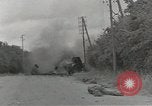
United States 1st Infantry Division soldiers advance into French cities and fight for Aachen during World War II.
The role of United States 1st Infantry Division (Big Red One) in various campaigns in Europe during World War II. United States 1st Infantry Division men fight in France as they advance further inland into the country. Soldiers relax, get a haircut and write a letter back home to their families. On July 25th , 1944 German aircraft launch an air attack. Infantrymen fight in the streets of a city in France. Combat engineers plant land mines. 1st Infantry Division soldiers enter Coutance, Mortain, Etampes, Meaux and Soissons. Soldiers around a monument at the Belgium border. 1st Infantry soldiers advance towards Aachen. Tanks fire as soldiers fight against the Germans in Aachen. Men on a machine gun. On October 25th 1944 Aachen surrenders to the Allies. U.S. Army armored vehicle drives over Nazi flag lying in a street.
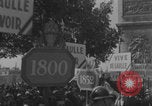
General Charles de Gaulle lay a wreath in front of the Arc de Triomphe (WW2)
General Charles de Gaulle lays a wreath at the Tomb of the Unknown Warrior at the Arc de Triomphe (Paris, France) during World War 2, following the liberation of Paris. Various signs read “1800”, “1793”, “Vive De Gaulle” (“Long live De Gaulle”), “De Gaulle Au Pouvoir” (“De Gaulle in power”), “Vive Les Alliés” (“Long live the Allies”) and “1944” are displayed in front of the Arc de Triomphe (Place Charles de Gaulle, 75008 Paris, France). A man climbs a lamppost to watch a parade. Boy sitting on tree branch watch the man climb a lamppost. Nurses and medics carry with flags of Allied nations (United States, France, United Kingdom). Arrival of General Jacques Philippe Leclerc, holding a walking cane. Leclerc shake hands with an Allied military figure. Charles de Gaulle arrives in Arc de Triomphe with a wreath. General de Gaulle salutes and lays a wreath in front of the Tomb of the Unknown Soldier. Soldiers and journalists surrounding General de Gaulle take photographs using cameras. General de Gaulle walks with Generals Jacques Philippe Leclerc and Marie-Pierre Koenig, and other French officials.
United States Coast Guard preparing for the Allied invasion of Normandy (WW2)
June 9, 1944. Sand flats seen at low tide in Normandy, France. Allied forces fighting their way inland during the Normandy invasion (Three days after D-Day) in World War II. Landing craft and destroyed buildings on the beaches of Normandy. German steel beach obstacles have been stacked out of the way. A United States Sherman DD tank sunk in sand. Badly damaged LCT-25 on the beach at Normandy, with her cargo of half-tracks still aboard and remains of the first one off, sitting at her ramp where it was hit by a German shell. Higgins Boat riddled with bullet holes. Scene shifts to January 1944 when United States Army troops descend from a troop transport ship into LCT-504 for practice maneuvers in the Chesapeake Bay. A soldier operates a Higgins Boat. Another soldier directs a Higgins Boat to the shore. Troops hit the beach in Higgins Boats driven by U.S. Coast Guardsmen from the Attack Transport ship, USS Samuel Chase (APA-26). United States troops carry equipment or belongings as they board ships to England in February 1944. Views of live aboard transport ships in convoys crossing the Atlantic Ocean. Coast Guardsmen near weapons at duty stations. Some troops are seen wearing life vests on board. Troops sleep or lie in hammocks in their quarters. Soldiers pass the time by playing cards, sleeping, reading and writing letters, and mending clothes on deck. Troops line the deck of the transport ship, USS Bayfield (APA-33), as the ship approaches port in England. Landing craft from the Bayfield, carrying troops, are seen in assault training exercises in England. Troops wading ashore during training. Coast Guard officers and sailors are seen aboard larger landing ships in exercises. Coast Guard officer smoking a cigar, as landing craft from the USS Samuel Chase speeds away after landing troops ashore. Trucks drive ashore from landing craft. Scene shifts to May 1944 and a formation of Consolidated B-24 Liberator bomber aircraft dropping bombs on enemy targets in Normandy. Aerial view shows bombs falling.

Activities of Free French Forces in France during World War II
French General Marie-Pierre Kœnig and his staff (plus a civilian official) review U.S. Army troops in Paris, before they depart, after the liberation of Paris,in 1944, during World War 2. General Koenig has been appointed by General Charles de Gaulle to consolidate French control and administration in Paris. In the opening scene, He and the group are seen walking past the U.S. troops as they stand at attention. Later Koenig and the others stand at attention as the American troops march past, on parade. Views of the U.S. troops marching out of Paris, past landmarks and along the Avenue des Champs-Élysées and through the Arc de Triomphe de l'Étoile (Arch of Triumph). Complete change of scene, shows an American armored personnel carrier moving through a French town and an M3 half track firing at a building. Then U.S. infantry spread out as they attack the area. Next American jeeps are seen traversing a steep bridge. Winding roads in rugged country are seen. A GI using binoculars. American artillerymen firing M116 75mm Pack Howitzers, including some under camouflage nets. Soldiers working to repair and strengthen a timber bridge. A truck carrying Free french soldiers who climb down and receive small arms from another French soldier in a jeep. Camera pans over the boots worn by the French soldiers. Closeups of two. Change of scene shows Free French troops in snow at an Alpine location, where they set up military equipment. French soldiers scanning mountain peaks. A soldier on skis. The soldiers responding to a whistle signal from an officer. They take up positions and fire weapons.