


 Francais
 Deutsch
 Italiano
Refine Your Search
+"France" +1944 stock footage and images
- Showing 115 to 120 of 1897 results more
more Hide
Hide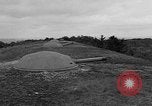
Americans capture Fort Obergentringen and turn its guns on Germans in Thionville, France, during World War II
American soldiers of the U.S. 90th Infantry Division, walking atop captured Fort Obergentringen, Near Thionville, on the west side of the Moselle River, in World War 2. Next, the Fort's German Krupp 105mm guns are seen firing numerous shells at German positions in Thionville, east of the river. American soldiers with binoculars observe the shell strikes from the fort. Smoke rising from the shelling. [Note: A September 17, 1944 wireless report about the fort's capture , to the New York Times, by Frederick Grahamby, stated that "The fort's name is Gingringen and from 1870 to 1919 it belonged to Germany." However, it is actually Fort Obergentringen (Fort Guentrange) on the hills of Guentrange, overlooking Thionville, and built in 1899.]
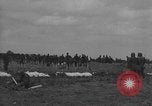
Graves being prepared for fallen U.S. troops at the temporary American St. Laurent Cemetery, in France, during World War II.
German prisoners of war at work digging graves for fallen American soldiers, at the temporary American St. Laurent Cemetery, established by the U.S. First Army on June 8, 1944, shortly after the D-Day invasion of Normandy (Operation Overlord). This is the first American cemetery on European soil in World War II, and located on a cliff overlooking Omaha Beach and the English Channel, east of St. Laurent-sur-Mer and northwest of Bayeux in Colleville-sur-Mer. (It is now the Normandy American Cemetery and Memorial.) Vertical posts with dog tags attached, mark the gravesites of the fallen troops. American soldiers sit near covered dead bodies of the fallen and perform tasks of identification and grave assignment. Covered remains of one soldier are carried across the field on a stretcher. Barrage balloons are seen in the sky overhead.
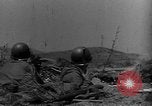
Preparations in England for the D-Day invasion of Normandy in World War II
World War 2 invasion of Normandy, France. President Franklin D. Roosevelt, Marshal Joseph Stalin, and Prime Minister Churchill, meeting at Tehran, Iran, in December 1943. U.S. Generals George Marshall and Hap Arnold, at conference table. Closeup of General Dwight D. Eisenhower. Map showing defense areas of the German 7th, 15th and 19th Armies in Europe. Map showing ports at Brest, Cherbourg, Le Havre, Dieppe, and Calais. Cherbourg is highlighted. U.S. Army trucks, tanks, and artillery, stockpiled in England. Railroad train carrying M3 Stuart tanks. U.S soldiers leaving troop ships and marching to their camps in Britain. Allied troops practicing amphibious assaults on Southern coast of England. Formation of B-26 bombers. View from Allied aircraft flying low over German-occupied area. B-17 aircraft dropping bombs over Germany. Bombs away view seen as bombs drop toward enemy targets. German fighter planes attacking B-17 bombers beginning in February 1944. Gunner in turret of B-17 firing at them. Dogfight views with German fighter aircraft. A B-17 exploding in the air. German fighter downed by B-17 gunner. Gun camera footage of German Bf 109 attacked from rear by gunfire. Just as it is hit it releases its drop tank. American soldiers in trucks, DUKWs, M4 tanks, and M8 armored Cars. Troops receive gas masks, waist life belts, field rations, and French money. May 30, 1944, American soldiers board tanks, trucks and other vehicles bound for embarkation points in England. Seen are Stuart M3 light tanks, jeeps, and M7 Priest tanks. M7 tanks are seen, equipped with intake and exhaust ducts. (At TC:11:39, U.S. M7 Priest tanks, equipped for deep wading, are seen passing the base of the Jubilee clock on the beachfront at Weymouth, on their way toward Castle Town in Portland for embarkation.) Transport ships are loaded at the embarkation ports. Trucks being backed onto LCT-453. U.S. Army infantry marching and boarding transport ships. Troops marching into LST 376 at Plymouth, England. Higgins Boats, from the USS Samuel Chase (APA-26) bringing troops to board her. Troops on deck of Attack transport, USS Joseph T. Dickman (APA-13). Barrage balloons overhead. Soldiers shooting craps on a troop ship deck. Coastguardsmen playing with a puppy dog. Gun crews on U.S. Navy warship being briefed. Soldiers field-strip and check their weapons.
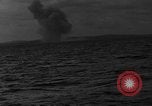
United States Navy heavy cruiser USS Quincy, CA-71 and battleship USS Nevada, BB-36, in World War II
Night action at sea during World War 2. A massive explosion occurs as a mine detonates. Flashes in the dark as tracers are fired at night and flares fall on the surface. United States Navy heavy cruiser USS Quincy, CA-71, painted in Camouflage Measure 31-32-33 series Design 18D. Next is the battleship USS Nevada, BB-36, painted in Camouflage Measure 22. ( Note: This was likely filmed between May 1944 and September 1944 when these two ships supported both the Normandy and Southern France Invasions.)
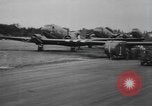
U.S. Paratroopers preparing, and then departing from England, to airdrop over Normandy during World War II
An airfield in England, filled with Waco CG-4A Gliders and their C-47 tow planes, in readiness for the invasion of Normandy, France, in World War 2. U.S. Army Air Forces intelligence officer briefing C-47 and Glider pilots and crews about conditions expected in the drop zones of Normandy before D-Day in World War 2. Brigadier General James Gavin,Commander of the 82nd Airborne Division, giving a final briefing to his paratroopers. A military chaplain holding final religious services for troops. General Dwight D. Eisenhower, visiting paratroopers of the 101st Airborne Division, as they prepare to depart on the night of June 5, 1944. U.S.Army paratroopers boarding their C-47 aircraft to depart for Normandy on June 5, 1944. Several are seen tying parapacks of heavy equipment to the aircraft for separate release. Paratroopers of 101st Airborne Division, loading equipment aboard a CG-4A Glider, and getting final briefing from their pilot. Other 101st Airborne troopers don personal equipment on the ramp near their C-47 airplane, which displays paint-striped wings and fuselage. Jumpmaster makes final check of his troopers. The paratroopers boarding their aircraft with heavy loads of equipment. C-47 aircraft take off towing their gliders.
Joseph Stalin, Franklin Roosevelt and Winston Churchill at Tehran conference; also Yugoslavian and French resistance fighters.
General Secretary of the Communist Party Joseph Stalin, President Franklin D Roosevelt of the U.S. and Prime Minister Winston Churchill of the UK seated on porch of Soviet Embassy building in Tehran, Iran, 28 November 1943, during World War 2. Scene shifts to group of Yugoslav Partisans and closeup of their leader, Marshal Tito, at their mountain headquarters. Yugoslavian Marshal Tito smoking a pipe while standing on the porch of his headquarters with American Office of Strategic Services (OSS) Officer, Army Major Linn M. Farish, U.S. Liaison to the Partisans, and British Brigadier General Fitzroy Maclean, Winston Churchill's special envoy to the Yugoslavia leader. Next scene shows French resistance fighters with their flag on a mountaineer's pick. It reads,""Vaincre ou Mourir"" and displays a cross of Lorraine. Closeups of French resistance fighters at attention and also relaxed, smiling, and singing. Scenes of various such groups joining in the June 6, 1944 Allied invasion at Normandy, France. Aerial glimpse of D-day task force crossing the English Channel. Animated map shows Germany being attacked by Russian forces from the East, by the other allies from Britain in the West and from Italy, in the South. Allied forces moving across a pontoon bridge and engaging German forces in France. A U.S. M3 Gun Motor Carriage firing its 75mm gun. American troops firing machine guns, carrying wounded on stretchers and using flame throwers. Troops, including ambulatory wounded moving under enemy fire. Paratroopers of the 101st Airborne Division in France. One carries a wounded buddy. American troops firing a variety of artillery from under camouflage netting. French underground forces engaged in Paris. Closeup of one wearing a French Adrian helmet firing a rifle. Another throws a grenade out an apartment window. An American tank moving under the base of the Eiffel Tower as French Resistance fighters run across the area. French citizens celebrating the liberation of Paris. View from an American jeep as French people cheer. Closeups of French people. A bombed out bridge. A battlefield cemetery. Destruction and death in the wake of combat. Fallen French civilians lying on pavement. A U.S. tank slowly driving through a masonry wall. Soviet forces advancing through destroyed buildings. Chinese troops marching along the Great Wall. British troops on parade in tropics. Asian ally troops marching. Huge formation of marching U.S. soldiers. United Nations flags in the breeze.