


 Francais
 Deutsch
 Italiano
Refine Your Search
+"France" +1944 stock footage and images
- Showing 109 to 114 of 1897 results more
more Hide
Hide
U.S. shuttle-bombing of German positions and military installations under Operation Frantic during World War II.
Film title slate indicates "Operation Titanic" but it, in fact, depicts "Operation Frantic" with U.S. shuttle bombing operations over Germany from bases in Great Britain, Italy and Russia during World War II. United States Army Air Force B-17 Flying Fortresses in flight. Aerial view of bombers in flight with several aircraft flying in formation leaving behind contrails. View inside bomber aircraft with bombardier preparing to drop bombs. View of bomb bay door opening and closeup of hand near bomb drop switch. Bombs awawy view as bombs are dropped from American aircraft. German defenses are bombed along the invasion coast of France (just prior to D-Day) on June 2, 1944. Aerial views of B-24 and B-17 bombers also in flight bombing German military installations in German-occupied northwestern Europe. Aerial view of a target area. Smoke rising up from bombardment. Two different U.S. Army Air Force B-17 Liberator aircraft are seen falling from the sky toward crashes after being hit by German enemy fire. One of them has smoke trailing from it, and the other is in a free fall. Railroad and marshaling yards are also bombed over Debrecen, Hungary on June 2, 1944, with aircraft continuing on (shuttle bombing) rather than returning to base. United States Army Air Forces B-24 Liberator flying in formation on June 21, 1944. Aerial view as they bomb the Focke-Wulf Fw 190 engine aircraft factory near Basdorf, Germany. German factories are bombed. B-17 aircraft on the same date are seeing in formation and bomb railway stations, freight yards, and factory targets, along with the Nazi German Ministry of War, Ministry of Propaganda, and Gestapo headquarters in Berlin, Germany. Heavy flak bursts seen in the air near the aircraft. Dogfight scenes as several German airplanes are shot down. Machine gunners aboard U.S. bomber aircraft firing at German fighter aircraft and shooting down 43 of them, according to narrator. Aerial view of ball turret rotating below bomber and firing guns at German fighter aircraft. The B-17s and B-24s bombing the targets. Synthetic oil plants and refineries are bombed at Ruhland Germany, east of Leipzig. Planning for the operation was done on December 7, 1943. A document about the operation is typed. Animated map shows Nazi positions and method of shuttle-bombing, allowing American aircraft to bomb from Soviet bases, and allies broadly to bomb German targets from bases in the United Kingdom, Italy, and Soviet Ukraine.
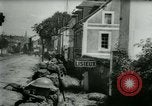
British soldiers fight the Nazis in Lisieux and General Charles De Gaulle visits Chartres en route to Paris liberation
British soldiers enter the town of Lisieux, France. Armed British soldiers patrol the streets. Soldiers walk past the destroyed buildings. Firing and bombardment. Soldiers and British tanks fire at Nazis hiding in the town. A French civilian woman brings a glass of water and a pitcher to a prone British soldier firing at German positions from a street corner. Soldier prone firing a machine gun. People in the town of Chartres, a center of resistance. A young woman resistance soldier talks to an Allied French soldier. French General Charles De Gaulle and other officers greeted by the town on August 23, 1944. De Gaulle addressed the town to commend their resistance. De Gaulle looks at the Chateau de Rambouillet in Rambouillet, France, from where he directed the French armored divisions in their push to Paris. Views of the palace, gardens, and a lake at the Chateau de Rambouillet with Charles De Gaulle standing beside the lake. (World War II period).
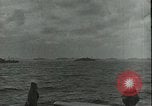
Soldiers of the 1st Infantry Division in England and during the invasion of Normandy and subsequent campaigns toward Germany (WW2)
Soldiers of the 1st Infantry Division training in England under General Clarence R Huebner, in preparation for the D-Day Normandy invasion in World War II. U.S. Navy ships underway at sea. Heavy naval guns bombard the coast of France on D-Day. U.S. Army soldiers seen during assault on Omaha beach with heavy losses on D-Day. U.S. soldiers and tanks encounter heavy German resistance in the "hedge rows." American soldiers digging trenches with shovels and picks and treating wounded comrade. Dead German soldier lying in street as Americans enter the town of Caumont (Caumont l'Eventé). Frenchman civilian pours wine for American soldier after they liberated Caumont l'Eventé from the entrenched German forces. An American helps a French civilian woman to reach a safe place crossing rubble. Damaged French houses along the sides of street. During rest, a soldier gives another a haircut, and another writes a letter. U.S. Air Force B-17s fly overhead and bomb near St. Lo, France on July 25, 1944. Other U.S. Army artillery units, the 4th and 9th Divisions, and General Patton's tanks provided support so the 1st Infantry (First Infantry or Big Red One) could occupy the area. Army combat engineers dig up mines and use construction equipment to clear debris. Wrecked houses and rubble. U.S. soldiers keep advancing through towns and eat and rest as they can. Road sign reads: "Coutances." First Infantry goes through Mortain, Etampes, Meaux, Soissons and across the Belgian border. German prisoners of war walk with their hands raised. German soldier digging out of fox hole. Siegfried Line and dragons teeth. Strong German resistance encountered at Aachen. Tanks fire in the field. House to house fighting in Aachen. Surrender of Aachen. A German flag laying in the street is run over by a U.S. military vehicle. German resistance is heavy during battle scenes in Battle of Hürtgen Forest. German and American artillery are seen in Hurtgen Forest. U.S. wounded treated. The 1st Division is pulled out for rest at the rear, in Belgium.
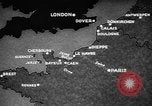
German Army fights Allied infantry and tanks while retreating from the Western Front in Europe, during World War II.
German Army fights with the Allied infantry and tanks on the Western Front in France and England, during the summer of 1944 in World War 2. Animated maps show English and French invasion coastlines. During Battle of Caen, German soldiers load ammunition on a camouflaged truck. The truck driven on roads. A German soldier on truck observes American bombers in sky overhead. Truck parks to the side and German antiaircraft guns fired. Night view from ground of bombs being dropped and buildings burning in the distance in Caen, France. German military trucks move at night on roads passing by burning fires. View from inside cabs of moving German vehicles. Daytime view of heavily bombed and destroyed city of Caen with ruins of houses and shops; German infantry walk through the streets of the destroyed and empty city. German soldiers fully loaded with their weapons ready for a battle. Close views of their faces with determined expressions. German tanks, armored vehicles, and infantry move on roads. Among them are two Borgward IV remote-controlled demolition vehicles (Schwerer Ladungsträger Borgward B IV, or heavy explosive carrier Borgward B IV) each driven by one man. Soldiers of German Army observe approach of U.S. Army forces. A German soldier arranges shells for artillery to fire as they fire on Allied positions. Wehrmacht infantry soldiers advance cautiously along roads. German soldiers take cover and prepare to attack as American tanks pass through a village. German soldiers fire on U.S. Army tanks. German soldiers direct an unmanned, remote-controlled small armored vehicle laden with explosives across a field and detonate it near U.S. Army vehicles (it is known as a Goliath Tracked Mine, or Leichter Ladungsträger Goliath (Sd.Kfz. 302/303a/303b); also known as a "beetle tank" to Allied forces, or a German robot tank). Large explosion as the remote-controlled demolition vehicle is detonated. Dead U.S. Army soldier along a road side, and injured German soldiers are aided by other German soldier
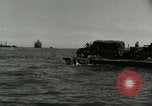
A Rhino barge and other vessels during invasion of France in World War II
A large military barge, marked "US RHF-25" (Rhino Ferry) passes camera viewing from a boat in the water (unseen). Large transport ships seen in background. The barge is filled with military equipment including trucks, construction equipment, and soldiers. As it proceeds, the camera reveals a large transport ship behind it. Closeup of soldiers standing among the cargo on the barge. Landing ship Tank, (LST 499) flanked by a tug boat. Barrage balloons aloft. Closeup of LST 499 port bow. A transport ship in the background. (Note: on June 8th, 1944, LST 499 struck a mine while backing away from Utah Beach, loaded with wounded and medical personnel. Fourteen Crew members were lost, and an unknown number of casualties among the wounded passengers and medical personnel.)
Beach and wreckage three days after the D-Day Allied invasion of Normandy, France during World War II.
Opening scene behind introductory writing, shows U.S. troops climbing down from a landing craft and walking towards a beach during Normandy invasion of World war 2. Date is D-Day +3 (June 9, 1944) and allies are setting up logistic resupply operations. Views across beach at extreme low tide. A cluster of DUKW amphibious vehicles sitting on the sand, below some cliffs. Some buildings of the French village of Arromanches-les-Bainsin background. Closeup of a demolished French dwelling at base of cliff. Two U.S. soldiers walk along a road at the waterfront, where steel barriers that have been removed from the beach, are piled up. Closeup of the steel barriers. An M4 Sherman tank, equipped with deep wading gear is seen mired in the sand. A closeup of U.S. Landing Craft Tank (LCT-25) on the beach with an M3A1 Half-Track destroyed on its offramp. It had been hit by shell fire on D-day, setting other half-tracks and the landing craft afire. Closeup of the destroyed halftrack.