


 Francais
 Deutsch
 Italiano

Refine Your Search
+"France" +1944 stock footage and images
- Showing 127 to 132 of 1911 results more
 Hide
Seabees construct an artificial harbor during the Allied invasion of Normandy, France in World War II.
A film about the role of U.S. Navy Seabees in construction of artificial harbors in the English Channel during the Allied invasion of Normandy in World War II. U.S. Navy Captain Clark, in charge of artificial harbors and Commander Calair, in charge of installing Phoenixes and pier heads in the English Channel. Ships underway in the English channel. Tugs at a harbor. Beetles being pulled. A tug prepares to tow a Phoenix. Men work on lines. Whales spread across the channel. Pier head at sea. A dumb barge underway at sea. A captain looks at the towing operation from the bridge of a vessel. Aircraft in flight. Crew aboard a phoenix. Gliders in flight above the convoy. A signalman sends a blinker signal. Animated diagram depicts the creation of an artificial harbor. First tow arrives at Normandy on June 6, 1944. Landing crafts at the Normandy beach. Artificial harbor being constructed. A bridge being completed and pier head being attached to it. Seabees at work.
Allied invasion force departs England en route to France for invasion of Normandy, in World War II.
D-Day minus 1 (June 5, 1944) U.S. Invasion craft jammed into harbor at Weymouth, England, the day before D-day, during World War 2. Troops sitting on deck of LSI(L) 88, drinking coffee and playing dice game. One soldier looking through binoculars, at an English woman,in doorway of her flat, who is looking back through her binoculars. Several other women in the flat complex are hanging laundry out to dry.The American soldier cups his hands and tries to call out to the woman.One of his friends joins in the fun. Scene shifts to Formation of U.S. B-26 bombers in flight. A city is viewed from a bomber, with smoke rising from bomb bursts. Formation of U.S. B-17 bombers escorted by P-47 fighters. Scene shifts back to troops at port of embarkation, where large group is seen at a Catholic mass being held on a pier by U.S. chaplain.LCI(L)s numbers 49, 89, and 93, are seen tied up in background. A U.S.Coast Guard officer briefs his crewmen. Several of the invasion fleet ships begin moving out of the harbor. A U.S. Navy Captain, conversing with Major General Clarence R. Huebner, Commander, U.S. 1st Infantry Division, on deck of a ship. Buckley-Class Destroyer escort, in camouflage paint, is seen with other other escorting warships. Barrage Balloons fly aloft. View from LCI(L) departing pier in Weymouth. Several others preparing to depart as well. LCI(L) 498 is seen closeby. Columns of invasion craft underway. Captain Miles Imlay,USCG, deputy commander, Assault Group O-1, and Commander of Flotilla 10, on the bridge of his flagship, LCI(L) 87. The U.S. Attack transport USS Samuel Chase (APA-26) is seen. Soldiers loading rounds into an ammunition belt. Crew members on an invasion ship man an antiaircraft gun (as friendly aircraft fly overhead). An 83-ft Coast Guard rescue cutter. U.S. Battleships. Soldiers napping on deck of the USS Samuel Chase. Below decks, a Coast Guard Commander joins others being briefed with help of a mockup of the Normandy coastline.
U.S. troops in Scotland rehearse for amphibious invasion of Normandy, France during World War II
Higgins Boats (landing craft) from the USS Bayfield (APA-33) are seen heading toward the shore on the River Clyde in Scotland, where they carried out amphibious landing exercises from 14 March, through 21 March,1944, in preparation for the Allied invasion of Normandy during World War 2.. Snow-covered mountains dominate the background. View of a U.S. Coast Guardsman standing in one of the boats. Several landing craft are seen near the shore in the background. Snow extends almost as low as the beach. Several landing craft moving in loose formation across the water, with rising moon low on horizon in background. View of one Higgins Boat plowing through the water, towards the camera. The moon is now higher in the sky. American troops wading ashore through surf, in the moonlight. Some stars are visible high in the background sky. Troops coming ashore along a wide stretch of beach. Clouds obscure the sky.

Allied forces preparing in England for the Invasion of Normandy.
A dramatized film entitled "Beachhead to Berlin" describes preparations for the Allied invasion of France and the drive toward Berlin. Film combines actors and actual footage. Harbor in Greenway England in July, 1944. U.S. Coast Guard Barracks. Coast Guard men playing cards. One on a bunk contemplating. Chaplain's office: Chaplain typing and smoking a pipe. Audio narration of his letter being read, describing how things transpired at the Normandy beaches during the Invasion of France. Then actual footage of wounded being transported on ships after D-Day Normandy invasion. In England, footage of LCIs, LCVPs, Coast Guard cutters, including the Flying Angel Rescue Cutter. All of these ships participating in "dry run" practices for the actual Normandy landing. Coast Guard crews on decks of ships. Infantry loading landing crafts in England for dry runs. Landing craft arriving on English beaches during dry runs. A jeep drives off a landing craft and gets stuck on metal mesh on the beach. A tank is driven off a landing craft. Men maintaining ships. Scraping rust from the deck, painting identifications on ships, repairing rope ladders, and welding. (World War II period).
German Chancellor Adolf Hitler and Prime Minister of Italy Benito Mussolini discuss strategies for war in the European Theater.
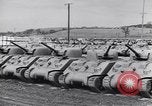
Officials confer during World War II. Allied war material stacked on a port in England, including U.S. tanks, trailers, razor wire, fencing, and trucks in preparation for invasion of Europe in 1944. American and British soldiers work and load the supplies for their shipment to the war front. U.S. soldiers unload at a beach site. British Army soldiers roll a covered artillery piece . It has a chalk handwritten label on the gun barrel that says, "Slim's Deadly Poison" and an image of skull and cross bones. Laborers building a German fortification in coastal France. German General viewing English Channel from coastal fortification along the Atlantic Wall. German Chancellor Adolf Hitler and Prime Minister of Italy Benito Mussolini confer in a meeting. The officials discuss strategies for the war over a large map. Newspapers with English headlines speculating about the coming Allied invasion. George Marshall and other Allied officers of the War Council of the united nations assembled at a large conference table and in discussion for the Invasion of Europe (D-Day invasion of France).

U.S. film designed to boost national morale during World War II. Numerous scenes of American forces engaged in combat.
Several American school children, including one in a Boy Scouts of America uniform, recite the pledge of allegiance during World War 2. Scene broadens to encompass a school yard filled with elementary school students reciting the pledge in front of an American flag flying high on a pole. As scene fades images appear of battleships firing guns; an F4F airplane taking off from an aircraft carrier; landing craft approaching a beach; American soldiers fighting with small arms and a flame thrower, in jungles of New Guinea; a U.S. gun crew firing heavy artillery; and a U.S. P-38 aircraft on a rainy runway, spraying water as it takes off, in the Aleutian Islands. U.S. troops firing automatic weapons on a Pacific Island. A B-17 pilot wearing an oxygen mask in his cockpit, flying in a formation creating contrails at high altitude over Germany. Waist gunner firing at an attacking German fighter plane that explodes in air. U.S. troops in jeeps moving over jungle road. U.S. ski troops on snow in Iceland heading downhill toward their tents in the snow. American troops during amphibious landing in the Philippines. U.S. troops aboard army halftracks on desert in Iran. American paratroopers dropping from C-47 aircraft over France. U.S. soldiers marching through two large gates with cadre of Chinese soldiers in China. American troops fighting in Italy and firing a 155mm howitzer. U.S. infantry following a sherman tank over a war-torn landscape with shells bursting nearby. Crowded, busy street scenes of traffic and pedestrians in Manhattan, New York City, and Chicago, Illinois. Army tanks being manufactured by war production workers in a Detroit war production plant or factory. A Los Angeles shipyard filled with workers at shift change. Closeups of individual American soldiers in combat helmets. U.S. troops descending rope nets from transport ships to board landing craft, and approaching the beaches of Normandy, France, under fire, on D-day, June 6, 1944. Views of the Statue of Liberty, including closeups.