


 Francais
 Deutsch
 Italiano
Refine Your Search
+"Germany" +1918 stock footage and images
- Showing 49 to 54 of 83 results more
more Hide
Hide
Scenes from WW1 include Woodrow Wilson, Franklin Roosevelt, troop deployment, munitions factory, ship building, WWI battle, and Armistice Day.
A title reading “1917”. An American ship sinks down in the Atlantic Ocean after it was torpedoed by a German U-Boat during World War I. United States President Woodrow Wilson signs the United States declaration of war on Germany. President Woodrow Wilson at work in his desk. A United States soldier blows a trumpet. United States soldiers crowd the deck of a ship sailing to Europe during WWI. The American Expeditionary Forces are waving as the ship sails away from the port. Franklin Roosevelt during World War I. American troops disembark from their ships after arriving in Europe. American women working in military supply factory. Women manufacture bullets using hand drills. A woman assembles munitions. Men building battleships at shipyard assembly line. Allied soldiers running in the battlefield to avoid being hit or bombed by the Germans. Bombs explode in the battlefield in Europe during World War I. Soldiers avoid bombs. A railway gun fires. An biplane falls in smoke after being hit. Explosion from tank in battlefield. Soldier rolls down to a trench. Explosion beside a rolling tank. A German soldier ducks in trench. An Allied soldier fires from a trench. A soldier behind him throws a grenade. Soldier with machine gun ducks from a trench. Tank rolls and fires in battlefield. Black explosion in battlefield. Soldiers run and avoid explosions. German soldiers fire a machine gun and throw grenades. Surrendered German prisoner soldiers march out as prisoners-of-war. American soldiers celebrate Armistice Day. View of the United States flag. Allied soldiers march in victory through ruined city. Americans celebrate Allied victory in World War I, filling with crowds in New York City. Americans hold banner saying, “Germany Surrenders”. Celebrating Americans in New York City, hold American flags and their hats triumphantly after Allied Victory in World War I.
First phase of munitions manufacture in a German factory during World War I
Munitions manufacture in Germany. A 70 kg steel ingot is heated in furnace. Workers remove it and place it in a 500 ton press. It is then moved to a drawing press reduces its cross section, lengthens it and cuts it into segments. Workers move it to a reheating furnace where many cylindrical pieces are heated until red hot for forging. They are then moved to a drop forge that further shapes them. A woman war production worker wearing a dress is seen operating the controls of the drop forge heavy equipment in the arms factory.
Munitions being manufactured in a German factory during World War I
Munitions manufacture in Germany. Women move newly manufactured heavy munitions casings to a table where they are measured. Worker uses drill press to machine hole for fuse in nose of casing. A woman mounts the casing in a lathe using a chain hoist. She turns (machines ) the outer casing. A small amount of smoke rises from the heat generated at the tool bit. Cutting fluid is poured on the tool bit and casing as it is turning in the lathe. A woman brushes particles from a batch of casings as they are being machined. Men and women perform quality control checks on finished casings. Army representatives perform military acceptance checks on finished casings, using gauges.
Steps in manufacture of munitions in a German factory during World War I
Munitions manufacture in Germany. Guide rings are formed and fastened into grooves around munitions casing. Casings are stood on their bases in molds. Molten metal is poured into the molds. Casings with molded metal on bases are removed and placed into lathe where guide rings are machined. Metal chips fly off the lathe during this process. The guide rings are further machined with rotary milling machine. A woman grinds casing surfaces in a machine. Casings are given water pressure checks. Water spouts from a defective casing. Munition casings are cleaned and packed.
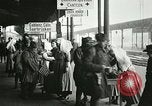
Welfare activities by Red Cross people at conclusion of World War I.
Coffee and sandwiches are served to American Army troops in Trier, Germany by the Red Cross activists. U.S. soldiers approach Red Cross women at a table in the train station and receive food. Signs beside tracks name various German cities. Two different groups of women red cross workers pose for cameras in front of the "Army Red Cross Enlisted Mens Club." Inside, U.S. Army soldiers check in at the club desk, staffed by Red Cross women workers. U.S. troops gather around a piano played by a Red Cross worker and the group sings along with the piano. Soldiers dance with Red Cross women in a dance hall at the club.
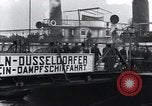
U.S. Third Army entering German Rhineland during World War 1
United States soldiers entering Koblenz, Germany (sometimes spelled Coblenz) from the Coln-Dusseldorfer riverboat at the dock on River Rhine during World War 1. Views from aboard the steamship and from aboard other boats on the Rhine, looking at the steamship and beyond toward a castle overlooking the River Rhine and homes and buildings on the edge of the river. Soldiers seen having food and on duty after their arrival at German Rhineland on Occupation duties. United States flag is also seen.