


 Francais
 Deutsch
 Italiano
Refine Your Search
+"Germany" +1938 stock footage and images
- Showing 31 to 36 of 148 results more
more Hide
Hide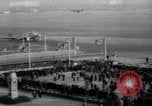
Hitler lands at Tempelhof aerodrome and is greeted by enthusiastic crowds in Berlin
Adolf Hitler's triumphant return to Berlin after his visit to Vienna, in March 1938. A Junkers Ju-52 trimotor aircraft is parked on the ramp at Tempelhof Airport (Platz d. Luftbrücke 5, 12101 Berlin, Germany) Berlin. Another is seen landing (carrying Hitler). Nazi flags fly over passenger area crowded with spectators. Cars are parked along the ramp and large white letters spelling "Berlin," visible from the air, are displayed on the ground. Formations of people are seen in various areas of the airport. A closeup of mostly young people swaying back and forth, having fun. A motorcade of cars makes its way through the formations of spectators. Adolf Hitler is standing in the lead car, giving the Nazi salute as spectators cheer him. His car stops, and Hitler steps out to be joined by Hermann Goering and a helmeted army officer carrying a sword. Views of the dense crowds lining both sides of the pathway. Scene shifts to Hitler, Goering, and the Army officer, walking past an honor guard presenting arms in salute. The army officer salutes with his sword and takes up a position in front of the Honor Guard, while Hitler returns the salute and continues with Hermann Goering. Camera pans over the dense cheering crowds in the Wilhelmplatz (77 Wilhelmstraße, 10117 Berlin, Germany). Hitler and Goering appear on a balcony. (Note: the only sound is of crowds cheering.)
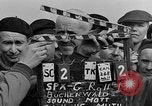
Kurt Gatner, an Austrian internee at Buchenwald concentration camp in Germany.
Internees at a concentration camp in Buchenwald, Germany. Kurt Gatner, a former Chief of Prime Minister Schuschingg's body guard from Vienna, Austria. He says that he was arrested in 1938 soon after the occupation of Austria by Germans. He states how he was badly treated at various concentration camps. He talks about the harsh punishments being given at these camps. He thanks the American and other Allied forces for liberating him and many others from the camp. Other internees in the background. (World War II period).
United States interests in South America and Latin America just before World War 2, and German presence in the Americas
Opening scene shows U.S. State Department officials of the Division of the American Republics in a meeting. They examine a map titled "Inter-American Highway" showing a proposed highway running from the border of the U.S. and Mexico at Laredo Texas, all the way through Mexico, Latin America, and into South America. View of South American farmers loading hay into a horse cart, then of cattle in a stockyard being herded by a cowboy on a horse. Aerial view of city of Rio de Janeiro Brazil circa 1938. Narrator discusses threat of dictatorships in countries of South America. Views of German ships and German contracted ships loading and unloading at Buenos Aires harbor. Narrator describes system of barter where Argentina sends goods to Germany in exchange for German-made goods. Swastika flag on one of the cargo ships. Dock crane with German sign "Deutsche Maschinenfabrik A.G. Duisburg". Letters on side of a ship reads 'Buenos Aires Maru'. Supplies unloaded from ship. Cargo stacked including wooden boxes with German writing labeled "Vorsicht - San Paulo Brasilien". In a Latin American or South American city, view of the storefront for luxury goods by Herm Stoltz & Co. A Nazi German flag hangs above the store entrance. Fine leather goods, cameras, figurines, steins, etc from Germany are shown in store window displays. View of Nazi German books on display in storefronts, including closeup of translated book "Mein Kampf" ("Mi Lucha") by Adolf Hitler, bearing an image of Hitler on front cover. A German passenger aircraft parked at an airfield, which narrator describes as being part of a German airline offering service to South America within two days of Berlin, Germany. More German airplanes are shown at an airport in South America. View of government offices in Rio de Janeiro Brazil. Large crest with a bird atop an entrance. Interior office view of President Getúlio Vargas of Brazil seated in discussion with American diplomats. Narrator indicates that Vargas learned of German colonists in Brazil planning his overthrow by assassination, and therefore outlawed all Nazi activity. Poster of Vargas communicating his policies. Scene switches to exterior view of the State, War, and Navy Building (later the Executive Office Building) in Washington DC, with the First Division Monument in the foreground. Interior view of office door bearing sign for Under Secretary of State. Inside, Sumner Welles is seen in discussion with officials. He is asked about the American attitude toward Latin America. Welles describes the importance of strengthening ties between the countries of the Americas. Under Secretary Welles states that the welfare of all of the countries in the region may depend on their continued solidarity.
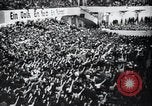
Glimpses of Nazi war preparations
Nazi German rally on September 26,1938 in Berlin Sportpalast stadium where signs on walls contain slogans (translated): "One People, One Nation, One Leader" and "Fuhrer leads, we follow." Remilitarized and mobilized Germany: German troops in formation. Vast array of German military troops, arms, equipment, and war vehicles, in a huge stadium, with flags flying above grandstand, in distance. Large columns of German Army soldiers marching in formation. Hitler reviewing troops on parade. Crowds waving small hand-held swastika flags. Glimpse of troops parading at Nazi Rally Grounds stadium in Nuremberg, one year before World War 2.
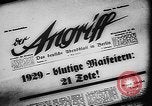
German people during Beer Hall Putsch on the streets to oppose KPD; and later scenes including Adolf Hitler speaking at May Day celebration
Unrest in Germany in decade following World War I. Rally and demonstration in Munich in Marienplatz area, between Communist KPD members, police, and NSDAP brownshirts. This was known as the Beer Hall Putsch or Munich Putsch in November 1923. Crowds opposing the Treaty of Versailles. Trucks and jeeps loaded with policemen at the riot place. Buildings in the background. Scene shifts to a Nazi rally at the Lustgarten in Berlin on May Day (May 1, 1938). A tall May Pole is seen decorated with Nazi flags and streamers. Adolf Hitler addresses a large crowd from a dais on the steps of the Altes Museum. Swastika sign on panels on either side. German biplane aircraft fly in formation overhead, demonstrating German military buildup, re-militarization, and rearmament of Germany leading up to World War 2.
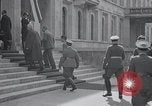
Historic signing of Munich Agreement, September 29, 1938 by Hitler,Mussolini,Daladier,Chamberlain
Hitler and Hermann Goering with representatives of France, Britain and Italy, on September 29, 1938. Hitler and Goering in meeting with Benito Mussolini on occasion of Munich Conference. Hitler and Mussolini converse. Civilians gather on the street outside the Metropol Hotel in Munich. Benito Mussolini, of Italy, seen signing the pact, along with Édouard Daladier of France. Hitler shakes hands with Daladier after the signing. The group around Hitler includes Neville Chamberlain, Benito Mussolini, and Mussolini's son-in-law, Galeazzo Ciano.