


 Francais
 Deutsch
 Italiano
Refine Your Search
+"Germany" +1943 stock footage and images
- Showing 19 to 24 of 300 results more
more Hide
Hide
German V-1 rocket fails to launch during WW2
Title card says “Erprobungsstelle der Luftwaffe Peenemünde- West” (“Test site of the Peenemünde-West air force” in English). “Flakzielgerät 76 V99 Schnittaufnahmen 4.8. 1943 HK” (“Anti-aircraft target device 76 V99 cut recordings 4.8. 1943 HK” in English). A V-1 rocket, also known as a buzz bomb or doodlebug, on a launch ramp in Germany during World War 2. The Argus engine on the V-1 fires up, but the rocket fails to launch from the ramp.
German animation shows V-1 Argus motor function during WWII.
Title card saying “Flakzielgerät 76 Trickaufnahmen Argus 11. 12. 1943 HK” (“Flak target device 76 trick shots Argus 11.12.1943 HK” in English). An Illustration showing the parts of the Argus engine of the V-1 rocket, an early cruise missile developed in Germany during World War 2, with the parts named in German. Animation demonstrates how the pulse-jet action works on the Argus jet engine.
German occupation, martial law, and Danish resistance in Denmark during World War II
Film about Denmark after the Nazi German occupying force declared martial law and state of war with Denmark, in 1943-44 during World War 2. It was made by Danes and smuggled out of Denmark during that period. Opens with view of a church building and flocks of birds. Views of German army troops marching into Copenhagen, Denmark on April 9, 1940. SS troops dressed in black, marching. German soldiers carrying rifles with fixed bayonets, goosestepping. A fire burning at site sabotaged by Danish resistance elements in 1943. Derailed trains carrying goods to Germany. Fire at a German factory. Danish workers with bicycles staging a strike in protest German measures in response to resistance actions. Danes gathered in outdoor observance memorializing those killed by the Germans. A shop owned by German sympathizers (Quislings) destroyed by other Danes. People gathered on street on 29 August 1943, when the occupying German forces attacked the remaining Danish garrison and declared martial law. Announcement posted in Danish on a wall. View of Danish Naval vessels ordered scuttled by the Danish Admiralty, including the coastal defense ship,Peder-Skram, seen in front of a large building, the submarine, Havfruen (not seen) and others seen sunk at docks in Copenhagen harbor. Bullet hole through a glass window. A week later, on Sunday, 5 September, 1943, a German Panzer light tank is seen moving on a street, as pedestrians go about their business in Copenhagen. German soldiers patrolling on a motorcycle with sidecar. A man holding his hands up as he is hustled through a crowd under arrest by a German in black uniform (possibly Gestapo or SS). Motorcycle driving through pedestrians on the sidewalk. Spectators line a fence by an open field near a building labeled "Badstue Badminton." One, a woman, speaks through the fence to a Danish soldier interned there. View of the quarters of the Royal Guard at Rosenborg, occupied by German soldiers and with Nazi flag flying above it. Civilian relatives of interned men wait outside army headquarters for news about them. A courtyard, during a mass funeral, is filled with memorial flower wreaths covering the coffins of Danish soldiers and civilians killed by the Germans. Camera focuses on a wreath from King Christian of Denmark, among the many others. Two German soldiers march up a path at the Royal Residence Amalienborg, where King Christian is arrested. Views from moving camera as Danish flags are seen flying all over the city of Copenhagen, on 26 September, 1943, to celebrate the King's 73rd Birthday. The major exception is the Nazi Gestapo headquarters in the "Shellhus" (the prewar Shell Oil offices) shown in isolation. Views of people moving their belongings on hand carts after their homes were taken over by Germans. The slogan in English, "Do it well and do it now,"is seen left by Danish resistance fighters where they sabotaged a German military installation.
Montage of scenes showing the continuous close coordination between the United States and Britain during World War II
Film shows an invasion task force at sea overwritten by a slate reading, "Casablanca." Narrator speaks of January, 1943, in World War 2. View of the city of Casablanca in Morocco. U.S. President Franklin D. Roosevelt seated next to British Prime Minister, Winston Churchill as they meet in Casablanca, at the Anfa Hotel, January 14–24, 1943, during World War 2. Roosevelt wears a black armband on his left sleeve in mourning over the death of his mother, in 1941. Backs of Military officers seen from behind, with Churchill and Roosevelt on chairs in the background. Then a closeup of Roosevelt and Churchill seated with high ranking Allied military officers behind them, including U.S. Admiral Ernest King and U.S. General George Marshall. View from directly overhead of marching American soldiers. Huge number of British soldiers led by a Rolls Royce armored car, are seen walking across the desert, celebrating their victory over German forces at Tunisia. Prime Minister Churchill and President Roosevelt seated on the lawn in front of the White House during the third Washington Conference (code-named Trident) held in Washington DC, from May 12 to May 25, 1943. Closeups of both men. Scene shifts to a U.S. invasion task force in the Pacific. Glimpse of a Benson-Livermore class destroyer near hills in the Pacific. A navy Douglas Dauntless dive bomber flies over ships in an invasion task force. U.S. troops are seen in a Higgins Boat landing craft from the transport ship USS President Jackson (APA-18). Troops storming ashore from landing craft. U.S. troops firing artillery field pieces, and raising the U.S. flag on a captured island in the Pacific. Scene shifts to European theater, where an Allied warship is firing its guns during Allied invasion of Sicily, code named Operation Husky, 9 July – 17 August 1943. Amphibious assault taking place. A jeep is seen pulling an artillery piece through shallow surf. An army truck drives through shallow surf, out of a landing craft. Breech view of artillery gun being fired and shell ejecting. A shell exploding near the camera. Camouflaged antiaircraft guns firing. Series of brief scenes showing Soviet Russian infantry and tanks advancing against German forces in Russia. Next scene shows Benito Mussolini in military dress uniform, giving a speech, and then posing next to a Bronze statue of Roman emperor, Julius Caesar, in Rome, Italy, as troops march past him. A bust of Mussolini being pulled down. Rioting Italians. Axis defenders in Sicily, carrying a white flag as they surrender to Allied powers. Views of Lieutenant General Mark Clark and a Major General pleased at the surrender. American troops being cheered by Sicilians as they ride in jeeps. Italian men receiving food after the surrender, as a British soldier stands nearby. U.S. Army Air Force B-24 Liberator bombers in flight over the Northwest Pacific. Aerial view of Kiska in the Aleutians. B-17 flying Fortress bomber in flight with bomb bays open. Bombardier at his station in the aircraft he presses button to release bombs. Formation of B-24 bombers dropping bombs. View from aircraft of them exploding on the ground. Aerial view of surfaced German submarine being strafed by Allied aircraft. After several attacks it is sunk. B-24 bombers raining bombs over Germany. Huge explosions on the ground raising plumes of white smoke. Bombed out remains of Coventry Cathedral in England. Religious services being held in the ruins. View of the Pentagon building just outside Washington DC, and the British Prime Minister's residence at 10 Downing Street, London, England. View of Quebec Canada. A Canadian sentry on a hill. The Wolfe–Montcalm Monument in Governors' Garden beside the Château Frontenac, Quebec, Canada. Views of the Chateau Frontenac. Canadian troops patrolling around the Hotel. Royal Northwest Mounted Police on the grounds. Canadian soldiers with antiaircraft guns, scanning sky for possible threats. Armed couriers loading bags of official dispatches into a car. The dispatches being delivered to waiting aircraft. Censors examining postal mail. Conference attendees showing their passes to Canadian Mounted police officers at the hotel entrance. Closeup of an actual pass issued to a U.S. Army Major.
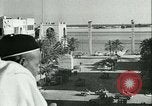
The North African Campaign, Allied invasion of Sicily, and Allied bombings of Nazi Germany during World War II.
Pictures taken by military and news cameramen during World War II. North African Campaign: The British Eighth Army enters Tripoli in Libya. Allied soldiers on tanks. Civilians and children watch as the troops move into the city. A British flag. British Army Field Marshal Harold Alexander (1st Earl Alexander of Tunis) stands in a car and greets the troops and civilians as it moves along. Allied invasion of Sicily, 1943: Field Marshal Alexander's British Dominion and U.S. forces advance. The task force underway off the Sicily coast. Soldiers get off landing ships and crafts. They wade through shallow water and advance inward on the beach. Germany: Allied aircraft in flight. The airplanes bomb Nazi industries. The aircraft bay doors open, bombs away as bombs are released, and they descend towards the target area. Smoke due to the explosions.
Internees from Brussels at the Buchenwald concentration camp interviewed in Germany.
Internees at a concentration camp in Buchenwald, Germany. Jean Blume, leader of socialist national movement against occupation in Belgium, shares his experiences of the days spent as a prisoner at Breendonk concentration camp in Belgium. He expresses joy at being liberated by American Army from Buchenwald concentration camp. (Note: Jean Blume was a Resistance Leader during the Nazi occupation in World War 2. The Gestapo arrested him on January 19, 1943 and he was imprisoned in Breendonk. In May 1944, he and many others, were sent to Buchenwald. They were released on April 11, 1945.)