


 Francais
 Deutsch
 Italiano
Refine Your Search
+"Germany" +1945 stock footage and images
- Showing 55 to 60 of 2006 results more
more Hide
Hide
Aircraft strafing industrial targets in Germany near end of World War II in Europe
Aircraft strafing a factory. Dark view of strafing railroad. Aircraft industrial targets in Germany in 1945, near the end of World War Two in Europe.
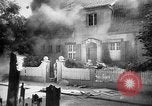
Russian feature film reenacting Soviet forces advancing in Germany and a German civilian family prepares to leave their house
From a Russian feature film "Meeting on the Elbe" (dubbed in Korean). Reenactment of the "East Meets West" meeting of the American and Russian soldiers at the River Elbe near Torgau Germany on April 25, 1945. Reenactment : A burning house. Smoke rising from the house. Russian troops in tanks move along the road in front of the house. The interiors of the house of a German civilian. The damaged interiors of the house. The German civilian rushes with his baggage. A Russian soldier behind the civilian. The civilian sits in a chair with the baggage. A girl and a boy beside the man sitting in the chair. A man in the room talks to the soldier. The civilian with the woman and the boy beside him. A soldier outside the entrance gate to the house as Russian forces take over the German town. (World War II period).
Views of captured Me 262 factory at Walpersberg, Kahla, Germany, near the end of World War 2
Scenes of captured site where Me 262 jet aircraft were assembled by Flugzeugwerke Reichsmarschall Hermann Göring (or Goering) (REIMAHG) in an old porcelain sand mine in the Walpersberg mountain, near Kahla. Germany. (The secret project was codenamed "Lachs" or Salmon). View of a tunnel entrance, from inside. .A partial Me 262 with wings, is silhouetted against tunnel entrance and several in stages of assembly can be seen darkly inside.a bombproof bunker. A middle/rear fuselage of an Me 262 is seen on a wagon outside the bunker buildings. Two bombproof bunker buildings are seen on their own. A tall derrick crane is seen moving objects from the facility. (Existing mining tunnels within the Walpersberg razorback mountain were expanded for production and bombproof buildings were constructed around its perimeter. An inclined lift was used to raise Me 262's from the perimeter building area to the top of the mountain, where a takeoff strip had been created for delivery of the aircraft to the Luftwaffe. The U.S. Army occupied the site on April 12th 1945, and reportedly removed enough partial assemblies and parts to produce five Me 262s for testing and research.)
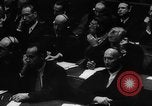
Nazi criminals are questioned during the Nuremberg Trials in Nuremberg, Germany.
Events related to the Nuremberg Trials held at the Palace of Justice (Fürther Str. 110, 90429 Nürnberg, Germany) in Nuremberg, Germany. German attorneys defend the accused. One by one the accused are cross examined. Rosenberg is examined on the count of high mortality rate among Russian prisoners of war. Joachim von Ribbentrop is questioned about the military pressure on Russian from Germany. Goering is questioned about his knowledge of the policy to exterminate Jews. Speer testifies about negative things Hitler said about Goering in response to Goering's telegram suggesting that Goering took power in April 1945.
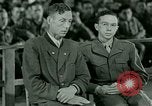
Testimony of Franz Strasser, questioning by prosecutor, and sentence given during military commission trial in Dachau, Germany.
Nazi Kreisleiter Franz Strasser on trial in Dachau, Germany, before a U.S. Army military commission, for the shooting of unarmed United States Army Air Force flyer prisoners on December 9, 1945. Other officers and soldiers in the courtroom. Defendant Franz Strasser is questioned about landing of an American plane, call to the police, the American flyers in custody of Police Chief Lindemeyer, and Strasser's knowledge of whether the flyers were unarmed. Frans Strasser answers the questions through an interpreter. Commission officers and United States flag seen on stage. U.S. Army commission judge delivers the commission verdict of guilty, and states that Strasser is sentenced to death by hanging. The interpreter reads aloud in German the verdict and sentence to Strasser. (World War II period).
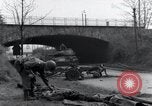
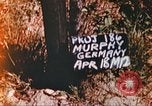
U.S. Army officer identifies remains of American soldiers killed in final days of World War II, in Hilden, Germany.
A U.S. Army Captain examines bodies of American soldiers of the 46th Tank Battalion, 13th Armored Division, killed when their Sherman M4 tank was struck by panzerfaust anti-tank weapons and 20mm fire, on April 17, 1945, in the final days of World War 2, in Europe. The wrecked tank and human remains are seen at the intersection of Ellerstraße & Hülsenstraße, in Hilden Germany. Closeup of the Captain looking closely at the dog tags of one dead soldier. Next, he is seen checking the dog tags of other dead tank crew members, as local German townspeople watch from nearby. He and another officer cover the bodies with a large tarpaulin.