


 Francais
 Deutsch
 Italiano
Refine Your Search
+"Germany" +1945 stock footage and images
- Showing 49 to 54 of 2006 results more
more Hide
Hide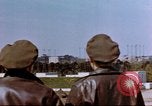
United States Airmen visit the Zeppelinfeld and Zeppelintribüne in Nuremberg, Germany
Activities of United States Airmen in Germany very soon after end of World War II in Europe. United States Army Air Forces Lieutenants visiting the war-damaged Zeppelintribüne, at the zeppelinfeld, in Nuremberg, Germany, 1945. They climb the stairs of the Zeppelintribüne grandstand. Later, the American soldiers look at the remains of the Swastika and Eagle that formerly adorned the Zeppelintribüne, and was blown up by the U.S. Army. One tries to pick up a piece of it. Airmen stand and chat. One Lieutenant helps another to lit up a cigarette. They smoke cigarettes, and pose for a photograph on the field.
Trucks loaded with refugees and their luggage drive past through the streets in Ulm Germany.
Mass movement of German refugees in Germany during World War II. Trucks loaded with the refugees and their luggage drive past on streets in region of Ulm, Germany. A group of refugees rests alongside a highway with their luggage. They load their luggage on a truck. A directional board on a street. Second part of clip is from September 13, 1945, again at Ulm: At a railroad train station: German refugees gathered at the station with their luggage. A blond German girl child sits on a suitcase. A German family stands at the door of a boxcar.
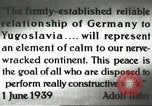
Tripartite Pact signed by Germany, Italy and Japan in Berlin, Germany. Ensuing attacks by Germany and Japan in World War II
This film is a scattering montage of World War 2 scenes from 1939 through 1945. Part of an agreement between Nazi Germany and Yugoslavia is shown in English. It is dated June 1, 1939 and ostensibly signed by Adolf Hitler. Next, German Ju 87, Stuka dive bomber aircraft are shown peeling off from formation, on April 6, 1941, to attack Yugoslavia. Bombs bursting on the ground. Closeup of a Stuka airplane in a dive, making its characteristic whine, and dropping bombs. Bombs exploding just outside some concrete walls. German infantry running along railroad tracks and entering backyard of house in a village. German soldiers observing from overlooking hill; climbing over rubble; and marching along a road toward a village. Animated map showing German invasion areas early in World War II, extending through most of Europe and into Norway, by 1941. Animated map shows further invasions into France, Belgium, low countries, the Balkans, and Eastern front towards the Soviet Union. Map highlights Tokyo, Rome, and Berlin. Delegations walking in hall of Reich Chancellery in Berlin, to sign Tripartite pact, on September 27, 1940. The group is led by by Count Galeazzo Ciano (Italian Foreign Minister, and Mussolini's son-in-law); Joachim von Ribbentrop, Germany's Foreign Minister and Japan’s Ambassador Saburō Kurusu. The diplomats are seen, next, standing near a table as Adolf Hitler enters rendering Nazi salute. He shakes hands with Count Ciano and Ambassador Kurusu. Hitler is seated to watch the proceedings. Von Ribbontrop is seen signing for Germany. Next scenes show German armored units heading East in Operation Barbarossa (June of 1941). A sign identifies the town of Eydtkau (Eydtkuhnen) on the German-Lithuanian border. German armor and artillery moving eastward. German troops destroying international crossing barriers. German troops firing siege guns. Montage with glimpses of German battle scenes showing tanks, guns, rockets in action with attendant explosions, fires, and destruction. Formations of German warplanes in flight, including Junkers Ju-52s that carry troops, including paratroops. View from above of Junkers Ju-87 Stuka dive bombers in formation. Battle of Britain scenes, with view of St. Paul's Cathedral in London, England (which miraculously survived the Blitz). The Tower Bridge in London, seen through a haze following blitzkrieg. German Junkers 87 Stuka dive bombers peeling off from formation to attack. British anti-aircraft searchlights shining beams skyward. Diving bombers illuminated by the lights. Anti-aircraft guns firing. Nighttime scenes showing gunfire flashes, explosions, tracer bullets and fires in London. British fire brigades fighting fires in London buildings as some collapse from the German bombing during the so-called "Blitz." Scene shifts to Pearl Harbor, December 7, 1941, as a Japanese bomb explodes on a U.S. Navy warship. The USS Arizona billowing smoke and listing as it succumbs to Japanese bombing. Another view of the Arizona sinking. Smoke rising from Battleship Row, at Pearl Harbor. Glimpse of postwar Nuremberg trial.
Crash landed USAAF P-47D Thunderbolt at Eschborn Airfield, Germany, near the end of World War II in Europe
Germany about a month before the end of World War 2 in Europe. A crash landed United States Army Air Force Republic P-47D Thunderbolt aircraft, nicknamed "Mom's Irish Mick." It was assigned to the 404th Fighter Squadron, 371st fighter Group, and crash landed on Advanced Landing Ground Y-74 Frankfurt/Eschborn that had been seized by advancing U.S. forces, in 1945. The aircraft carries tail number 44-33253 and was piloted by Charles T. Martin III. Officers retrieve ammunition from the wing gun. Crane brought in to lift the fighter plane also known as the Jug. Crane pulls the P-47 off field. The hulk of a Gotha 242 transport glider stands next to the American flag at half mast with air field tents in the background. A formation of P-47s flies over the flag. Four P-47s buzz and pull up with the flag in foreground. P-47s flying in 'V' formation with American flag in foreground and officers on the ground. Four P-47s circle for landing. A North American T-6 Texan training plane, a.k.a. Harvard, with occupants in both cockpits, taking off and pulling up.
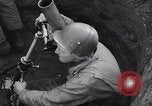
United States 81 mm mortar crews fire shells at enemy targets in Germany during World War II
American soldiers in fortified position firing 81mm mortar in support of U.S. infantry in Germany during final months of World War 2, in Europe. Early in February,1945, U.S. soldiers of Company M, 3rd Battalion, 313th Regiment, 79th Division, are seen supplementing their ammunition with captured German 80mm mortar shells. Closeup of the U.S. 81mm mortar shell next to a German 80mm shell. M Company soldiers firing the German shells from their 81mm mortars at German targets across the Mulde River. They are operating amongst homes in a residential area. Explosions in distance from the mortar shells.
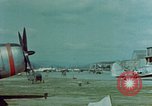
American P-47 aircraft at an Allied occupied airfield in Germany.
Aircraft P-47s parked around hangars at Allied occupied airfield in Germany in 1945. P-47aircraft taxiing and taking off. 'Chick' written on side of one airplane. (World War II period).