


 Francais
 Deutsch
 Italiano

Refine Your Search
+"Germany" +1945 stock footage and images
- Showing 43 to 48 of 2008 results more
 Hide

Eminent prisoners including Baroness Schuschnigg, Lord Lascelles being released from a Nazi prison in the Alps in Germany.
Eminent prisoners held in Nazi German prison camps in Germany are seen being released after the Allied victory during World War II. Snow covered Alps in Germany. A villa in the mountains. Eminent prisoners released from German camps include wife of Austrian Chancellor Kurt Schuschnigg, the Baroness Schuschnigg, industrialist Fritz Thyssen, Prince Leopold of Prussia, German General Franz Halder, Anti-Nazi Pastor Martin Niemöller, Allied pilots, Lieutenant John Winant (son of American Ambassador to England), Lord George Lascelles, the nephew of King George VI, John Alexander Elphinstone, Michael Alexander, and Max de Hamel, cousin of Winston Churchill. Scene changes to Magdeburg, Germany where German General Kurt Dittmar,a Nazi radio broadcaster (Official Military Commentator of the German Armed Forces), together with his son, young soldier Berend Dittmar, surrenders to American soldiers of the U.S. Army 117th Regiment, 30th Infantry Division, on April 25, 1945.
Chief prosecutor Robert H. Jackson opens the Nuremberg War Crime Trials at the Palace of Justice in Nuremberg, Germany.
The Nuremberg War Crime Trials at the Palace of Justice (Fürther Str. 110, 90429 Nürnberg, Germany) in Nuremberg, Germany after World War II. The Palace of Justice where the proceedings of the war crime trials take place. Guards at an entrance doorway check the identity cards of the visitors. Adolf Hitler's Deputy in the Nazi Party Rudolf Walter Richard Hess, the President of the Reichstag Hermann Wilhelm Goring and Foreign Minister of Germany Joachim von Ribbentrop seated in a courtroom. Judges take their seats. Chief United States prosecutor Robert H. Jackson opens the trials. He states about crime against peace of the world. A judge states his comments. The defendants pleading to the judge. Goering attempts to make a statement and is admonished by the court. All defendants plead not guilty. From a newsreel released November 29, 1945.
German surrender scenes and views from wrecked German cities at end of World War 2
Documentary titled 'Deutschland Erwache' recounts Germany's wartime experiences. Explosion seen as the Nazi Swastika emblem is blown up on top of the Zeppelintribüne (at Zeppelinfeld) at the Nazi party rally grounds in Nuremberg in 1945 by the U.S. Army. Following explosion, the pieces from the destroyed emblem fall from the sky. Montage shows: German Prisoners Of War (POWs) marching; Ratification of the German surrender documents (from surrender two days earlier at Reims) held at Soviet headquarters in Karlshorst, Berlin, Germany on May 9, 1945. German officers present include Colonel-General Hans-Jürgen Stumpff from the Luftwaffe, Field Marshal Wilhelm Keitel as Chief of Staff of OKW, and Admiral Hans-Georg von Friedeburg as Commander-in-Chief of the Kriegsmarine. They are seen entering room and signing documents. View of Keitel signing the surrender document. Soviet Russian General looking at surrender documents. General Eisenhower, General Montgomery and others shown in brief glimpses. Stalin, Roosevelt and Churchill at Yalta. Aerial views of heavily bomb-damaged cities in Germany, including wrecked German cities of Cologne, Nuremberg, Hamburg, and Berlin. View of Brandenburg gate in background and rubble of bombing in foreground as two people carry a stretcher down the street. A wrecked street sign for the Unter Den Linden lies on the ground partially covered in mud. Ground level views of smoking ruined buildings in Berlin and a few German citizens walking on the streets following Battle of Berlin. Views of dead German soldiers on a battlefield. German soldiers helping to carry and tend to wounded and bandaged German soldiers. Large group of German citizens gathered in a public square.
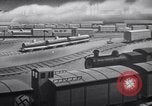
Allied bombing missions to destroy railroads and marshaling yards in occupied France and Germany during World War II
Cartoon representation of German rail yards and war factories, opens the film. Cities of : Anklam; Bremen; and Frankfurt are highlighted as critical factory and railroad junctions. Animated map shows Allied air strikes against French marshaling yards in Spring of 1944 in preparation for the invasion at Normandy. In February, 1945 Allied officers use large wall map to discuss and plan the destruction of all railroad operations in the Ruhr and surrounding areas. View of U.S. bombers in formation (with fighter cover overhead) on bombing missions in Operation Clarion, against all small and medium rail junctions in Germany. View from Allied bomber of Bombs falling and exploding at a rail junction. More aerial views of bombs exploding in numerous places during this operation. An American B-17 Flying Fortress bomber dropping bombs on a railroad marshaling yard. Aerial view of bombs exploding on targets in Essen. Views of wide destruction wrought at German railroad facilities. A US Army Air Forces P-51 fighter plane descending to strafe a target. Gun camera views of aircraft strafing lines of communication in Germany, including road and barge traffic. Closeup of runs firing from P-51 aircraft. Railroad trains being strafed and dramatic explosions at target rail sites.
Cologne Cathedral; queue of German citizens in German town; Victor pontoon bridge and wrecked Remagen Bridge in Germany
View from a ground level entrance of the partially wrecked Cathedral of Cologne in Cologne, Germany during World War 2. Scene shifts to a town or village with U.S. Army trucks passing by and German civilians in a queue, a few doors down from the Konditorei (patisserie or bakery). Directional sign pointing toward 67th Medical Evacuation Hospital implies the location is in or near Bonn, as the 67th was located there until March 31, 1945. Scene changes to an elevated view of the Rhine River from the Northwest looking toward the Victor Bridge pontoon bridge, one other pontoon bridge, and the wrecked Ludendorff Bridge (also known as the Remagen Bridge), in the distance, at Remagen, Germany.
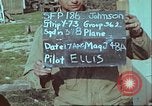
U.S. fighter planes strafe targets of opportunity in Germany, near end of Second World War
March and April, 1945. Near the end of World War 2, P-47s of the U.S. 9th and 8th Air Forces attacking ground targets in Germany. They strafe various ground targets virtually at will. One chases a German Me-109. Rapid succession of identifying slates and fragments of gun camera footage. The first involves P-47 of the 100th Fighter Wing, 362nd Fighter Group, 378th Fighter Squadron, operating out of Frankfurt, Rhein Main Airbase (Y-73) Germany. Others involve the 8th Air Force, P-51s of the 338th Fighter Squadron and possibly other units.