


 Francais
 Deutsch
 Italiano
Refine Your Search
+"Japan" +1941 stock footage and images
- Showing 31 to 36 of 84 results more
more Hide
Hide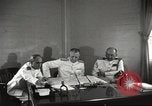
Admiral Kimmel and staff in a meeting, and U.S. Navy ships docked at Pearl Harbor, Hawaii
Admiral Husband E. Kimmel, U.S. Navy, Commander in Chief, U.S. Fleet and Pacific Fleet, (center), confers with his Chief of Staff, Captain William W. Smith, (right), and his Operations Officer and Assistant Chief of Staff, Captain Walter S. DeLany (left), at Pearl Harbor, in 1941. Closeup view of Admiral Kimmel. View of two U.S. Navy submarines and several ships docked at Pearl Harbor, and crew men working on some of the ships. USS Indianapolis (CA-35) is seen at dock. Dock crane removing a 5 inch gun from USS San Francisco (CA-38) in the beginning stages of a refit. She would still be getting refitted when the attack on Dec. 7th occurred. Covered Lighter barge YF-240 is also seen. This is the barge that was next to USS Nevada during the attack. This was filmed before the December attack on Pearl Harbor by the Empire of Japan. (World War II period).
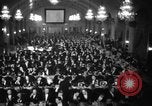
U.S. President Roosevelt talks about America's support to Britain and praises Winston Churchill during a speech in the U.S.
Excerpts from speech of U.S. President Franklin D. Roosevelt at the White House Correpondents' dinner on March 15, 1941 in Washington DC. Officials and dignitaries seated in a hall having dinner. President Roosevelt at a podium and speaks into a microphone. He speaks about people of the world supporting Britain and even Canada. He talks about America's full support to the British. Roosevelt in his speech praises British Prime Minister Winston Churchill. He also speaks about America's support in world reconstruction and humanity. Roosevelt speaks that their should not be any racism. Every one should be treated equally and have equal rights. He talks about security, standard of living, and market for manufacturing. He says of dictators in Nazi Germany and Imperial Japan, "We believe that the rallying cry of the dictators, their boasting about a master-race, will prove to be pure stuff and nonsense. There never has been, there isn't now, and there never will be, any race of people fit to serve as masters over their fellowmen."

Events on the Eastern front early in World War II; Nazi Germany battles Russia
Goosestepping German troops on the march and German Panzer I tanks moving in formation across a field in World War 2. A formation of German Fieseler Fi 156 Storch airplanes in flight overhead, accompanied by two He-111 bombers. German paratroopers jumping from Ju-52 aircraft. Grand Admiral Erich Johann Albert Raeder head of the German Navy, making a statement. Bucolic scenes of European farm country and grape vineyards, with local people harvesting crops and grapes. Soviet troops marching on parade to a military band on the sidelines in Red Square, Moscow, soviet Union. Soviet motorcycle soldiers armed with light machine guns. Soviet T-26 light tanks in formation. Glimpse of Red Square, with St. Basil's Cathedral and other famous buildings. Soviet troops crossing a river on inflated boats. A long column of T-26 tanks moving along a dirt road. Sky filled with variety of Soviet warplanes, including four-engine bombers (with fixed landing gear) to bi-wing aircraft. Soviet paratroopers jumping from a Tupolev ANT-6 bomber. They climb out on the huge corrugated wing and slide off. View out past the tail of an ANT-6 bomber. Soviet Union and Japan conclude a neutrality pact. Views of the pact being signed by Foreign Minister Vyacheslav Mikhailovich Molotov for the Soviet Union and by Japanese Foreign Minister Matsuoka and Ambassador Yoshitsugu, for the Japanese, in Moscow on April 13, 1941. Joseph Stalin is observing in the center of the scene.
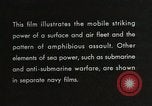
2nd Sino-Japanese war, precursor to World War II in the Pacific. Pearl Harbor attack. Early phase of Pacific conflict between Japan and the U.S.
The film 'Sea power in the Pacific' showing Japanese dominance in China and at start of World War 2. Then it chronicles U.S. efforts to build Navy and fight back on sea and in the air. Opening scene shows Japanese Mitsubishi G3M (Type 96) bombers high overhead, and then closeup in formation. View from bomber of bomb bays open with bombs falling and view from ground of explosions and destruction. Overlay on film says: "China---1931." (This is not correct. The G3M bomber was not yet in service.) This film depicts Japanese attacks during second Sino-Japanese War, commencing 1937, Chinese civilians running to escape Japanese bombing of Singapore. Buildings destroyed and on fire. Next, Japanese troops, carrying the Rising Sun flag, are seen establishing a beachhead in an Amphibious assault. More scenes of Japanese infantry advancing through Singapore, ad it is being destroyed and burned. Soldiers charging along an alleyway, with pagoda in background. Next, Japanese soldiers are seen attacking Nanking, and committing atrocities and killing Chinese during the so-called "Rape of Nanking," in December, 1937. Chinese civilians being summarily shot and dumped into a large open grave after execution. Two Chinese prisoners with hands bound, being executed by rifle fire. Jubilant Japanese troops celebrating their victory. Map shows areas of China occupied during second Sino-Japanese war and the East Indies to the South. View of oil tanks; an open pit tin mine; a native cutting rubber tree bark to collect latex. Flags on map show regions of English, French, and Dutch colonial interest. It also shows Islands to the East, fortified by the Japanese. Cartoon shows Japanese soldier opposed by and American sailor (representing U.S. Sea Power). Next, famous images of the Japanese attack on Pearl Harbor, Hawaii, December 7, 1941, are shown, including the USS Arizona burning and sinking. Hawaii, Midway, Wake, and the Philippines Islands, are highlighted on a map and Japanese control of the Pacific is illustrated. Japanese soldiers are seen displaying a captured American flag. U.S. Lieutenant General Jonathan M. Wainwright is seen surrendering the garrison at Corregidor, on May 6, 1942. View of Japanese General Masahara Homma discussing surrender terms with Wainright. Map shows interlocking web of Japanese fortified bases in Pacific and need for seapower to oppose it. View of American shipyard with hundreds of workers, employed to build ships for the war effort, in World War 2. Views welding, metal fabrication, and other shipbuilding activity. A new ship going down the ways and a woman christening a new ship with splash from bottle of champagne. A new "Liberty Ship," the Richard Bassett, going down the ways at Bethlehem-Fairfield Shipyard Inc. Baltimore, Maryland. Closeup view as the stern of another ship enters the water upon launching. View of it from a distance. Shipyard workers knock supports from under what may be a landing craft, as it is launched. Japanese warships underway in the Pacific and firing their naval guns. Explosions on a shoreline from naval bombardment. Japanese infantry wading ashore during an amphibious assault. Map shows where Japanese forces attempt an amphibious assault on Southern New Guinea, thwarted by the U.S. Navy in the battle of the Coral Sea of May, 1942. In June, 1942, a Japanese attempt against Midway Island, was again checked by the U.S. Navy in the Battle of Midway. View of USS Wasp (CV-7) carrier deck filled with airplanes, including Grumman F4F Wildcats. A Douglas SBD Dauntless dive bomber being cleared for takeoff from the Wasp. Gun camera film showing Japanese airplanes being shot down by pursuing U.S. aircraft.
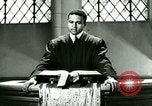
African American Preacher speaks of existential threat to Liberty posed by Nazi Germany and Imperial Japan in World War II.
African American Preacher speaking from church pulpit to his congregation about threats to Liberty, during World War 2. Closeups of parishioners listening intently. Suddenly, in contrast, the statue of a German Eagle atop a wreathed swastika is seen followed by views of Adolf Hitler looking over maps with his war planners. Next, a Japanese Rising Sun Naval Ensign flag is seen followed by views of Japanese Naval war planners aboard ship, and Japanese war planners at an Army headquarters. Glimpse of Hitler and staff amused by something at Christmas holidays. (A decorated Christmas tree stands in the background.) An entire huge apartment house collapses from German bombing in Europe. An aerial view from a bomber with smoke rising from bomb strikes below, displays labels reading: "Thirteen Countries Conquered," and "150,000,000 People Enslaved." A German officer stands beside a group of hanged persons at a public execution. Scene shifts completely to formation of Japanese Mitsubishi G4M bombers (Mitsubishi Navy Type 1 attack bombers) releasing bombs in flight. Bombs exploding at various sites on the ground. Chinese civilians fleeing from Japanese bombing during the 2nd Sino-Japanese war. Bombs bursting and destruction. Chinese rescuing wounded and collecting the dead. Japanese bombs striking U.S. battleships, at Pearl Harbor, Hawaii, on December 7, 1941. American sailors running to battle stations and firing antiaircraft guns from a ship. Formations of Japanese warplanes diving from overhead. Several U.S. Douglas SBD Dauntless dive bombers with cockpits open (possibly representing Japanese dive bombers in a movie ) drop bombs. Explosions and fires from bombing. American sailor furiously turns controls to raise elevation of antiaircraft gun. Japanese airplane streaming black smoke passes overhead. U.S. sailors scrambling to battle stations on a ship. Japanese fighter plane firing its machine guns on a strafing run passes over a ship. An African American sailor lying on a deck, fires a M1917 Browning machine gun and falls back. Another sailor takes his place.
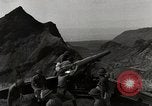
Japanese people worship in temples and salute the United States flag in Hawaii.
American soldiers practice with anti-aircraft artillery in Hawaii circa 1941-1942. People of Japanese descent visit a Shinto shrine and show respect to the United States flag. Flags of United States and Japan on display at entrance of a shrine or temple. Japanese civilians visit a Shinto shrine. They walk through a torii gate. Girls in kimono worship at the Shinto shrine. Priest bows in temple. A family of Japanese descent worships in shrine together. Japanese children carry the United States flag and hold hands over their hearts as the flag passes by during a civic ceremony. Woman serves punch at a social gathering. Men stand and talk. (World War II period, just before time of opening of internment camps and relocation centers for civilians iof Japanese descent).