


 Francais
 Deutsch
 Italiano
Refine Your Search
+"Japan" +1941 stock footage and images
- Showing 25 to 30 of 84 results more
more Hide
Hide
Japanese operations to destroy the U.S. Pacific Fleet in Pearl Harbor, Hawaii and mission on Philippines, during World War II.
Dai Toa News of Japan briefs about Nippon's operations in Pearl Harbor, Hawaii and in Philippines, during World War II. Animated map shows Japanese planes on a mission to Pearl Harbor. Japanese carriers and warships in Pacific Ocean. Commander aboard a carrier and addresses pilots. Number of bomber aircraft take off from deck of aircraft carrier one after the other. U.S. Pacific Fleet annihilated by bombers of Nippon during attack on Pearl Harbor on December 7, 1941. View of U.S. Navy ships bombed at Pearl Harbor. American War Losses. Fleet of Japanese warships in ocean.
Japanese troops and military elements moves forward to attack Manila in Philippines.
Japan's Military moves up to attack Manila in Philippines in December 1941, during World War 2. Japanese troops cross a bridge. Trucks and artillery towed. Japanese occupation soldiers move forward. Smoke rises from houses. Troops march in field and smoke rises in the background. Tanks move forward from a village. People besides road wave Flag of Japan to greet Japanese troops in City. Damaged United States aircraft on airstrip. A plane takes off. Animated map shows movement of Japanese aircraft portraying aerial attack over Corregidor.
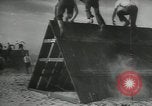
Training of American draftees before World War II; also Japanese attack on Pearl Harbor and Roosevelt's request for declaration of war.
United States soldiers and new recruits at a camp in the U.S. before outbreak of World War II. New recruits and U.S. Army soldiers in training run obstacle course. Soldiers in their uniforms march through the camp area. Tents in the background. Newly drafted U.S Army soldiers learn to fire weapons on firing range using artificial wooden rifles. U.S. soldiers seen training with wooden replica machine guns and using empty Adelphi beer cans as substitute artillery ammunition for training purposes. Teams of soldiers compete in moving a giant ball. They compete in blindfolded boxing on their knees. Lacking adequate war materiel for training, they make do by pretending that trucks are tanks and labeling them with such signs. They pretend with wooden guns and throw flour sacks instead of grenades. Scenes of the Pearl Harbor raid by the Empire of Japan on December 7, 1941. Views of the USS Arizona being hit and various ships on fire soon after the attack. United States President Franklin D. Roosevelt is seen addressing Congress, where he asks for a declaration of war against Japan.
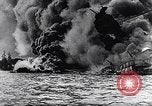
Japanese attack on Pearl Harbor in presaged by a decade of Japanese military aggression in China (WW2)
Opening scene shows the famous image of American battleship USS Arizona as attacked by Japanese forces in Pearl Harbor on December 7, 1941 in World War II. The ship is engulfed in black smoke, and listing. Change of scene to a waterfront in Japan during 1938, where numerous Japanese soldiers board troop ships bound for Manchuria, China. Next, are scenes of Japanese troops marching as they occupy Manchuria. Closeups of some Japanese soldiers. Scene shifts to a train moving on the South Manchurian railway, at a station showing a sign reading,"Chin Hsien." View of steam locomotive pulling a train away from the camera position. (Narrator states that a Japanese train, on the South Manchurian Railway, had been dynamited) This incident triggered a Japanese attack on Mukden, Manchuria. Japanese infantry are seen placing numerous bundles of reeds as a bridge across a wide, shallow, stream and proceeding to cross on their way to invade Mukden. Military supplies are carried on pack animals. In the air, overhead Japanese Mitsubishi G3M Type 96 land-based attack aircraft are seen flying in precision "V" formation. On the ground, Chinese civilians run for cover in the City of Mukden. (The date is September 18, 1931.) Glimpse of Chinese civilians looking at bombing victims on street of Mukden. Brief view of Geneva Switzerland, where League of Nations was housed. A memorial stone monument in that city to Woodrow Wilson, President of the United States and founder of the League of Nations. An entrance to the League of Nations headquarters in the Palais Wilson in Geneva, Switzerland. League delegates in session inside the Palais Wilson. A Japanese Naval Fleet, under command of Admiral Kichisaburō Nomura, is seen steaming toward the Chinese coast and begin a naval bombardment, firing their guns, 15 miles from Shanghai. Japanese Naval biplanes are seen in flight overhead. Japanese troops marching in the streets of Shanghai, as sidewalks of onlookers wave Japanese flags. Next, Japanese troops are seen marching out of Shanghai, at the insistence of the League of Nations. (Narrator states Japan signed a truce with China on May 4th, 1932.) View of Japanese troops entering further, into Mongolia. Japanese soldiers waving flag celebrating formation of the Puppet State of Manchuko in Northeast China and Inner Mongolia, in 1932. Japanese statesmen leaving the League of Nations headquarters, after Japan resigned from the League on February 24, 1933. Japanese infantry moving further into China supported by field artillery fire. Explosions from artillery and damaged buildings, as Japanese troops advance in China. Invaders using tall ladders to scale walls of a damaged fortress in China. Japanese pilots receiving briefing and boarding their Mitsubishi Ki-30 single engine light bomber aircraft at an airfield. View of them taking off and inflight, dropping bombs on Chinese targets. Aerial views of bombs exploding on ground below. Retreating Chinese army marching along the Great Wall of China. Chinese people and military forces moving their military and civilian resources deep into the Chinese interior.
A 1942-1943 film report to the American public about the progress of World War II in Europe and the Pacific.
Opening slate at start of film reads: "1942--1943 The Turn of the Tide." A column of British armor enters Bengazi, Libya, led by several troops in tankettes. Next seen are a Lee Medium Tank, M3 followed by an infantry tank, a jeep, another infantry tank and another Lee M3 Medium tank. Closeup of local people greeting the troops with upraised hands giving the "V" for victory sign. Another Lee M3 tank passes close by the camera. Black smoke is rising in the background. Scene changes to a half sunken ship near another burning in the harbor. Another view of this from further away above port buildings. Closeup of three smiling British soldiers leaning over a cartoon on a tank, of Winston Churchill (As a bulldog smoking a cigar and wearing a cap with the word "Victory" written on it). A crumpled captured flag with swastika on it. British Field Marshal Bernard Montgomery stands atop a vehicle (unseen) and looks through binoculars. Below, a column of British supply vehicles is making its way along a path in the desert. Two tanks coming toward the camera through sand. Animated map shows Nazi territory being threatened by the Allies from the Mediterranean, the USSR, and the English Channel. Views of Soviet infantry advancing against German forces in the snow of winter on the eastern front. Soviet troops firing updated 76-mm divisional gun model 1902 hidden in woods. Shells exploding in snow-covered field as Soviet BT series tanks advance. Various Soviet artillery firing from fixed gun batteries and from woods. A shell striking in distance. Fallen German soldiers lying on snowy field. Makeshift battlefield crosses marking graves of fallen German soldiers. German steel helmets lined up in the snow. A sign, posted on a birch tree, lists the names and birth dates of 16 German soldiers from the 3rd Panzer Division (3Pz-Pi-BH.39) buried at this site on November 28, 1941. Scene shifts to Joseph Stalin addressing Soviet troops in Red Square, Moscow, Russia. All the soldiers in formation seem to be singing (unheard). Film switches to animated map again. This time delineating the Eastern front being pressed by the USSR, and showing area of the 2nd Soviet winter offensive in 1943. Change of scene from Europe to the War in Asia, against Japan, shows General Douglas MacArthur after arriving by a B-17 bomber at a Pacific island American base. He ascends a steep hill in a jungle area, accompanied by other officers. Closeup of MacArthur. American infantry moving in single file in New Guinea, as a field piece fires a round in the direction they are headed. U.S. artillerymen load shells into a 105mm howitzer gun. A fire burns as mop-up operations begin on New Guinea. An Australian soldier is seen firing a Bren gun in jungles. Other Australian soldiers fire a mortar that explodes, raising earth and dust. More views of shells exploding near Allied soldier advancing. A soldier with fixed bayonet makes a fake charge toward the camera. Views of Japanese prisoners of war guarded in an outdoor compound. Japanese dead soldiers on Guadalcanal. An animated map shows new battle lines in the Pacific, closing in on Japan, with pressure from China, the USSR, and the Pacific islands being captured by the U.S. Arrows are added showing new pressure from American naval fleets and from British and American bombers out of Australia and captured islands.
Japanese footage of preparations and attack on Pearl Harbor in Hawaii
Japanese edited film footage chronicling the Japanese approach and attack on Pearl Harbor in December of 1941. Contains Japanese slates and narration. An arrow points from Japan to Hawaii and a dotted line going to United States on a map. Japanese officers on bridge of aircraft carrier. Two Japanese aircraft carrier ships, the Kaga and the Zuikaku underway in heavy seas. Flight quarters being held on carrier. Crew gets ready for attack on Pearl harbor. Japanese pilots being briefed on the mission while standing on the deck of Japanese aircraft carrier (possibly the flagship carrier, Akagi). Japanese pilots on flight deck scatter towards their planes. Single engined planes on flight deck. Japanese planes take off in formation. Map of Hawaiian Islands. Japanese bombers in flight. Bombing on Pearl Harbor. Fire and smoke seen due to explosions. Pictures of Japanese Navy officers who attacked Pearl Harbor in suicide submarines. (World War II period).