


 Francais
 Deutsch
 Italiano

Refine Your Search
+"Japan" +1942 stock footage and images
- Showing 1 to 6 of 102 results more
 Hide
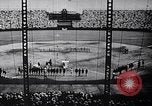
US baseball players visit Japan in 1931; also anti-Japanese propaganda circa 1941-1942 during World War 2.
Huge crowd attends baseball game between visiting American players and Japanese team in Tokyo, 1931. Lou Gehrig, Al Simmons and Lefty Grove mentioned by announcer but not seen. American representatives walk out to pitcher's mound to greet pitcher. Shots of Babe Ruth hitting. Shots of Japanese player rounding third, sliding safely into home. Film suddenly morphs into anti-Japanese propaganda circa 1941-1942; shows Japanese newspaper publisher who was murdered. Scenes of sumo wresting and judo and kendo seen and compared to alleged acts of Japanese diplomatic and military treachery and spying. Shots of fishermen, tourists, barbers and others said to be spies and soldiers for Tokyo. Closeup of a Japanese man gardening. Japanese men on small fishing boats, raising boat sails, and pulling in heavy loads of tuna fish in nets. Japanese tourists supposedly taking photographs of American ships in Hawaii. Female Japanese barbers giving haircuts. Japanese military officials in Japan organizing papers, films, and incoming information. Japanese industrialist figure emerging from car. Scenes of Japanese industry supporting war preparations: Exterior views of Japanese factories in Osaka, textile mill operations in Tokyo, chemical plant operations in Nagoya, steel mills, and a large newly completed ship being launched in Nagasaki. Overhead view of steel mill operations. View of a slum town area in Japan and simple living arrangements of Japanese citizens. Japanese laborers at work in small home factories for textiles, pottery, and other goods, said to be in "semi-slavery." Workers include men, women, and child labor. Shows production of goods said to be produced in other countries that are pirated, mislabeled by Japan, and dumped at low prices abroad to undercut competitors. Products shown include factories and production lines for spark plugs, scotch whiskey, matches, silk, cotton, bottled beer, toothbrushes, hair brushes, hair combs, and American flags produced in Japan and offered for sale at lowest prices in the United States. Shipping dock areas in Japan showing large ships at docks, cranes in use, and importing of oil, rubber, scrap iron, tin for war materiel.
A 1942-1943 film report to the American public about the progress of World War II in Europe and the Pacific.
Opening slate at start of film reads: "1942--1943 The Turn of the Tide." A column of British armor enters Bengazi, Libya, led by several troops in tankettes. Next seen are a Lee Medium Tank, M3 followed by an infantry tank, a jeep, another infantry tank and another Lee M3 Medium tank. Closeup of local people greeting the troops with upraised hands giving the "V" for victory sign. Another Lee M3 tank passes close by the camera. Black smoke is rising in the background. Scene changes to a half sunken ship near another burning in the harbor. Another view of this from further away above port buildings. Closeup of three smiling British soldiers leaning over a cartoon on a tank, of Winston Churchill (As a bulldog smoking a cigar and wearing a cap with the word "Victory" written on it). A crumpled captured flag with swastika on it. British Field Marshal Bernard Montgomery stands atop a vehicle (unseen) and looks through binoculars. Below, a column of British supply vehicles is making its way along a path in the desert. Two tanks coming toward the camera through sand. Animated map shows Nazi territory being threatened by the Allies from the Mediterranean, the USSR, and the English Channel. Views of Soviet infantry advancing against German forces in the snow of winter on the eastern front. Soviet troops firing updated 76-mm divisional gun model 1902 hidden in woods. Shells exploding in snow-covered field as Soviet BT series tanks advance. Various Soviet artillery firing from fixed gun batteries and from woods. A shell striking in distance. Fallen German soldiers lying on snowy field. Makeshift battlefield crosses marking graves of fallen German soldiers. German steel helmets lined up in the snow. A sign, posted on a birch tree, lists the names and birth dates of 16 German soldiers from the 3rd Panzer Division (3Pz-Pi-BH.39) buried at this site on November 28, 1941. Scene shifts to Joseph Stalin addressing Soviet troops in Red Square, Moscow, Russia. All the soldiers in formation seem to be singing (unheard). Film switches to animated map again. This time delineating the Eastern front being pressed by the USSR, and showing area of the 2nd Soviet winter offensive in 1943. Change of scene from Europe to the War in Asia, against Japan, shows General Douglas MacArthur after arriving by a B-17 bomber at a Pacific island American base. He ascends a steep hill in a jungle area, accompanied by other officers. Closeup of MacArthur. American infantry moving in single file in New Guinea, as a field piece fires a round in the direction they are headed. U.S. artillerymen load shells into a 105mm howitzer gun. A fire burns as mop-up operations begin on New Guinea. An Australian soldier is seen firing a Bren gun in jungles. Other Australian soldiers fire a mortar that explodes, raising earth and dust. More views of shells exploding near Allied soldier advancing. A soldier with fixed bayonet makes a fake charge toward the camera. Views of Japanese prisoners of war guarded in an outdoor compound. Japanese dead soldiers on Guadalcanal. An animated map shows new battle lines in the Pacific, closing in on Japan, with pressure from China, the USSR, and the Pacific islands being captured by the U.S. Arrows are added showing new pressure from American naval fleets and from British and American bombers out of Australia and captured islands.
1940 launching of USS Hornet (CV-8); accomplishments of USS Hornet, famous for the 1942 Doolittle Raid during World War II.
A film titled 'The Life and Death of The USS Hornet' dedicated to the workers of America's shipyards and war plants during World War II. The Capitol building in Washington DC. U.S. President Franklin Roosevelt gathered at press conference to announce the bombing of Tokyo Japan by Doolittle Raid forces in April 1942. Reporters run out to phones and typewriters. A man at NBC microphone in 1943. The headlines of newspapers read 'Japs Murder Doolittle's Fliers'. American people in groups and families listen to radio broadcasts, gathered at work and in living rooms around radios to hear the radio news. They buy newspapers at newsstands. Headline of newspaper reads "Carrier Hornet was Shangri-La". Workers at shipyard, factories, machine shops. Men and women war workers of varying ages and races, including white, Japanese-American, and African-American seen welding, machining, and working to buld the ship and its parts. Scenes from the launching of USS Hornet CV-8 in December 14, 1940, with sponsor Annie Reid Knox at the launching.
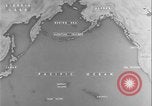
U.S. forces buildup of Aleutian Islands position following the Japanese bombing of Dutch Harbor in 1942, during World War 2
Map of the pacific including Japan, Aleutian Islands, and Alaska. Illustrated lines show various distances from the U.S. mainland to Tokyo and locations in the Aleutian Islands. Graphic zooms in on Dutch Harbor. Scene changes to footage showing the aftermath of Japanese bombing of Dutch Harbor, which took place on June 3 and 4, 1942, during WW2. A large cloud of smoke rises in the distance, more close by. People use hoses to spray out fires. Scene changes to present establishment of a U.S. position in the Aleutians. Shot of General Eugene M. Landrum, who sits on a box, smoking a pipe, wearing a scarf and hat. Wide panoramic shot of U.S. camps being assembled near a beach. Anti-aircraft gunners stand alert beside their weapon. A team of men carry a large roll of field wire through the grassy terrain to establish lines of communication.

Doolittle Raid, fleet fueling operations, 1942. World War II.
Fleet of U.S. ships underway in the Pacific Ocean to launch the Doolittle bombing raid on Tokyo, Japan, early in World War 2. Most of the film is of the Fleet Oiler, USS Sabine, AO-25 fueling aircraft carrier USS Enterprise, CV-6. At times 01:38 to 01:44, the destroyer USS Benham, DD-397, is seen on the starboard side of the USS Sabine. heavy At times 02:15 to 02:20, the fleet oiler USS Cimarron, AO-22, fueling the heavy cruiser USS Northampton, CA-26 with a destroyer and aircraft carrier USS Hornet, CV-8 in background. At times 02:22 to 02:45 fleet oiler USS Cimarron, AO-22, coming along side the USS Enterprise.
Lt. Col. James Doolittle directs the Doolittle Raid on Japan and receives an award from Madam Chiang Kai-Shek.
From a 1943 newsreel covering the Doolittle Raid on Japan in April 1942. United States Navy aircraft carrier USS Hornet (CV-8) in Japanese waters. B-25 Mitchell medium bomber planes lined up on the deck of the carrier. Lt. Col. James Doolittle and Hornet skipper Captain Marc A Mitscher with the 80 volunteers seated near a 500lb bomb on board. He ties a Japanese medal (awarded to U.S. officers for humanitarian aid to Japanese people) on the bomb. The carrier in heavy seas 800 miles off the Japanese coast. A Japanese patrol boat is sighted and sunk. The survivors are taken prisoners. The crew readies the loaded bombers. General Doolittle in the cockpit as he leads the takes off. The planes take off in rough weather to bomb Japan. The Yokosuka Naval Base bombed and ablaze. The planes bomb armed plants, rail yards and oil refineries all over Japan. Soldiers examine a wrecked B-25 in Japan. U.S. pilots hold traditional Chinese umbrellas and pose with a Chinese man. Chongqing: Soong May-ling, better known as Madame Chiang Kai-shek, awards General Doolittle and his men for the gallant raid. (World War II period).