


 Francais
 Deutsch
 Italiano
Refine Your Search
+"Japan" +1942 stock footage and images
- Showing 7 to 12 of 102 results more
more Hide
Hide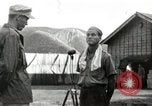
An American prisoner talks about the harsh treatment at a Japanese prison camp in Honshu, Japan during World War II.
American prisoners of war being interviewed at a Japanese prison camp in Honshu, Japan after World War II. A U.S. officer interviews a prisoner who has been liberated from a Japanese prison camp. The prisoner says that his name is James Robertson. He says that he is from St. Louis and was born in Chicago, United States. He speaks that he came to fight against the Japanese on April 22, 1941. He states that he was captured by the Japanese on May 6, 1942 in Corregidor, Philippines. He narrates an incident to prove that they were tortured at the prison camps. He also states how hot tea was poured on the legs of a prisoner.
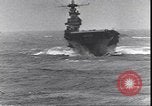
U.S. Army Air Forces B-25 Mitchell bombers take off from USS Hornet (CV-8) in the Pacific for raid on Japan during World War II.
A film based on mission of USS Hornet (CV-8) in Pacific Ocean during World War II. On 18th April, 1942 USS Hornet CV-8 underway with 16 U.S. Army Air Forces B-25 Mitchell bombers parked on flight deck to carry out Doolittle Raid on Japan. U.S. Army Air Forces Lieutenant Colonel James Doolittle, leader of the raiding force, wires a Japanese medal to a 500-pound bomb, during ceremonies on the flight deck of USS Hornet (CV-8). The B-25s are prepared for take off. The B-25s take off from flight deck of USS Hornet (CV-8). USN (United States Navy) Fleet Admiral William Halsey on the deck of USS Hornet (CV-8) looks up at B-25 in flight.
Japanese General discusses first American air raid on Tokyo, Japan, in World War II. Captured American fliers in custody
Several blindfolded American fliers are seen being taken from an airplane. They are crew of the 16th B-25 comprising the famous "Doolittle"s Raiders." (Their aircraft was serial number: 40-2268, nicknamed: "Bat Out of Hell." Low on fuel, they were captured after bailing out near Japanese occupied Nangchang City, China, on April 18, 1942.) Captured American pilot, Lieutenant William .G. Farrow, is seen smoking a cigarette, while being escorted by Japanese soldiers, out of a building. With him are members of his crew: co-pilot, Lieutenant Robert L. Hite; Navigator, Lieutenant George Barr; Bombardier, Staff Sergeant, Jacob DeShazer; and Engineer Gunner, Sergeant Harold A. Spatz They pose for a group photograph on the steps, with the officer crew members on the top step and the two enlisted crew members a step below. (Lieutenant Farrow and Sergeant Spatz were executed by the Japanese on Oct. 15, 1942, at Kiangwan Cemetery, Shanghai, China.)
Training film about The Battle of Coral Sea between Japanese and United States Navy and Air forces in the Pacific Ocean (WW2)
A 1950 United States Naval Training Film about the 1942 Battle of Coral Sea in World War II. Film titled 'The Battle of The Coral Sea'. Diagram shows the location of Coral Sea on the globe. Phase I of the battle from 1st to 4th May described. II Phase from 4th to 7th May explained. III Phase 7th to 11th May, of the battle that saw double action from both sides discussed. Animation shows the area captured by Japan after the battle. Japanese cut communication between United States and Australia. Japanese battleship at sea. Japanese troops in field. Doolittle raid on japan, U.S. plan described through animation. Bombing of Tokyo. Japanese Commander in Chief Admiral Yamamoto on ship. Location of Commandant 4th Fleet. Japanese Commander gives information about U.S. planes. He talks about plans and strategies of U.S. for war. Allied forces on Japanese land. United States submarines in Japan. Japanese plan of defense explained. Two invasion forces of Japan, Moresby and Tulagi described through animation. Allies counter attack Japanese targets. Allied TF 17 and TF 11 in Japanese province. Allied attack on Tulagi, Japanese counter attack.
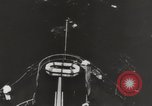
Exploits of the German Auxiliary Cruiser Thor in the Pacific Ocean during World War II
The German Auxiliary Cruiser "Thor" (Schiff 10) seeking Allied shipping targets of opportunity in the Pacific during World War 2. German Navy sailors relax on her deck. Some paint her motor launch. Several sailors in white trousers, dark jackets, and white side caps, hurry into formation where they are inspected by supervisor wearing a checkered necktie. Officers in Khaki look through binoculars as the Thors' Arado 196 float plane lands and taxis in, guided by sailor with signal flags. The pilot (possibly Flying Officer Meyer-Ahrens) is standing up in the cockpit. He reports to the bridge and exchanges salutes with Thor Captain, Kapitan-sur-Zee Günther Gumprich. Pilot discusses his flight observations with other officers. Smoke from a steaming ship seen on the horizon. An officer on the deck lights a cigar. Smoke and sound of Thor firing her 15cm deck guns. Silhouette of ocean liner SS Nankin, very low in the water. Next, life boats of the SS Nankin row toward Thor carrying passengers who climb aboard (this was on May 10, 1942). Next, the ship is seen moving in rough high seas. Smoke is seen from Thor's guns firing again, and another ship is stopped in the water. Based on profile of ship, it appears to be the Norwegian oil tanker Madrono (D/T Madrono), intercepted on July 4, 1942. Boarding party from Thor lowers away in motor launch tenders and boards the stopped ship. Sign on her says "No Smoking" in English (The Madrono was built in the UK). Armed German sailor from the Thor guards the merchant seamen on board. Glimpse of one of Thor's 15cm deck guns. Thor's sailors in German Kriegsmarine dress uniforms wave from deck, likely as ship is arriving at Japanese harbor. Japanese Naval officers board for a visit. Captain Günther Gumprich and executive officer socialize with Japanese officers. German and Japanese flags fly side-by-side. Officers and crew of German Cruiser Thor tour local sites in Japan. Two Thor sailors view Mt. Fuji.
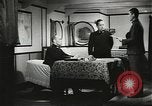
Japanese families receive news about loss of loved ones during World War II.
Excerpts from "The War at Sea From Hawaii to Malaya," a 1942 Japanese film that purports to present naval aspect of World War 2 from Japanese perspective. A Japanese radioman reports message about casualties to high ranking Japanese naval officer aboard a warship. The officer stands as the list of casualties is read. A photograph wrapped in black, of a young Japanese Naval Officer. Scene shifts to Japan, where members of a Japanese family listen to a radio news broadcast, about their son's honorable death. Another family listening to radio, his school teacher also listening. Girl in Kimono goes into an art room, kneels near the picture of a flaming ship and prays for the dead. View of a high torii (gate).