


 Francais
 Deutsch
 Italiano
Refine Your Search
+"Japan" +1942 stock footage and images
- Showing 73 to 78 of 102 results more
more Hide
Hide
Ships destroyed during Pearl Harbor attack salvaged in Hawaii.
Aftermath of Pearl Harbor attack. An animation shows a map of Japan as a fictional character Tojo makes a call from Tokyo to Nagasaki and other cities disseminating the news of Japanese attack on Pearl Harbor. He rejoices at the attack. The United States Navy ship Arizona capsized. Wreckage of damaged ships like Nevada, West Virginia, California. Navy personnel along with civil technicians start the salvage of United States ships. Men work on the ships. Ships like California, Nevada and West Virginia underway after repair. Sailors and supplies aboard the ships. Military preparations in United States to counter the Japanese attack. (World War II period).

Men work in saw mills, foundries and machine shops in Manila, Philippines during World War II..
Filipinos at work in Manila, Philippines during World War II, under Japanese occupation and colonial rule by Japan. People walk towards a factory. Filipino men work in a saw mill. Planks of wood suspended in air from a crane. Men at work. Stacks of planks of wood. Men work on machines. They hammer and saw. Men at work in a foundry. Fire burns in furnaces. Molten metal is poured. Men at work in a machine shop. Men work on machines. A man welds. A ship is launched from a dock into water.
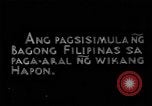
Filipino students study the Japanese language under Japanese Occupation (WW2)
Filipinos study the Japanese language during the Japanese Occupation of the Philippines in World War 2. Title card reads “Ang pagsisimula ng bagong Filipinas sa paga-aral ng wikang Hapon” (“The start of a new Philippines through learning the Japanese language” in English). A Japanese flag is displayed on a tall flagpole. Elementary schoolchildren performing physical exercises in front of a teacher playing a small piano. Schoolchildren form a circle around the teacher while dancing and singing. Schoolchildren enter school. Schoolchildren playing in the yard. Three Filipino boys sitting. A group of Filipino children sitting. Students crowd a school corridor. Children listen attentively to a teacher. A teacher writes in Japanese on a blackboard. Sign reads “Japan Cultural Hall Entrance- 219”. Young Filipino men and women attend a class in Nihongo (Japanese language). A Nihongo teacher teaches Japanese to Filipino adult students in a Japanese cultural center in Manila.
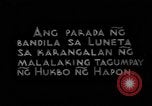
Japanese Army General Masaharu Homma reviews Japanese victory march at Luneta in Manila, Philippines.
Japanese victory march at Luneta in Manila, Philippines during World War II. Civilians stand at the side of a road. Japanese troops parade during colonial rule and occupation of Philippines by Japan. Japanese Army General Masaharu Homma reviews the parade sitting on a dais. Soldiers march holding Japanese flags. Women soldiers march. Civilians holding Japanese flags cheer. Civilians with Japanese flags in their hands march. Military officers sitting on the dais watch. Civilians march holding a huge Japanese flag. An officer addresses the crowd. A band plays. An aircraft in flight. People raise Japanese flags and cheer.
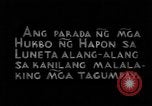
Japanese Army General Masaharu Homma reviews soldiers and army vehicles at Luneta in Manila, Philippines.
Japanese occupation of Philippines in World War 2 and beginning of colonial rule by Japan during the war. Japanese victory march at Luneta Park in Manila, Philippines during World War II. Slide in Filipino reads “Ang parada ng mga Hukbo ng Hapon sa Luneta alang-alang sa kanilang malalaking mga tagumpay” (“The Japanese Army’s parade in Luneta to celebrate their immense victories” in English). Japanese tanks in a row in Luneta Park (Ermita, Manila, 1000 Metro Manila). Soldiers blow bugles. Soldiers near the tanks. Japanese Army General Masaharu Homma on a horse followed by other men. They ride past soldiers on foot going in the opposite direction. The General reviews the troops. Cavalry units pass in review. The General salutes. Army vehicles pass in review. Soldiers in formation. Aircraft in flight. Army vehicles roll past cheering crowds standing at roadsides. People wave small Japanese flags. The vehicles move across the Ayala Bridge over the Pasig River. Sign over bridge reads “Welcome General Homma Welcome”.
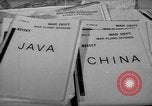
Folders of the War Plans division on a Munitions Building office table in Washington D.C (WW2)
The War Plans Division in Washington D.C during World War II. Folders on a table in an office. Inserts of individual folders marked with titles: China, India, Java, Libya, Australia, Philippines. A map of the Philippines, Japan, and surrounding countries on the table. Hands locate places on the map.