


 Francais
 Deutsch
 Italiano

Refine Your Search
+"Japan" +1942 stock footage and images
- Showing 19 to 24 of 102 results more
 Hide
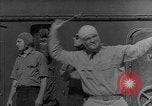
The USS Lexington entering World War II in the Pacific Theater and unrelated scenes of aircraft carrier warfare
A newsreel compilation of several unrelated shots. A P-40 of the 57th Fighter Group takes off from deck of the USS Ranger (CV-4). In an unrelated shot, a view looking back past tail of an aircraft after takeoff, with the USS Enterprise behind. A Douglas SBD Dauntless airplane takes off from a Yorktown class carrier. View back past its tail in a pre-war shot as an airplane leaves the Lexington behind. On Feb. 20, 1942, during World War 2, while en route to attack Rabaul,in New Guinea, the Lexington is attacked by eighteen Japanese planes. She shoots down several of them. Machine gunners firing. Bombs bursting in water near the ship. An F4F with collapsed landing gear near edge of flight deck. Black smoke rising from burning Japanese plane in water. Sky blackened with flak. Machine gun tracer bullets visible. Inserted scenes show the stern of a British carrier, and views of a bombing attack in the Mediterranean against a British Illustrious class carrier. Another inserted scene shows a lone sailor running the length of the flight deck on the USS Enterprise in the Battle of Santa Cruz. A Japanese airplane bursts into flames. Another is struck and dives trailing smoke.( An inserted view of U.S. Douglas TBD Devastators peeling off and launching torpedoes.) Douglas Dauntless aircraft recovering back on the Lexington. Flight deck full of aircraft as the Lexington makes way in the Pacific. Animated segment showing numerous drawings of aircraft carriers and airplanes headed toward Japan. (Inserted view of Four U.S. aircraft carriers, USS Lexington, USS Ranger, USS Yorktown, and USS Enterprise seen together in prewar maneuvers.)
The Americans surrender in the Battle of Corregidor and General Homma takes over the Philippines during World War II.
An orientation film titled ' Westward is Bataan' about Japanese capture of the Philippines and the Americans surrender during World War II. Scenes of destruction from the Japanese attack on Pearl Harbor in Hawaii, United States on December 7, 1941. U.S. ships being strafed and explosions occur. Excerpts from Japanese newsreel showing surrender of U.S. forces at Corregidor. United States soldiers in Corregidor, Philippines. U.S. Army General Jonathan Wainwright meets Japanese officers to surrender during the Battle of Corregidor. Japanese soldiers near Heam Battery on May 6, 1942. Japanese soldiers remove the American flag from a pole to raise the Japanese flag after the surrender. People celebrate Japanese victory in Tokyo, Japan. In Manila people gather along the streets as they wave the Japanese flags to welcome Japanese General Masaharu Homma. General Homma enters a building. Japanese soldiers parade as they carry the remains of the soldiers who lost their lives during the Battle of Corregidor. The boxes carrying the remains of the dead Japanese soldiers being handed over to Japanese women at a ceremony.
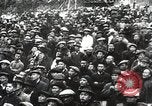
U.S. Army Air Forces employ air power in the India-Burma theater during World War II. Chinese troops are equipped and trained by U.S. soldiers.
Camera pans across scenes showing masses of Chinese. Narrator cites their large population as a war asset. Lt Gen. Daniel Sultan Commander of US Forces, India–Burma Theater (USFIBT) describes the Allied mission as simply "placing guns in the hands of men in order that they can kill our common enemy." He describes Japan's 1942 strategy of completely isolating China from outside help. Animated map shows Japanese forces attacking China from bases in Thailand and advancing north, driving British forces into India, and leaving Burma in Japanese hands.Glimpse of Japanese troops occupying Burma. Views of American troops evacuated to India. View of Chinese soldiers boarding U.S. Air Transport Command C-46 transport planes for flights from Kunming to Dinjan and Chabua, India. Closeup of some troops inside the cabin of a plane. Chinese soldiers await transport as a C-47 aircraft takes off in the background. Aerial view of two C-47 planes in formation. View from the air of high cloud covered mountains. Storm clouds over the mountains. Downward view from an aircraft flying over the Himalayan Mountains (called flying the "hump" by U.S. pilots). View of Chinese soldiers inside a transport plane. View out the window of a transport plane landing in India. A C-46 airplane taking off. A large formation of Chinese troops seen after more were brought from China to India, later in the war. American soldiers training troops of the Chinese 38th and 22nd Divisions. General Sultan speaks of the need to build up the U.S.Air Transport Command. Two C-47 airplanes on the ground. One named "The Joker." View of sky filled with B-24 Liberator bombers. Sky filled with C-47 transport planes. Chinese soldiers training in Kunming, climbing out of trench in live fire exercise with machine guns firing over their heads and explosive charges detonating near them. Air frame of a P-47 aircraft being loaded and several of Bell P-39 Airacobra aircraft being loaded aboard ship bound to strengthen the U.S. Army 10th and 14th Air Forces in Burma, in 1944. Covered P-47 aircraft without engines being towed by jeeps along a street in Burma. A large airfield with many U.S. fighter planes parked on its ramps. Engines being installed on P-39 aircraft. A flight line filled with P-40 aircraft displaying Chinese roundels. Some fly over a flight line of U.S. Army Air Forces P-39 aircraft. Glimpse of a fighter plane escorting a transport aircraft. A formation of B-24 Liberator bombers dropping bombs and exploding on Japanese ground targets. Workers are seen unloading large amounts of cargo from a B-24 bomber. Workers rolling a large bomb from the plane onto the tailgate of a truck.
Launching of the new U.S. Navy aircraft carrier USS Shangri-La (CV-38), her name honoring the historic Doolittle Raid on Tokyo
USS aircraft carrier USS Shangri-La (CV-38) being launched from Norfolk Naval Shipyard. Mrs. Josephine Doolittle sponsors the USS aircraft carrier. Crowd cheers as the USS Shangri-La is launched. Flashbacks show B-25 aircrafts taking off from the USS Hornet to bomb Tokyo Japan in the Doolittle Raid of April 18, 1942. The base identified for that attack had been the non-existent "Shangri-La". U.S. President Roosevelt decorates General James Doolittle who was the Commander of Doolittle Raid. USS Shangri-La is christened and slides into the waters at Norfolk. (World War II period).

President Roosevelt addresses congress after attack on Pearl Harbor in 1941; civilians enlist in U.S. military for World War 2
World-wide wartime activities during 1941 and 1942. President Roosevelt addresses Congress after the attack on Pearl Harbor in 1941. Crowd applauds. Citizens and cars stopped in busy New York listening to the news on the radio being broadcast regarding the declaration of war against Japan. Long queues and lines of civilian men get registered in the U.S. army as recruits are called up. Men taking oath of U.S. military service in New York and Washington DC (on U.S. Capitol steps) and other cities in mass recruitment events. New recruits stand in line in a city to register for U.S. Navy or U.S. Army service. New recruits shown include baseball star Joe Dimaggio, boxer Joe Louis, John Aspinwall Roosevelt (who was President Roosevelt's youngest son), Tyrone Power, Clark Gable, Douglas Fairbanks Junior, and Warren Pershing (son of famed General John Pershing) all seen registering to enter military service. Justice Frank Murphy of the U.S. Supreme Court is seen operating a machine gun during training. Another scene with a mass group of recruits standing and taking an oath of military service.

Broadcasters announce Japanese Naval victories
Japanese Naval officers and civilian broadcasters announce Japanese Naval victories off the Netherlands East Indies and off Malaya. Japanese planes bomb British naval battleships Repulse and Prince of Wales off Malaya. Flashback shows Vessels.1942. (World War II period).