


 Francais
 Deutsch
 Italiano
Refine Your Search
+"Japan" +1944 stock footage and images
- Showing 79 to 84 of 106 results more
more Hide
Hide
Launching of the new U.S. Navy aircraft carrier USS Shangri-La (CV-38), her name honoring the historic Doolittle Raid on Tokyo
USS aircraft carrier USS Shangri-La (CV-38) being launched from Norfolk Naval Shipyard. Mrs. Josephine Doolittle sponsors the USS aircraft carrier. Crowd cheers as the USS Shangri-La is launched. Flashbacks show B-25 aircrafts taking off from the USS Hornet to bomb Tokyo Japan in the Doolittle Raid of April 18, 1942. The base identified for that attack had been the non-existent "Shangri-La". U.S. President Roosevelt decorates General James Doolittle who was the Commander of Doolittle Raid. USS Shangri-La is christened and slides into the waters at Norfolk. (World War II period).
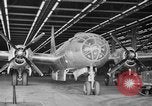
New B-29 plane towed out of a plant and takes off in the United States during World War II.
U.S. Army Air Forces film about B-29 aircraft construction. A completed B-29 bomber towed out of the construction factory during World War 2. Wheels of the bomber. Workers in plant weld, bolt and do other work to complete another B-29 plane. Women and men war production workers seen working in the plant look up and smile on hearing one of the new B-29 aircraft in flight overhead. Aerial views of B-29 in flight. Wing area and tactical gear of the plane. Close-up view of revolutionary flap design that constitutes one fifth of the wing area. Flaps shown moving on the aircraft. Close-up view of landing gear descending. B-29 aircraft lands. View of guns mounted on plane. Pilots shake hands with crew member. B-29 flight crew in briefing to receive information about bombing objective over Japan. Laborers assisting with loading and unloading the aircraft. B-29 taking off and again seen in flight.
U.S. airmen preparing 318th Fighter Group P-47 planes for strike missions during Pacific campaign, Saipan Island.
Preparing fighter planes for strike missions against Japan, Island of Saipan, Mariana Islands in World War II. P-47 Thunderbolts serviced and readied for strafing, dive bombing, and fire bomb strikes by U.S. personnel on Aslito Airfield. 318th Fighter Group Commander Colonel L. M. Sanders discusses the next strike with 19th Squadron Commander Major Harry McAfee. Pilots are briefed by officer. Men preparing planes for strike missions. A man holding Japanese flag. Man working on wing of P-47 Thunderbolt fighter. Soldier loads 50 cal machine gun belt onto aircraft. Demolition bombs transported on airfield. Men loads bombs and rockets onto a P-47.
P-47s of USAAF 318th Fighter Group encounter heavy antiaircraft fire while strafing Japanese targets on Tinian in World War II
Battle of the Pacific during World War 2, fought on the island of Tinian, Mariana Islands. P-47 Thunderbolt aircraft, of the 318th Fighter Group, drop the Napalm on the island. Smoke billowing up from Napalm incendiary bomb explosions on island. P-47 dive bombing enemy positions on island. Tracers being fired to and from P-47s. Smoke rising from explosions in jungle. P-47 strafing buildings near the shoreline. Heavy antiaircraft and ground fire from forces of Japan at the planes as they dive. P-47, number 42-75304 of the 333rd Fighter Squadron, is seen closeup.

Allied Naval fleet attack Japanese installations on Guam.
Dramatization shows a Japanese man giving a radio message in Tokyo, Japan. Montage shows workers doing welding, working at aircraft plant, cutting metal beam, handling ingot and doing other activities. Allied ships fire at Japanese installations on Guam. Japanese planes shot down in dogfights. Allied troops aboard landing crafts reach the shore under heavy enemy fire. (World War II period).
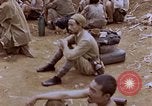
U.S. forces plan airbase construction after the battle of Saipan during World War II
America forces begin preparing Saipan as an advance base in the Pacific campaign against Japan in World War 2. Japanese military prisoners as well as civilian women and children are seated on the ground, shaded by a tree on a coastal plain in Saipan. American officers review a map laid out on the hood of a jeep. They converse in a group as they stand near a rudimentary small gauge railroad track in the sand. Sheer cliffs are close behind them and the ocean is nearby. A jeep is seen parked and another moves along a bumpy path. Officers and soldiers stand on and near the small gauge rail line. Several jeeps are parked. Camera pans over sheer cliffs behind. (Some contain openings that housed Japanese fortifications.) Camera pans over wide flat area where the Japanese were building an airfield near Marpi Point on the northern end of the island of Saipan. Construction materials cover the area and several jeeps travel through it. Final scene shows more Japanese civilians in a group where several American soldiers are attending to their needs.