


 Francais
 Deutsch
 Italiano
Refine Your Search
+"Japan" +1944 stock footage and images
- Showing 73 to 78 of 106 results more
more Hide
Hide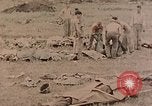
1st Marine Division bury fallen Marines from battle of Peleliu, Palau Islands, in World War II
Burial of dead U.S. Marines, from battle of Peleliu, Palau Islands against Japan in World War 2. (Location is likely, island of Bliliou near Village of Teliu.) The covered bodies of fallen Marines are set out on litters. Later, Marines, wearing arm length black rubber gloves, lower the bodies into graves. A caterpillar tractor with bulldozer attachment smooths earth over the line of grave sites each dug in a row.
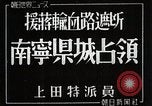
Japanese troops attack and capture Nanning in China.
Japanese troops capture Nanning in China. Japanese troops march amidst mountains in China. They march with artillery. They cross Ford River by wading with horses. Japanese troops attack city. Explosions in city. The flag of Japan. Japanese troops march on horseback. View of victory march. (World War II period).
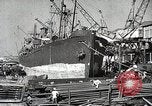
Construction of India-Burma-China Pipeline during World War II
Opening scene shows a large transport ship at a dock in Calcutta, India, during World War 2. It is surrounded by cranes unloading it. In the foreground, numerous sections of pipe are piled up on the dock. Closeup of group of pipe sections being lifted by crane from the ship's hold. Some individual pipes are seen moved by groups of Indian workers carrying them over their heads. Other Indian workers roll pipe sections onto barges that are seen clustered together near a steel bridge. A convoy of trucks is seen carrying the pipe sections along the Ledo road. Some bundles of pipe sections are carried on jeeps. View of an Army Air Forces C-47 transport plane taking off. Sections of pipe being offloaded from a C-47 plane. Numerous pipe sections in organized stacks near the airfield. Sections of pipe being fastened together. Engineers re-condition the road bed using construction equipment. Long connected pipe lines being pulled through water. Caterpillar tractors working on a muddy section of the road. Workers installing pipe near graves of workers who died from disease and other causes. Workers sending a bundle of pipe segments across a river by means of a Zip line. A worker's camp of tents in the background. Workers dressed in rain gear and boots carrying a pipe section through water during the Monsoon. Workers using machetes to chop their way through jungles. An open utility train moving Chinese troops along a single-track rail line, passes pipeline workers standing aside. Engineers and other pipeline workers distributing pipe sections along the rail line from railroad flatcars. Trucks driving the road, in Burma. Various views of the pipeline in including one showing lines of pipe forming a suspension bridge across a river. Other scenes show the pipeline crossing ravines, submerged under rivers, climbing vertical cliffs. Aerial views of the pipeline from low flying aircraft. A vehicle marshaling yard filled with army vehicles. M3A3 Stuart light tank moving past a yard filled with them. Army trucks moving out of their parking yard. Aerial view of large airfield with many parked Air Transport Command C-47 airplanes. B-29 bombers being refueled at an airfield. One is seen taking off. Lieutenant General Daniel Isom Sultan, Commander India-Burma theater, comments that the pipeline is a lifeline to our beleaguered ally and that the Chinese are in on this. Views of Chinese soldiers engaged against Japanese forces. They fire artillery pieces and heavy machine guns. British soldiers carrying Bren guns and struggling to move artillery pieces in the mud. They are seen firing artillery from under camouflage canopies and firing Vickers machine guns. Aerial view of the British controlled port in Calcutta, India, where war materiel is seen being unloaded. Tanks being transported on an Indian railroad. War supplies moving on a barge line and on roads. View of a British airfield in India. North Burma Chinese troops with their weapons and army vehicles. U.S. troops advancing on roads in the jungles. Chinese Marshal Chiang Kai-shek with U.S. President Franklin D. Roosevelt and British Prime Minister Winston Churchill, at the Cairo Conference of November 22–26, 1943. General Sultan concludes the film by reassuring American soldiers that they are in the China-Burma-India theater in the common allied effort to fight against Japan.
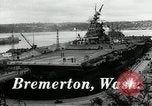
The aircraft carrier USS Bunker Hill being repaired at the Puget Sound Naval Shipyard, Bremerton, Washington, during World War II
View of the aircraft carrier, USS Bunker Hill in dry dock at Bremerton, Washington. She is being repaired after being attacked by Japanese Kamikazes during the invasion of Okinawa in World War 2, in which suffered more than 600 casualties including 346 dead and 43 missing. View of the ship's captain, George Seitz, looking over the damage to the ship. Camera shows severe damage below decks of the Bunker Hill and outside, where the flight deck is seen completely destroyed and collapsed into the ship's interior. View of a large scoreboard displaying a Japanese flag for every enemy plane downed by crew of the Bunker Hill. A sailor totals them and writes "475" on the board. Crew members are massed on shore and wave enthusiastically about returning to sea and rejoining the battle against Japan. (Note: The USS Bunker Hill repairs were not completed until after the war ended.)
U.S. campaigns against Japanese in Marshal Islands, New Britain, and Rabaul, in the Pacific during World War II
U.S. offensives against Japan in the Pacific Theater during World War 2. A United States Carrier Task Force in the Pacific Ocean. Fighter planes and dive bombers on the deck of the Task Force. Sailors push trolleys containing bombs. A map shows Marshall Islands. Douglas Dauntless dive bombers take off to strike against the enemy. U.S. Navy fighter planes engage defending Japanese aircraft and down many of them, as seen in gun camera footage. The first wave of Douglas Dauntless dive bombers returns to its carrier for refueling, rearming, and debriefing. Sailors on the aircraft carrier man anti-aircraft guns to defend against attacking Japanese aircraft. Black flak fills the sky and a number of Japanese aircraft are destroyed by the anti-aircraft fire. A Japanese bomb explodes near the flight deck of a carrier. (Narrator notes that 85 Japanese aircraft were destroyed in this one operation.)An animated map shows New Britain Island. U.S. Major General William Henry Rupertus, Commander of U.S. Marines on a ship. He looks through a pair of binoculars as a U.S. planes (B-24 Liberators) drop bombs on Rabaul. U.S. warships launch an attack at the enemy positions. Fire and explosions. The Marines load into landing craft and move towards the shore. They land behind an intense naval bombardment. Marines head ashore from beached LCI-1 Class Landing Craft Infantry (Large), number 343. M 16 tanks, equipment, and artillery roll ashore from Landing Ships Tank (LSTs). . The tanks lead the way through the jungle terrain and the marines advance behind them. Marines fire mortars as they advance. They flush out Japanese from trenches and bunkers. A damaged Japanese Mitsubishi fighter plane and wreckage of others. Some dead Japanese soldiers. The Marines wade through deep water as they push on to Rabaul. Others advance through deep mud. More views of them slogging through mud.

U.S. soldiers attack the Los Negros Island in the South Pacific and capture an airstrip from the Japanese.
Americans win new air bases from Japan in South Pacific during World War II. Americans bombers fly towards Japanese targets in the South Pacific. Planes drop bombs on enemy positions. Explosion along the coast. Smoke rises up. Animated picture show Manus in the Admiralty Islands. American troops shell the island. U.S. cavalrymen land on the Los Negros Island and march forward. Soldiers load and fire artillery. Soldiers carry the wounded on stretcher. Dead Japanese soldiers. Soldiers move towards the airstrip on the island. Wrecked Japanese planes. Heavy equipment on the airstrip. American planes at the airstrip.