


 Francais
 Deutsch
 Italiano
Refine Your Search
+"Japan" +1945 stock footage and images
- Showing 37 to 42 of 1093 results more
more Hide
Hide
U.S. 8th Regiment Combat troops during invasion of Aguni, Shimajiri District, Okinawa, Japan during World War II.
Invasion of Aguni, a village in Okinawa, Japan during World War II. Battleships at sea during invasion of Aguni in Ryukyu Islands in Japan on 9th June 1945. Artillery fired from the ships. Landing crafts carrying 8th Regiment Combat troops approach the island. The troops holding guns, advance on the island. The soldiers fire guns. The soldiers move under cover. The Japanese civilians come out of their hiding in underground shelters. A civilian and few others come out of their hiding place. The Japanese civilians being held. Women and children standing on the road. The native women prostrate before a soldier. The soldier offers them cigarettes to calm their fear. Soldiers with the women and children.
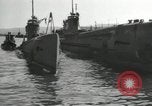
Operation Road's End, preparing to destroy Japan's submarine fleet. Crews decorate their submarines with cherry blossoms
Operation Road's End. Inspection of Japanese submarines,moored in Sasebo Bay, Japan, that are scheduled for destruction, after World War 2. View from a boat passing several of these submarines. One has a group of U.S. Naval officers and others on its deck. View of Japanese submarines I-366 and Number 107. Japanese sailors are decorating the submarines with branches of cherry blossoms. A Japanese officer looking down from boat I-402, as the camera passes below. Closeup of him posing on his boat for the camera.. Captain Atogi Nakamura, Lt. Tashio Tanaka and crew members posing aboard Japanese submarine I-58 (that sank the USS Indianapolis on July 30, 1945 with torpedos fired by Lt. Tanaka).
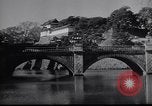
Film tracing activities of General Douglas MacArthur from defeat of Japan in World War II through Korean War (1950)
Highlights covering General Douglas MacArthur, from 1945 through 1950. The Imperial Palace in Tokyo, Japan. Several Japanese bowing towards the Palace. General Douglas MacArthur exits a car in Tokyo and walks up steps to enter his headquarters in Japan. Emperor Hirohito walks between two U.S. sentries, as he leaves a building and enters his limousine. Japanese citizens form lines on streets to cast ballots in election.Several Japanese women voting. Exterior of the Japanese National Diet building. Interior with representatives seated. A farmer behind a cultivator, pulled by an ox, in a rice paddy. Japanese school children waving American and Japanese flags together, as MacArthur leaves his Tokyo headquarters, walks down steps, and enters car. MacArthur saluting at a military ceremony, where his wife, Jean MacArthur, and son Arthur are spectators. Explosions in hills, from American Patton tank shelling North Korean positions in Korean War. American soldiers firing a mortar; infantry advancing along sides of road; and American tank commander rendering first aid to wounded comrade. United States Air Force (USAF) C-47 transport aircraft ferrying American troops into Korea, from Japan. American infantry marching across a bridge; firing mortars and rifles; and advancing on foot across fields. American troops on trucks followed by a Patton medium tank. MacArthur meeting troops on river boat; riding in a jeep; being briefed by U.S. officer in the field; examining a knocked out tank; and decorating U.S. troops in winter. Closeup of MacArthur in winter gear with his circle of five stars pined into a fur cap. Views of U.S. amphibious landing at Inchon (or Incheon) in Korean War. MacArthur watching from a ship offshore. Syngman Rhee, President of South Korea, reading message of appreciation to General MacArthur and shaking hands with him at the podium. U.S. President Harry S. Truman, pinning a medal on General MacArthur,on Wake Island in October, 1950.
U.S. orientation film for Allied occupation forces, to provide background for understanding Japanese and their society
Background information for United States occupation forces in Japan after end of World War II. At start, the film shows sky filled with U.S. Navy airplanes flying in formations. They include Vought F4U Corsair aircraft, among others, and are seen overhead above the Battleship USS Missouri (BBB-63). Closeup of the USS Missouri with her crew in formation on deck wearing dress whites. Next, General Douglas MacArthur is seen and heard speaking from a podium on the Missouri's deck. He invites the representatives of the Emperor of Japan, and the Japanese Government, and the Japanese Imperial headquarters, to sign the instrument of surrender. The date is September 2, 1945, just after the end of World War 2. Closeups of the Japanese delegation, which includes envoys Foreign Minister Mamora Shigemitsu and General Yoshijiro Umezu, and of MacArthur. Japanese Foreign Minister Mamora Shigemitsu sits at a table. Closeups of him signing the surrender document. Change of scene to Japan, where camera pans over many thousands of Japanese people assembled to learn of their fate. Closeups of Japanese soldiers and family members, as Narrator asks how should the U.S. occupying force treat them. View of soldiers in plain non-military uniforms. Views of Japanese responding en masse to a leader, during World War 2. Views of child victims of the war. Closeup of Japanese soldier firing a short barrel light machine gun. Views of Japanese pedestrians including families, most in western dress. Japanese workers in an office. Film shows artists view of one worker's brain, and then many brains, as Narrator refers to need for reorienting Japanese thinking. View of learned wise Japanese leader at a podium. View of a Japanese soldier posed with his sword above the head of a war prisoner. Japanese mother feeding her baby. Closeups of Japanese babies. Closeups of Japanese school age children, in a group, and some doing things in school, and some at a playground. Group of uniformed Japanese students studying the art of Japanese calligraphy. Students doing artwork, studying nature outdoors, and paying attention to a teacher using a black board to explain how to calculate volumes of different shaped vessels. Students in classes of Geography and of geology. Japanese chemists, architects, and lawyers at work. Telephone switchboard operators at work. Electrified train moving on a track.
Views of the United States. Farms, cities, highways, and beaches. Destruction in Japan by atomic bomb. U.S. infantry in combat
Farmers harvesting grain and corn with machinery on American farms with a narrow tractor harvester. Steel mills and heavy industry and cargo railroads in the United States. Industrial views with smokestacks releasing much smoke and smog (also pollution scenes). Scenes of New York City with busy streets filled with cars, buses, and truck traffic, together with pedestrians. Many varied 1940s and 1950s cars on the roads. Elevated and also aerial views of U.S. highway networks busy with 1940s and 1950s cars. Views of Jones Beach, on Long Island, New York. Scenes of destruction in Japan from the atomic bomb, with sweeping views of destroyed city in Hiroshima or Nagasaki circa 1945 or 1946. U.S. Army infantrymen engaged in house-to-house fighting in Europe during World War II, firing rifles and moving between points of cover in a city filled with rubble.
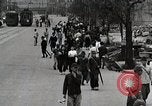
Demolished Office Buildings and Stores in Tokyo, Japan seen a month after the end of World War 2.
Shows Japanese crowd along street in Tokyo and demolished department stores and office buildings. Demolished safety deposit vault. Demolished buildings. Demolished Shinbashi theater.13 September 1945.