


 Francais
 Deutsch
 Italiano
Refine Your Search
+"Japan" +1946 stock footage and images
- Showing 19 to 24 of 317 results more
more Hide
Hide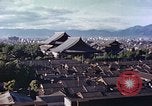
Higashi Hongan-ji Buddhist Temple and related areas in Kyoto, Japan.
Tourism in Kyoto, Japan. View of the Higashi Hongan-ji Buddhist Temple, which towers far above the tightly packed Japanese homes (Japan, 600-8505 Kyoto, Shimogyo Ward). View of the wooden Torii gate inside a Shinto shrine near the Higashi Hongan-ji. A fire breaks opposite eight-story Marubutsu Department Store (presently known as Kintetsu Department Store). Mountains in distance. Another view of Higashi Hongan-ji Buddhist Temple and related areas. A view around Kyoto Railroad Station (Higashishiokoji Kamadonocho, Shimogyo Ward, Kyoto, Japan). Rooftops of closely packed wooden houses and other buildings.
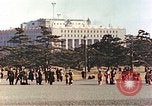
Japanese people bow in front of the gates of the Imperial Palace in Tokyo, Japan.
Japanese people in front of the gates of the Imperial Palace in Tokyo, Japan to bid the Shōwa Emperor a Happy New Year. The front of the Palace Gate shows Japanese people bowing. Dai-Ichi Building (Dn Tower 21, 1 Chome-13-1 Yurakucho, Chiyoda City, Tokyo 100-0006, Japan) in the background. A Japanese family bows in union. Before they bow, coats and hats are removed and laid under the arm. A family of two children and their parents line up and bow. The children are dressed in kimonos. Several girls line up and bow. Three girls walk along a road. A family comprising of a mother, two small children and a boy in a student's clothes take off their coats and bow together. Two women pray and bow. Grounds of the Imperial Palace in Tokyo, Japan.
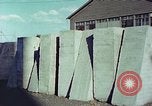
Protective measures taken to protect machinery at Japan Iron and Steel Works, Yawata from incendiary attacks of World War II.
Protective measures taken at the Japan Iron and Steel Works, Yawata (also called Yawata Steel Works) to face the incendiary attacks during World War II. Heavy reinforced concrete portable blocks used at the Japan Iron and Steel Works to protect machinery. The building opposite the river from Tokyo Electric building where gel incendiary bomb landed at an angle onto the front face of tile work. A black smudge left by the bomb. Concrete revetments used to protect transformers from blast and fragmentation at the Japan Iron and Steel at Yawata. Sand filled heavy plank walls used to protect transformers.
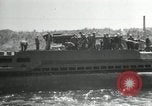
U.S. Military inspection of Japanese submarine aircraft carrier at Sasebo Bay, Japan during Operation "Road's End."
Operation "Roads End,"involving the post-war scuttling of the Japanese submarine fleet. U.S. sailors opening boxes of demolition charges on the deck of Japanese Sen Toku I-400-class submarine aircraft carrier, number I-402, moored in Sasebo Bay, Japan. (It was converted to a tanker sub, and completed only 3 weeks before the end of the war, and never placed in service. I-402 is one of only 3 such boats ever completed.) A U.S. Navy launch, approaches and ties up to the I-402. Close view of the submarine as the launch approaches. Vice Admiral Robert M. Griffin, commander of U.S. Naval Forces,Japan, a Rear Admiral, and a Captain, climb from the launch onto the submarine. Scene shifts to a smaller sub ,tied up next to the I-402, where an U.S. Army Colonel, and Navy Captain, are conferring with a Japanese officer. A utility boat is tied up in the background. The Army colonel goes into a hatch leading below decks followed by the Navy Captain. Next scene shows Admiral Griffin emerging from an open hatch on the deck of the I-402. He speaks to a navy Commander standing nearby. Empty explosives boxes, previously seen, are now stacked in a pile near the boat's conning tower. Camera shows a Japanese aircraft carrier moving past a Japanese submarine. View from deck of the I-402, showing the smaller sub to the right, and another Japanese sub, behind, with smoke rising from it. High hills overlooking the bay, in background. Admiral Griffin conversing with the Rear Admiral. Japanese crew lounging on the utility boat next to the I-402. Group of American officers conversing near the hangar door of the I-402. View downward from the conning tower, of the admirals and other officers. U.S. Army Colonel points out something on deck of nearby small submarine. An I-400 class submarine and a Japanese cruiser. Japanese sailor opens hangar door of I-402. Admiral Griffin and his aide, inspect inside. The two admirals and the Captain examining the hangar.All the American officers gathered on deck of the I-402.
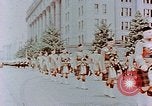
Marching troops of Commonwealth forces in front of Imperial Palace Plaza, Tokyo Japan, after World War II.
Allied military forces in Japan after World War II. Marching troops of Commonwealth forces in front of Imperial Palace Plaza, Tokyo Japan. Troops of Cameroon Highlanders, British Indian Army troops following their band in red coats, Australian Army, Canadian Army troops following their band parade one after the other. Indian Army, Royal Air Force, Royal Canadian Air Force, Royal Australian Air Force, Indian Air Force and Australian Army band during the march past.
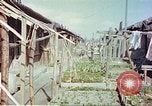
A housing plan employed for workers by Japanese mining companies in Japan after World War II.
Homes constructed for Japanese workers in Japanese cities after World War II. Homes of barracks variety which are given to those workers who are employed at the Higashi Misome Coal Mine. A Japanese woman washes small pieces of clothes in a wooden bucket in front of her home. A housing plan that is employed by the Higahu-Misome Mining Company. It further illustrates the conditions in which those homes are kept. A view from a train as it passes through various towns and cities while en route to Kyoto. The type of buildings found in most cities of Japan which were untouched in the strategic air attack against Japan