


 Francais
 Deutsch
 Italiano
Refine Your Search
+"Manila Philippines" +1946 stock footage and images
- Showing 7 to 12 of 18 results
The Philippines under Japanese occupation, liberation by allied forces, Philippine Independence ceremony.
The Philippines under Japanese occupation, liberation, and subsequent granting of independence by the United States in World War 2. Bodies of Filipino and United States soldiers killed during the Japanese invasion of the Philippines. Captured American, Filipino, and Australian soldiers raise their hands after the Fall of Corregidor. United States General Jonathan M. Wainwright negotiating the surrender of The Phillipines with Japanese General Masaharu Homma in 1942. Brigadier General Lewis C. Beebe and Major Thomas Dooley are seen to Wainwright's left. An American warship firing during the United States Pacific campaign to defeat Japanese occupying forces in the Pacific. United States soldiers get off an amphibious landing craft during the U.S. retaking of the Philippines. United States General Douglas MacArthur arrival in Leyte Gulf with a retinue consisting of Philippine President-in-exile Sergio Osmeña, Lieutenant General Richard Sutherland, Philippine Brigadier General Carlos P. Romulo, Major General Courtney Whitney, Philippine Sergeant Francisco Salveron and CBS Radio correspondent William J. Dunn in Palo, Leyte, the Philippines- a fulfillment of his promise to return to the Philippines. General Douglas MacArthur speaking at the Independence Day ceremony in Manila on July 4, 1946. “America never wavered in that purpose. America today redeems that pledge.” Says General MacArthur. United States Senator Millard Tydings, the co-sponsor of the Tydings–McDuffie Act (a law that provides independence to the Philippines after a 10-year transition as a Commonwealth) attends the ceremony. Paul V. McNutt, the United States High Commissioner of the Philippine Commonwealth (later the first United States Ambassador to the Philippines), reads the United States President Harry Truman's official proclamation of Philippine Independence. Filipino elites and United States dignitaries watch the ceremony in the Independence Grandstand (a temporary structure built in front of the Rizal Monument). Manuel Roxas being sworn in as the first President of the Philippines after gaining independence from the United States. The Philippine national anthem, Lupang Hinirang, plays in the background. High Commissioner McNutt lowers the United States flag from the flagpole as President Manuel Roxas raises the flag of the new Republic of the Philippines. A celebratory parade following the Independence ceremony takes place, which includes floats from various provinces in the country. A float with signs reading: "Let's Produce and Rebuild,". "Mountain Province" float with women wearing formal Filipino Baro’t Saya gowns. "The City of Manila" float with soldiers. "The University of the Philippines" (UP) float featuring two women dressed as allegorical figures and sign saying, “The University of the Philippines At the Service of the State”. "The Division of City Schools" float features two Filipinos in traditional attire in front of a Statue of Liberty model. A float, likely belonging to the National Library of the Philippines, with children and a huge book model. The Chamber of Commerce Philippines float contains a machine gear model and small models of an aircraft and a ship. American soldiers marching, carrying the United States flag. A military marching band play. Filipino soldiers marching with the Philippine flag. Military aircraft in flight above the Independence Grandstand in Manila.
Crowds at barricades and U.S. Color Guard carry U.S. flag during inauguration ceremony of Republic of the Philippines.
The inauguration of Republic of the Philippines after the end of World War II. Crowds at the Independence Grandstand (a temporary structure built in front of the Rizal Monument) with the American and Philippine flags on tall flag poles in Rizal Park (Luneta Park), Manila. A child stands at a barbed wire fence. U.S. Color Guard carry a U.S. flag. Crowds at a ceremony. Filipino women wearing traditional Baro’t Saya and Maria Clara dresses are seen at the ceremony.
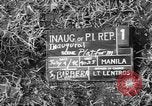
U.S. Senator Millard E Tydings and others arrive and address during inauguration ceremony of Republic of the Philippines.
Inauguration of Republic of the Philippines after the end of World War II. Crowds at barricades across the Rizal Monument in Luneta Park. U.S. Senator Millard E Tydings arrives at grandstand. General of the U.S. Army, Douglas MacArthur shakes hands with Robert Finnegan. Tydings and others in grandstand. President of Republic of Philippines Manuel Roxas shake hands with General Macarthur. Prelate makes invocations. Senator Tydings speaks. Crowds in stand. MacArthur makes a speech. U.S. ambassador Paul V. McNutt speaks. Crowds standing in rain. McNutt lowers U.S. flag from staff. MacArthur speaks to Hannegan and turns around and laughs. President Roxas speaks and takes an oath.
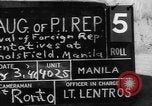
Representatives of Brazil, Argentina and Poland arrive for inauguration ceremony of Republic of the Philippines.
Inauguration of the Republic of the Philippines after the end of World War II. A man with a pet dog. Delegates at a field and pose for camera. Representatives of Brazil, Argentina, and Poland disembark from a U.S. plane. Unidentified U.S. Senators and delegates at Nichols Airfield in Manila. View of a civic parade.
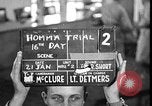
Major Tisdell talks about American surrender to the Japanese in 1942 during the trial of General Homma in Manila, Phillipines.
U.S. Army Major Achille C. Tisdell testifies before a military tribunal in Manila, Phillipines during the trial of Japanese Army General Masaharu Homma for World War II crimes. Major Tisdell, aide-de-camp to Commanding General of the American forces in Luzon Major General Edward King, speaks about the American unconditional surrender in Bataan before the Japanese forces. He recalls that an interpreter told American Commanding General Edward King to get U.S. Army General Jonathan Wainwright. General King expressed that there were no means to contact General Wainwright. He says that General King presented four conditions of surrender to the Japanese that included his return to the headquarters to notify the surrender and a 12 hour armistice. But Japanese declared that the surrender must be unconditional. General King asked if U.S. troops would be well treated. The Japanese replied that they were not barbarians.
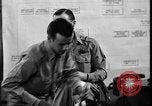
Major Tisdell says that U.S. officers were disarmed after American surrender in 1942 in Manila, Phillipines.
U.S. Army Major Achille C. Tisdell testifies before a military tribunal in Manila, Phillipines during the trial of Japanese Army General Masaharu Homma for World War II crimes. Major Tisdell, aide-de-camp to Commanding General of the American forces in Luzon Major General Edward King, speaks about the American unconditional surrender in Bataan before the Japanese forces. He recalls that an Japanese officer asked General King how many guns and tanks they had. The Japanese asked General King whether they would surrender and the General nodded his head. After this all American officers were disarmed.