


 Francais
 Deutsch
 Italiano
Refine Your Search
+"Manila Philippines" +1946 stock footage and images
- Showing 13 to 18 of 18 results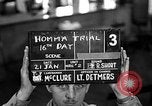
Major Tisdell speaks about events after American surrender in 1942 during the trial of General Homma in Manila, Phillipines.
U.S. Army Major Achille C. Tisdell testifies before a military tribunal in Manila, Phillipines during the trial of Japanese Army General Masaharu Homma for World War II crimes. Major Tisdell, aide-de-camp to Commanding General of the American forces in Luzon Major General Edward King, speaks about the Americans being taken to various prison camps. He says that Major General Edward King and General Jones were taken to Camp O'Donnell. He says that other officers including him were taken to a warehouse near San Fernando and from their they were taken to U.S. head quarters. Major Tisdell recalls that leaflets were dropped for the prisoners. He hands over a leaflet to a member of the tribunal. Tisdell reads out the part of the leaflet related to treatment of prisoners of war.

Major Tisdell speaks about the Battan Death March during the trial of General Homma in Manila, Phillipines.
U.S. Army Major Achille C. Tisdell testifies before a military tribunal in Manila, Phillipines during the trial of Japanese Army General Masaharu Homma for World War II crimes. Major Tisdell, aide-de-camp to Commanding General of the American forces in Luzon Major General Edward King, is being asked about the Bataan Death March and the atrocities inflicted on American prisoners. He says that while on his way to San Fernando he saw dead bodies of U.S. prisoners lying on either side of the road. The bodies were blood stained and it seemed that they were cruelly killed.
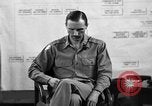
Major Tisdell describes ill treatment of prisoners at Japanese camps during the trial of General Homma in Manila, Phillipines.
U.S. Army Major Achille C. Tisdell testifies before a military tribunal in Manila, Phillipines during the trial of Japanese Army General Masaharu Homma for World War II crimes. Major Tisdell, aide-de-camp to Commanding General of the American forces in Luzon Major General Edward King is asked about how long he was at Camp O'Donnell. He says that he was there from April 13, 1942 to June 1, 1942. He recalls that at the camp the commanding officer of the prison camp addressed them. Major Tisdell being questioned about the Red Cross supplies. He says that once Red Cross food and medical supplies arrived at the camp gates but were not permitted to enter. He also speaks about the number of times he was questioned at the camp and that he was offered an opportunity to move to Manila and work for the Japanese. He says that a number of times the prisoners were beaten for no reason by the Japanese guards.
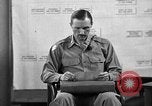
Major Tisdell reads out a Japanese note to the Americans during the trial of General Homma in Manila, Phillipines.
U.S. Army Major Achille C. Tisdell testifies before a military tribunal in Manila, Phillipines during the trial of Japanese Army General Masaharu Homma for World War II crimes. Major Tisdell, aide-de-camp to Commanding General of the American forces in Luzon Major General Edward King reads out an advisory note of the Chief of Imperial Japanese Army and Navy sent to the Americans on March 22, 1942. A member of the tribunal asks him whether there was any doubt that the Japanese had accepted the American surrender. Major Tisdell also testifies about the location of American headquarters and the surrender by the Americans.
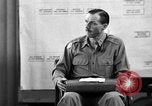
Major Tisdell speaks about time of American surrender during the trial of General Homma in Manila, Phillipines.
U.S. Army Major Achille C. Tisdell testifies before a military tribunal in Manila, Phillipines during the trial of Japanese Army General Masaharu Homma for World War II crimes. Major Tisdell, aide-de-camp to Commanding General of the American forces in Luzon Major General Edward King, is asked about a base hospital. He says that injured American soldiers were taken care of. He also says that enough ration was available for American troops in Bataan. He testifies that Major General Edward King was taken from Camp O'Donell to a camp at Tarlac. A member of the tribunal asks about the time when the order of the surrender was issued. Tisdell replies that he does not remember the exact time. He also talks about December 1941 when he worked in an artillery section in Manila. A woman at a typewriter as Major Tisdell testifies.

General MacArthur speaks on Philippine Independence Day
Filipinos attend the proclamation of Philippine independence ceremony in Manila as the United States grants independence after World War 2. Smiling crowds of Filipinos in attendance. A Filipino boy watches the ceremony while holding a hotdog on a stick, a common snack brought under American influence in the Philippines. View of the Independence Grandstand (a temporary structure built in front of the Rizal Monument) in Manila with American flag and Philippine flags on tall flag poles. United States General of the Army Douglas MacArthur gives a speech during the Philippine Independence ceremony. “with this ceremony, a new nation is born. A nation conceived in the centuries-old struggles of people to attain the political liberty to embark upon its own national destiny.” Says General Douglas MacArthur. Filipino women with umbrellas watching MacArthur’s speech. Map of the Philippines. Filipinos smiling. View of Jones Bridge, on the riverbanks of the Pasig River, connecting to the Binondo Chinatown district in Manila. The Philippine National Bank (PNB) in Escolta Street, the historic financial district of Manila. Heacock’s Department Store, selling American appliances such as Remington, with various Manila billboards such as “ASIA LIFE”, “Elizade & Co Inc. Tanduay Distillery” and “Goodrich”. The old Legislative Building (now the National Museum of the Philippines). View of the Port of Manila. Men offloading crates of sugar and hemp to be exported to markets abroad, particularly in the United States. A ship sailing away from the Port of Manila. Factory smokestacks emitting smoke. Filipinos in steel and petroleum plants. Filipinos building a vehicle on an assembly plant. People at the Philippine Legislative Building entrance. Filipinos in panic, running for shelter, after air raid siren sounds. Evacuating people board a crowded bus. Japanese bombing of Manila. Japanese tanks with soldiers enter into Manila, prominently flying the Japanese flag. Japanese soldiers wade through water on a coast, climb a steep hill. Smoke in battlefield.