


 Francais
 Deutsch
 Italiano
Refine Your Search
+"Normandy France" +1944 stock footage and images
- Showing 19 to 24 of 579 results more
more Hide
Hide
Allied troops aboard ships and gliders head for Normandy, France for the D-day invasion during World War II.
Allied invasion of Normandy, France during World War II. U.S. General Joseph McNarney, Deputy Chief of Staff at a desk as he outlines the importance of June 6, 1944 the day Allied forces attacked the Germans in Normandy. He speaks about the decision to knock down the Nazis first and then the Japanese during the World War. He says that the invasion of Normandy was planned in November 1943. He also states how General Dwight D. Eisenhower, Supreme Commander of the Allied forces in Europe, planned and executed the invasion. He also speaks about how the U.S. Army Air Forces and the Royal Air Forces aircraft bombarded the coasts of Normandy prior to the D Day invasion. Past events show American soldiers getting onto landing crafts in England as they leave for the invasion. The soldiers aboard the ships in the English Channel. The soldiers read the Bible and comics, sleep and cook aboard the ships. On June 5th , 1944 the ships head towards Normandy for the invasion. In England gliders carrying paratroopers take off from an airfield to bombard the German positions in Normandy. British soldiers receive ration and work on motorbikes. TNT (trinitrotoluene) charges being prepared by soldiers tasked with demolition duties. British soldiers check their guns and other weapons prior to the invasion. Jeep and artillery being loaded onto aircraft.
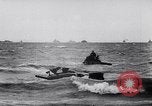
Various scenes of Allied troops participating in D-Day Invasion on beaches of Normandy France
A landing craft carrying Allied troops sinks in rough sea off beach at Normandy, France. Men are thrown in water and one of them swims to a life preserver. Smoke rises from beaches during battle. Fires dot the battlefield. British forces at Sword Beach. View of U.S. military trucks, tanks and DUKWS (amphibious truck), rolling onto the beach with U.S. Army soldiers are seen in the background. All footage from between D-Day and D-Day plus 3 (June 6 - June 9, 1944). (World War II period).
American troops in England, rehearse for the amphibious invasion of Normandy, France during World War II.
American troops rehearse amphibious landings at Slapton Sands, England in January, 1944, before the invasion of Normandy, France, in World War 2. American soldiers descend from a troop transport ship and board a Landing Craft Tank (LCT 504) that takes them toward the beach. A group of Higgins Boats is seen maneuvering in the water. Their troop transport ship is seen further offshore. Next, a Higgins Boat full of soldiers is silhouetted against the sky and the sun shining on the water. Closeup of Coast Guardsman at the tiller of the boat. Scene changes to a view from the beach as a Higgins Boat, from Transport ship, USS Samuel Chase (APA-26) hits the beach, drops its front door ramp, and soldiers rush ashore. Complete change of scene shows American troops, carrying full battle gear, coming up a gang plank to a large established port terminal, where they go up another gangplank to board a large transport ship.
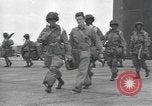
U.S. paratroopers board C-47 airplanes in England for the D Day invasion of Normandy, France in World War 2.
Paratroopers of the U.S. 502nd Parachute Infantry Regiment, 101st Airborne Division, at RAF Station, Greenham Common, proceed, in full battle gear, to board C-47 aircraft for their flight to Normandy, France, on June 5, 1944, during World War 2. Camouflage is seen on their helmets and their faces are blackened. One group is seen boarding C-47, tail number 43-15296. An officer reads briefing notes to them.They don life vests. A Captain and two Sergeants discuss briefing notes.Paratroopers help others who have difficulty climbing aboard the aircraft because of their heavy and ungainly equipment. Ninth Air Force Commander, Lieutenant General Louis H. Brereton speaks to Chaplain, Lieutenant Colonel Louis R. Goodrich, and shakes hands with some of the troopers, wishing them well, as they board C-47 number 42-92847, named, "That's All...Brother."(This was the lead aircraft for the airdrop, just behind the C-47s dropping pathfinders. It was piloted by the commander of the 438th Troop Carrier Group, Colonel John Donalson, and 87th Troop Carrier Squadron Commander, Lieutenant Colonel David Daniel.) The C-47s taxi out for takeoff, as senior officers watch them depart. (Note: There has been confusion about the name of the lead aircraft, C-47, 42-92847, because Colonel Donalson normally flew one named "Belle of Birmingham. " Research, including information from his daughter, indicate that he chose 42-92847, as lead aircraft, because it would have to be cut open to accommodate SCR 717C radar equipment, and he didn't want that done to his favorite airplane.)
Allies bring reinforcements and supplies following the succesful establishment of beachheads during the invasion of Normandy, France, in World War II
Beachhead at Normandy, France, following the Allied invasion in June, 1944 during World War 2. Numerous supply ships are in the water offshore. Landing craft are all along the beach. Military vehicles fill the beach itself. British and American troops, ashore, observe ship maneuvering near a floating dock. British infantry pour from the open ramp of large British landing craft, behind some American troops already landed and walking along the shore. American soldiers aboard a landing craft next to a transport ship. Closeup of one of the soldiers in the craft, who wears "Screaming Eagle" patch of 101st Airborne Division. The open deck of an exceptionally large landing craft is seen jammed with U.S. troops, ready to depart from a transport ship. They wave for the camera. An American army truck driving out of British Landing Ship Tank (HM 415) onto a floating dock. It makes its way behind others headed toward the shore. Closeup of soldier wielding a sledge hammer to secure pierced steel plank (Marsden Matting) onto the beach. A DUKW (duck amphibious truck). German prisoners of war, disarmed and under guard, marching casually toward the beach. Closeups of some passing the camera. View from the beach of some wading out to a waiting landing craft. View on the beach of others approaching the beach for evacuation. View shifts to captured German film depicting German coastal defenses and structures of the so-called "Atlantic Wall." German Field Marshal, Erwin Rommel, accompanied by Field Marshal, Gerd von Rundstedt, as they inspect the fortifications. Views of coastal guns. Several German soldiers, using a 4-wheel dolly, roll a huge shell and powder charge out of a bunker. They roll it toward a camouflaged railway gun. German soldiers climbing steel stairs up to the railway gun and hand-cranking the barrel into firing elevation. Marshal Rommel accompanied by a Navy admiral and a soldier, walks up to the twin barrels of a coastal defense gun. the pause directly in front of the barrels and converse. The Admiral and the soldier both salute, perhaps acknowledging a comment or order from Rommel. Extreme closeup of the gun barrels.Next, back on the beachhead, Briitish soldiers are seen walking along the beach past knocked out German fortifications and standing near other abandoned ones. A British soldier swings a sledge hammer a reinforced concrete structure on the beach. A French man and woman waving at American troops passing them. British soldiers riding in a British Universal Personnel Carrier, MK II. Two Frenchmen wave at the troops. In nearby town, British soldiers are happily greeted by local inhabitants, including a woman with a baby on the sidewalk; children looking out a window; and people gathered at a street corner. A British soldier holds a French boy and offers him a piece of candy. An American M7 ("Priest") self-propelled 105mm howitzer and armed with a 12.7mm anti-aircraft machine gun. It moves through an intersection controlled by an MP (military policeman). Another one named "Apache" follows it. Local French inhabitants cheering the Americans as they pass through the town. An American soldier stands near several children as a DUKW amphibious truck veers somewhat, to avoid them while passing. He bends down to talk to the children and shares some candy with them. Infantrymen walk into a town, keeping close to buildings on both sides of the street. French men,women, and children wave and show "V for Victory" signs as some military policemen walk past.

Infantry, artillery, and warplanes during the D-Day invasion by Allies in Normandy, France during World War 2.
The D-Day assault on Normandy by the Allies, against Germany's conquest in World War 2. Troops of infantry, artillery and tanks, warplanes ready assembled in south of England for attack at Normandy in France on June 06, 1944. Supreme Commander General Dwight D. Eisenhower and British General Montgomery in discussion with each other. B-17 bombers on mission to Nazi bases. Soldiers move from warships to landing crafts, and land on the coast of Normandy under enemy fire. Parachute troops jump from aircraft landing behind enemy lines. Surrendered German soldiers march, guarded by Allied soldiers. From a June 13, 1963 newsreel recounting events years earlier.