


 Francais
 Deutsch
 Italiano
Refine Your Search
+"Nuremberg Germany" +1945 stock footage and images
- Showing 55 to 60 of 66 results more
more Hide
Hide
The Soviet Red Army arrives after defeating the Nazis and a new government is formed in Germany after World War II.
Images from late in World War II in Europe. Nighttime views of aerial bombardment of Germany late in World War II. Aerial view of many fires and explosions on ground in Germany at night as seen from Allied aircraft. Hermann Goering touring ruins in a German city. A lineup of new German Army recruits late in the war, including a very young boy soldier in full Army uniform, talking to an official who, from the back, appears to be Joseph Goebbels. Allies advancing into Berlin. Artillery and rockets being fired during Battle of Berlin. A German civilian woman walking among rubble and ruins in a German city. Victory celebrations in Paris during he liberation of Paris. Crowds in Paris cheering happily, view of Arc de Triomphe with band marching. View of Winston Churchill and Charles de Gaulle walking side-by-side down a Paris boulevard as crowds cheer them. Soviet (?) military personnel wearing large improvised warm shoes walk in a snowy climate, exhausted. View of explosion as Nazi Swastika atop grandstand at Zeppelin field (Zeppelinfeld) in Nuremberg, Germany, is blown up by the U.S. Army after the defeat of Germany.
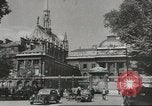
Comparison of post World War 1 and post World War 2 war crimes trials.
A court trial in session. Fascist Pietro Caruso of Italy in court. Norwegian Army officer Vidkun Quisling in court. General Henri-Philippe Petain of France. French politician Pierre Laval in court speaking forcefully. Prosecutors gesturing. Nazi Hermann Goering. Nazi generals being arrested at end of World War II including Field Marshal von Rundstedt. Germany's Kaiser Wilhlem II and General Staff during World War I. Henry Lloyd George of Britain, after World War I. Kaiser Wilhelm II, residing in Holland, after World War I. He smoke a cigarette and throws wood into a pile using his right hand. A post-war aerial view of bomb-damaged Nuremberg, Germany. The court house of Nuremberg. U.S. chief prosecutor Robert Houghwout Jackson on walk outside the Nuremberg courthouse. Enactment of British Courtroom scene. View from above of Red Square in Moscow, Russia, Soviet Union. View of a Soviet court in session.
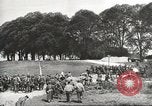
Russian and American forces in Torgau; German officials sign surrender documents at the end of World War II.
German officials surrender at the end of World War II. American and Russian troops meet near the river Elbe in Torgau Germany. United States General Reinhardt meets Soviet Army General Rusakov. Representatives of the German Army, wearing civilian clothing, sign a surrender document at Allied Mediterranean Headquarters in Italy, yielding Italy and Austria. W.D. Morgan signs for the Allies, on behalf of Supreme Mediterranean Commander Alexander. Massive American Flag raised to cover the giant swastika symbol at outdoor stadium in Nuremberg. Then in a later shot, explosion is seen as the Nazi Swastika symbol is destroyed (blown-up) by American troops at the Zeppelinfeld stadium in Nuremberg, Germany.
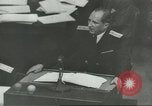
Hans Frank describes the atrocities inflicted on prisoners by the Nazis; Hoess testifies; footage of atrocity evidence.
During Nuremberg trial Hans Frank describes the Nazi policies of exterminating Poles and others. Atrocities inflicted on prisoners in Ourador Sur Glane, France in Bande, Belgium in Catacombe, Italy and in Czechoslovakia. Nazi German soldiers engaged in destruction following massacre of many residents in town of Lidice, Czechoslovakia in 1942 (retaliating for the assassination of SS officer Reinhard Heydrich.) Dead bodies in Nazi concentration camps, including Auschwitz, in 1945. Bones visible in crematory ovens. Victims inside crowded barracks including women prisoners who have been liberated. Large piles of items taken from victims before their deaths, including luggage, hair locks, toothbrushes, shaving cream brushes, shoes, clothing. Bones of victims piled at a concentration camp. Rudolf Franz Ferdinand Höss (sometimes spelled Höß or Hoess or Hess) describes concentration camps at Auschwitz in Poland during testimony. Victims in hospitals are shown, as words of Hess describe medical experiments include lowering the body temperature, injecting the body with poisons and infectious diseases and subjecting victims to high altitude pressure chambers. View of mutilated corpses. Sign that reads, "Arbeit Macht Frei" over the Auschwitz concentration camp gated entrance. Corpses of victims in the concentration camps.
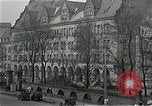
Soldiers and civilians have their passes checked at the Palace of Justice during the Nuremberg trials in Germany.
Exteriors of the Palace of Justice (Fürther Str. 110, 90429 Nürnberg, Germany) in Nuremberg during the Nuremberg trials shortly after World War 2. British guards in front of the entrance. Sign of the Nuremburg Palace of Justice in English and German: 'Loitering is Forbidden'. Soldiers and civilians have their passes checked before entering the courthouse. 'Palace of Justice' pass. Soldiers stand guard on the courthouse steps while others enter inside.

United States Chief Prosector Robert Jackson addresses the court during the Nuremberg Trials in Germany.
Prisoners seated in the dock during the Nuremberg Trials in Germany. Military Policemen stand guard. United States Chief Prosecutor Robert H Jackson addresses the court. Hermann Goering, Rudolf Hess, Joachim von Ribbentrop,Wilhelm Keitel, Karl Doenitz, Erich Raeder, Baldur Von Shirach, and Fritz Sauckel in the prisoners' dock. Hermann Goering makes notes on pad. Map on a wall indicates German aggression. (World War II period).