


 Francais
 Deutsch
 Italiano
Refine Your Search
+"Poland" +1944 stock footage and images
- Showing 1 to 6 of 36 results more
more Hide
Hide
Warsaw bombed by Germans in retaliation to 1944 uprising, various scenes of Warsaw before WW2
Newspapers around the world reporting on the bombing of Warsaw by Nazi Germany as retaliation for the Warsaw Uprising during World War 2. Newspaper headlines read, "Poles Fighting Inside Warsaw," and "Warsaw Being Razed by Hitler's Order," and "Warsaw's Plight" and "Warsaw Poles Fight Tanks in Streets." Scenes of Warsaw in flames as buildings are being bombed by German forces. Montage depicting Warsaw on fire. Scenes of Warsaw before WWII, including scenes such as the Warsaw Old Town Market Square (rynek Starego Miasta, 00-279 Warszawa, Poland), the column of Sigismund III Vasa (plac Zamkowy, 00-001 Warszawa, Poland), the Royal Palace (plac Zamkowy 4, 00-277 Warszawa, Poland) and the Lazienki Park, before World War 2. Statue of King Jan III Sobieski in Lazienki Park. Men strolling near a palace. Baroque gates in park.
German troops fire machine guns and artillery at enemy in Warsaw, Poland.
German troops with rifles and equipment march on a road in Warsaw, Poland during 1944 Warsaw Uprising of World War 2. German troops fire tanks. Soldiers fire machine guns from bushy area. German soldiers with panzerfaust anti tank weapons.l Explosions on ground. Soldier looks through binoculars. German Sturmgeschütz III (Stug III) Assault Guns firing. Russian tanks moving in distance. Close up views of destroyed Soviet tanks.
German Ju 87 aircraft dive bombing on suburb area of Warsaw in Poland during Warsaw Uprising.
German Luftwaffe Junkers Ju 87 aircraft bombing suburbs of Warsaw in Poland during 1944 Warsaw Uprising of World War 2. German soldier looks at bombing raid from a bunker. Formation of German Ju 87 aircraft attack large buildings in suburbs of Warsaw. Explosions on two buildings targeted. Aerial closeup view of Ju 87 dive bombing intended target building. Massive explosion as building blows up. Fire and smoke and debris in the air.
Polish resistance during German occupation of Warsaw in World War II. Scenes of pre-war Warsaw.
Remains of the Jewish Ghetto in Warsaw, Poland. Workmen and equipment appear to be demolishing it. The words: "Wawer, 27 XII 39" painted on sidewalk. Passersby place flowers at the spot. At another spot on the sidewalk is painted: "Polska Zwyciezy"(Poland Wins). Cardboard caricatures of Hitler are raised on a building wall and hung from a lampost. Base of lampost, where people walk their dogs, being painted "Nur fuer Deutch" (only for Germans). Newspapers in 1944 reporting on the increased internal Polish armed resistance, or Warsaw Uprising, against the occupying German forces. Scenes of fire and destruction arising in this increasing conflict. Scenes of pre-war Warsaw Poland, including landmark buildings, city square areas, parks, and fountains during pre-war peace time.
Hitler visits officers injured in the July 20th bomb plot and meets with Nazi officials, in World War II
Adolf Hitler visits German Army officers, who were injured, in the July 20th assassination attempt against him. They are being treated at a military hospital, in Rastenburg, during World War 2. Among the victims he visits are: Major General Walter Scherff; Navy Captain Heinz Assmann; Rear Admiral Karl-Jesco von Puttkamer; and General Walther Buhle. Hitler is seen with a small bandage in his right ear due to a ruptured ear drum from the explosion. He takes time and speaks with each of the wounded officers. As he leaves, women nurses, assembled outside, render Nazi salutes, and cheer him. Change of scene shows Hitler, at the Wolf's Lair compound, near Rastenburg, East Prussia (now Poland). He greets Walther Funk, Reich Minister for Economic Affairs; a local Gauleiter; Reich Minister Albert Speer; a Dr. Sauer; and Reich Minister Hans Heinrich Lammers, President of the Reich Cabinet. Next scene shows Heinrich Himmler, chief of the Nazi Gestapo, speaking with General (Generaloberst) Ferdinand Schörner. Hitler strolls with Hermann Goering, and is then seen, from behind, as he greets Reich Minister of Propaganda, Joseph Goebbels and General (Generaloberst) Heinz Wilhelm Guderian, Chief of Staff of the Army. Beside him is Hermann Fegelein. The Nazi top leaders stand and converse. Goebbels speaks with Martin Bormann and General Alfred Jodl, whose head is bandaged. (He was injured during the July 20, 1944 assassination plot against Hitler.)
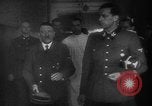
Hitler visits German officers, hospitalized for injuries from bomb plot against him. He also meets Nazi officials, in World War II
Adolf Hitler visits German military officers, at a military hispital in Rastenburg, during World War 2. They were injured in the July 20th assassination attempt against Hitler. He visitis and speaks with: Major General Walter Scherff; Navy Captain Heinz Assmann; Rear Admiral Karl-Jesco von Puttkamer; and General Walther Buhle. As he leaves the building, women nurses outside, give Nazi salutes, and cheer him. Change of scene shows Hitler, at the Wolf's Lair compound, near Rastenburg, East Prussia (now Poland). Among those he greets are: Walther Funk, Reich Minister for Economic Affairs; Reich Minister Albert Speer; and Reich Minister Hans Heinrich Lammers, President of the Reich Cabinet. Next scene shows Heinrich Himmler, chief of the Nazi Gestapo, speaking with General (Generaloberst) Ferdinand Schörner. Hitler strolls with Hermann Goering, and is then seen, from behind, as he greets Reich Minister of Propaganda, Joseph Goebbels and General (Generaloberst) Heinz Wilhelm Guderian, Chief of Staff of the Army. The Nazi top leaders stand and converse. Goebbels speaks with Martin Bormann and General Alfred Jodl,who was also injured during the July 20, 1944 bomb plot against Hitler. (Jodl's head is bandaged.)