


 Francais
 Deutsch
 Italiano
Refine Your Search
+"Poland" +1944 stock footage and images
- Showing 7 to 12 of 36 results more
more Hide
Hide
Training film for U.S. troops with the Army of occupation in Germany after world War II
Opens with bell tolling Victory against Germany in World War II. Next, a slate reads: "Victory Leads to Peace," and a farmer is seen with cattle pulling a plow. But narrator says "the problem now is future peace," and a map of Germany is shown overlaid with "Your Job in Germany." A cartoon of a soldier is superimposed on the map, along with one of a World War 1 American soldier and a figure of possible future soldier with similar mission. Camera focuses on parts of German aircraft in a jumbled heap. Closeups of weary defeated German soldiers at end ot World War II. Glimpse of Adolf Hitler speaking and haranguing an audience from a podium in an animated and forceful way. Swastika flags displayed from houses in a quaint German town. Joseph Goebbels, Nazi Reich Minister of Propaganda, at a microphone. Glimpse of a German concentration camp. But as they appear, each of the Nazi elements promptly disappears, showing the scenes without such Nazi symbols and persons. Skeleton remains of bombed buildings. Flower displays. Bucolic German rural countryside and quaint old villages in peaceful settings. Camera focuses on a book titled "German History." Chapter I, titled "Blood and Iron," shows Image of Otto von Bismarck. German troops march in a parade. Narrator states that "under Bismarck, the German empire was built." (He formed the German Empire in 1871, unifying Germany with himself as Imperial Chancellor, while retaining control of Prussia at the same time.) The film shows mounted German lancers as it alludes to Bismarck's campaigns against Denmark in 1867; Austria in 1866; and France, in 1870. Germany's leaders celebrating its status, in 1871, as the mightiest power in Europe. Troops marching and girls dancing nearby. Farmers plowing field with a horse and cow. Classic peaceful rural alpine scenes with local people in agricultural pursuits. A group of local German musicians playing folk music as village people dance outdoors. Back to the book, Kaiser Wilhelm II is shown on Chapter 2, entitled: "Deutschland über Alles." Gathering of German soldiers in Pickelhaube (spiked helmets). A German Big Bertha howitzer firing. German troops marching against Serbia; Russia; and France (with view of war damaged French cathedral). German invasion of Belgium in 1940 (with view of clock tower resting in rubble). German troops seen in Italy, walking past battle-damaged buildings. German Zeppelin dropping bombs on British targets and view of bombed out London neighborhood. Next scene shows a capsized ship with survivors running across its hull. Film slate labels the scene as United States, as if it is a U.S. ship attacked by Germany. (Actually, it is the Austro-Hungarian Battleship, SMS Szent Istvan, torpedoed, by Italian torpedo boats, during World War I.) Next, American soldiers in trench are seen going "over the top" and into "no man's land" on the western front of World War 1. Glimpse through a window of Kaiser Wilhelm II, after defeat of Germany, in 1918. View of Germans in a Beer Garden. Picturesque view of German town. A German orchestra performing. American soldiers marching out of Germany, with flags waving. Back to the history book,as chapter III is revealed, entitled "Today Germany, tomorrow, the world," and featuring Adolf Hitler. German troops invading Austria (where a civilian lies dead on the ground). German troops entering Czechoslovakia (where local people in tears render the Nazi salute). They march into Poland (where a girl weeps over someone, not seen, on the ground). They march into France (where a wounded, bandaged child cries in a bed). Next, is a scene from England, where a British child victim of bombing lies dead in the remains of a shelter. German troops invading Norway, Holland, Denmark, Belgium, Luxembourg and Russia (where a woman tries to rouse a dead woman). They invade Yugoslavia (where women sit near coffins of children) and Greece (where a woman rescues a naked child). A U.S. merchant ship explodes after being torpedoed by a German submarine (unseen). Scenes of destruction with people plucking dead victims from rubble of buildings. American troops invading Normandy, France on D-day, June 6, 1944. Several American soldiers fall to German gunfire on the beach. Wounded American soldiers being transported in jeeps on the battlefield and being placed on landing craft for evacuation. Americans walking past huge piles of destroyed aircraft parts. A landing craft filled with wounded American soldiers. American wounded and dead on a battlefield. Sailors abandoning a burning American ship by jumping into the sea. A sailor picked up in a life boat. A wounded American soldier being dragged from the beachhead at Normandy. Various wounds being treated by U.S. Medical Corps personnel. More scenes of American wounded being moved on stretchers. Scene shifts abruptly to German people folk dancing. Film concludes with question marks about the future.
Liberated United States airmen prisoners at Stalag 7A in Moosburg, Germany (WW2)
Liberated United States prisoners (mostly military airmen) at POW camp called Kriegsgefangenen-Mannschafts-Stammlager (Stalag) VII A, located just North of Moosburg, Germany during World War II. The airmen cook food. Several are seen sunning themselves. Airmen seen shaving, shining shoes and cleaning clothes. A group of airmen around sign 'I Wanted Wings' and 'Luft 3'. These are some of the prisoners who were originally held at Stalag Luft III, in German Province of Lower Silesia, near the town of Sagan (now in Poland). (Note: Stalag Luft III is famous because the "Great Escape" took place there in March, 1944. Prisoners were forced to march from Sagan to Spremburg during the coldest winter in Germany in 50 years. There, they boarded a train of boxcars for a 3 day trip to Moosburg in January 1945, because the Russians were closing in. The addition of these prisoners to Stalag 7A, at Moosburg, led to serious overcrowding of the camp. On May 1, 1945, the New York Times reported that "The Fourteenth Armored Division liberated 110,000 Allied prisoners of war at Stalag 7A at Moosburg." This corrected an earlier report that 27,000 prisoners had been liberated.)
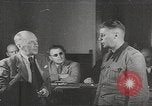
An inquiry commission investigates mass killings at Majdanek concentration camp in Lublin, Poland (WW2)
An inquiry commission inquires into holocaust mass killings by Nazi Germans at Majdanek concentration camp in Lublin, Poland in World War II. Views of many passports and identity cards of prisoners from Poland, Holland, France and other countries. Closeup view of identity card of Homère Fonteneau from Charentais, France, born in 1922. Views of other identity cards including an Italian with first name Bruno, a Dutch man with name P. Janssen, a boy named Constantine and his sister, a girl named Irena Eleanora Peters from Poland. View of prisoners who survived at the concentration camp.
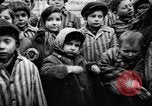
Nazi atrocities at the Auschwitz Concentration Camp in Poland (WW2)
Scenes of Nazi brutality at the Auschwitz Concentration Camp in Poland. View of small children at the camp showing the numbers on their arms. Procession of children moves in barbed wire enclosure. Close up of charred heads and remains of bodied in cremation oven. View of cans of Zyclon gas and other chemicals and drugs in a wooden box used to kill the victims. Bodies in deep trench, one dead woman with an unborn fetus beside her. The Russian commission examines deep grave filled with bodies after surrender of Nazi German SS guards in World War II.
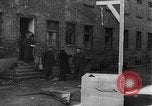
Prisoners demonstrate a scaffold, including the trap and noose at the Auschwitz Concentration Camp in Poland.
View of the prisoners at the Auschwitz Concentration Camp in Poland. Prisoners demonstrate a scaffold, including the trap and noose. Close ups of prisoners who were professors and doctors. (World War II period).

Prisoners, charged barbed wire fencing and ashes of atrocity victims at Majdanek, Poland Concentration Camp in World War II
The liberated Nazi concentration camp in Majdanek, Poland (also known as Maidanek) during World War 2. Surviving prisoners inside the barb wired fences of the concentration camp, near time of liberation by Soviet Russian Allied forces. Tattooed prisoner number on chest of a victim prisoner. Evidence of Nazi atrocities: Main chimney of crematorium. Ashes of human corpses that were burned at the camp. A group of seated German SS soldier prison guards, now POW, after capture by Soviet forces. Soviet Russian officials examine the clues from the concentration camp. Close up views of electrical sources and parts powering the barbed wire enclosures. Warning signboard on the fences. Guard towers and electrically charged barbed wire fencing. German guard pro-Nazi graffiti carved on a wooden fence post. Aerial view of large number of barracks in the camp at Lublin Poland, also known as KL Lublin. Clip is part of Nuremberg Trials prosecution exhibits 228, 229.