


 Francais
 Deutsch
 Italiano
Refine Your Search
+"Poland" +1944 stock footage and images
- Showing 13 to 18 of 36 results more
more Hide
Hide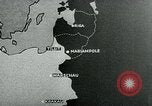
Leader of the Polish resistance General Bor-Komorowski meets the SS (Schutzstaffel) leaders in Poland.
A map of Poland. German tanks and fuel are transported to the First Volksgrenadier Division at the Eastern Front. German soldiers on tanks are transported to the Eastern Front. German vehicles and tanks are loaded on railway cars and seen underway being transported by railroad. Scenes of the Warsaw Uprising in Warsaw, Poland. Men march along the road in large numbers. Leader of the Polish resistance General Tadeusz Komorowski also called Bor-Komorowski or Bór-Komorowski meets the SS (Schutzstaffel) leaders including Erich von dem Bach-Zelewski during capitulation discussions. Polish prisoners of the Polish Resistance army surrender arms to German captors as they march under German guard. (World War II period).
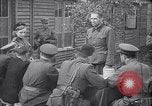
Russian officers interrogate camp guards, dig mass graves and inspect gas chambers of Majdanek concentration camp near Lublin, Poland.
The Nazi concentration camp in Majdanek, Poland (also known as Maidanek) soon after its liberation in World War II. Russian officer interrogates German guards and officials of the camp. Men dig up mass graves for evidence of atrocities and pull out dead bodies. Women weep as bodies uncovered. Decomposed and deformed bodies and pile of skull uncovered. Soviet Russian officers stand and view a mass grave. Barbed wire fencing and wooden sticks used for beating inmates. Zyklon B (or Cyclone B) chemical can that was used for gas in the gas chamber. Soviet officials tour the gas chambers. Guards and officials of camp interrogated with the help of a Russian woman interpreter. Various prisoners tell the story of atrocities at the Lublin Concentration Camp, KL Lublin. Clip is part of Nuremberg Trials prosecution exhibits 228, 229.
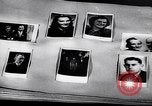
Corpses of prisoners and surviving inmates of the Auschwitz Concentration operated by Nazis in Poland during World War II.
Auschwitz Concentration camp of the Nazi Germans in Auschwitz, Poland during World War II. Photographs of victims of concentration camps belong to almost all countries of Europe. Inmates stand along barbed wire fencing of the camp. Tortured, starved and dying inmates. Corpses lie scattered everywhere on the ground near a house of the concentration camp. An old woman and a child survivor of the camp. Lump of human bones and inmates walk by them. Medics take inmates for medical check up and treatment. Dead bodies taken on a stretcher out of the barrack by inmates. Crowd of survivor inmates released from the camp. Clip is part of Nuremberg Trials prosecution exhibits 228, 229.
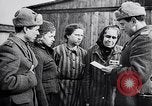
Russian soldiers rescue women and children prisoners and recover dead bodies at the Auschwitz Concentration camp in Poland.
Auschwitz Concentration camp of the Nazi Germans in Auschwitz, Poland during World War II. Russian soldiers note details of survivor women inmates from Yugoslavia. Inmates walk along with soldiers along barbed wire fencing. Male inmates carry a stretcher with dead body of a young woman. Pile of dead bodies taken out from a chamber. Horse carts draw lumps of dead bodies out of the camp. Young children released from experiment laboratories of the concentration camp, walk along paths guarded by barbed wire fencing. Clip is part of Nuremberg Trials prosecution exhibits 228, 229.
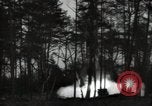
A-4 or V-2 missile launched from forest at Heidelager testing range, Poland, during World War II
Camouflaged A-4 missile, also called a V-2 rocket, being launched from a wooded site at Heidelager camp near Blizna, Poland, during World War 2. The V-2 rocket rises, above fire and smoke, and disappears overhead. (Note: These tests proved that a V-2 could be fired from almost anywhere. A few months later, V-2s were being launched against the Allies from similar hidden forested sites in Germany and Holland.)
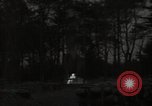
German A-4/V-2 missile fired from woods at Heidelager test range in Poland during World War II
German test launch of a A-4/V-2 missile, from a wooded site, at the Heidelager testing range near Blizna, Poland. The Missile moves upwards, emitting fire and smoke from its tail, and then heads downrange, with the fire in its tail visible throughout the entire clip.