


 Francais
 Deutsch
 Italiano

Refine Your Search
+"Soviet Union" +1948 stock footage and images
- Showing 1 to 6 of 31 results more
 Hide

Activities in a public library in the Soviet Union, 1948
Soviet newsreel with Korean narration. Film opens showing a public library in the Soviet Union. Patrons peruse books and other publications and take some to tables, where they read them. One man looks at a cinema schedule. Many persons gather to hear a lecture from a speaker who appears to be discussing farming livestock.
Post-World War 2 Soviet propaganda film (1948) depicting the rule of law at work in the USSR and mistreatment of people in America.
Soviet newsreel with opening slate in Korean, accompanied by Korean narration. Scene transitions to open pages of books written in cyrillic text, entitled "Constitution Basic Law Soviet Union." Camera pans to various sections of the Law Book. A man, seeming to be the senior judge, sits at a table flanked by a bemedaled woman and another man. Another woman sits at the end of the table. The senior judge is speaking as the camera backs away to reveal a room filled with people seated at the proceedings. Camera pans to cyrillic sign on a door, reading "People's Court, or People's Judgment." Next, a woman approaches the Judge (in his office, or chambers) and presents some documents that she discusses with him. Scene changes showing a poster of a woman holding a petition. Writing on the poster reads,"People's Court." Scene shifts to another courtroom where a man stands at a podium on a stage shared with a panel of people. A mural in the background depicts Joseph Stalin. Closeup of the speaker reveals he is the same judge seen in earlier scenes. As he speaks, the camera pans the serious looking audience that applauds when he finishes speaking. Next, a city street scene shows a tram moving. Then a woman is seen working at a desk inside a modern apartment. She is seen, next, speaking before a group comprising a cross-section of people, including a Soviet military officer. The woman lecturer holds a magazine depicting drawings of violence, including lynchings, and mistreatment against African American citizens in the United States.

UN Security Council elects President for May, 1948, at Lake Success, Long island, New York
UN delegates are seen gathering for a meeting of the Security Council at the temporary United Nations headquarters in Lake success, Long Island, New York. One of the first to be seated is Andrei Gromyko of the Soviet Union. Another delegate stops to converse with him. Camera pans across delegates settling into their respective places at large curved table. Their nations are identified by placards at each place. Attention is focused on French Delegate Alexandre Parodi, who has apparently just been elected President of the Council for the month of May, 1948. At TC: 00:54, He is seen standing with Secretary General Trygve Lie. And at TC:01:19 he gently uses a gavel. At TC:01:28, another delegate holds the gavel with him as they laugh. After a while, the delegates settle down and begin to conduct business.

Soviet Writers Congress convened in the Ukraine in 1948
Soviet newsreel with Korean dubbed narration. Opening slate shows the top of the Kremlin Spasskaya Tower inside a star with caption underneath in Cyrillic, reading,"Central Documentary Studio." Camera zooms in on the Spasskaya Tower clock, and then pans across several scenes including the city of Moscow, Russia, in the Soviet Union; an airliner in flight; industrial plants in operation; mining operations; farmers harvesting grain with machinery; Soldiers parading on Red Square; a sailor standing in front of a Soviet flag with star and hammer and sicle in the center; a steam locomotive displaying a red star moving on a railroad. A car pulls up to a large government building. Passengers enter the building and mingle with many others inside a large hall. Camera shows some famous Soviet writers, including Viktor Nekrasov and others with copies of their books. Later, all are gathered in an auditorium, where literary figures are seated at a table, along with some notables, including Nikita Khrushchev. One gives a speech from a podium.
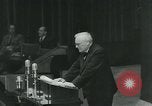
Illustration and comments about post--World War II spread of communism driven by policy and actions of the Soviet Union
Soviet Deputy Minister of Foreign Affairs, Andrey Vyshinsky (aka Andrei Vishinsky), making an impassioned speech, in 1948. Adolf Hitler making one of his bombastic speeches, during World War II. Animated map of Europe, showing countries becoming puppet states under post-World War 2 expansionism by the Soviet Union. It also highlights unrelenting Soviet hold over postwar zones of occupation in Austria and East Germany. The map goes on to illustrate expanding communist reflected in politics of Italy, France, Greece, and Finland.
Romanian Delegation departing from Moscow, Russia.
Romanian delegation headed by Romanian Prime Minister Petru Groza, foreign minister Anna Pauker, and Communist leader Gheorghe Gheorghiu-Dej is leaving from Moscow, Russia, Soviet Union, after signing a Mutual Assistance treaty on February 4, 1948. The delegation at a railroad train station is seen off by the Russian foreign secretary Vyacheslav Molotov and vice foreign secretary Andrei Vyshinskii. Prime Minister Groza gives the departing address on Russian-Romanian relations. February 1948.