


 Francais
 Deutsch
 Italiano
Refine Your Search
+"Soviet Union" +1948 stock footage and images
- Showing 7 to 12 of 31 results more
more Hide
Hide
Romanian Delegation departing from Moscow, Russia.
Romanian delegation headed by Romanian Prime Minister Petru Groza, foreign minister Anna Pauker, and Communist leader Gheorghe Gheorghiu-Dej is leaving from Moscow, Russia, Soviet Union, after signing a Mutual Assistance treaty on February 4, 1948. The delegation at a railroad train station is seen off by the Russian foreign secretary Vyacheslav Molotov and vice foreign secretary Andrei Vyshinskii. Prime Minister Groza gives the departing address on Russian-Romanian relations. February 1948.
World tensions after World War II. The Baruch Plan. The Berlin Airlift. The Korean War. The Cold War. The Atomic age. Ballistic Missiles
Speaking before United Nations Atomic Energy Commission (UNAEC) in its first meeting in June 1946, Bernard Baruch proposes international control of all atomic energy -- the so-called Baruch Plan. Low level aerial view of ruined post World War 2 European city. Goods including heavy equipment, locomotives, being loaded aboard ships to aid in the postwar recovery of Europe (The Marshall Plan). Workers in Western Europe making use of Marshall Plan materials to rebuild their national infrastructures. West European farmers restoring agriculture. View from overflying light airplane of parts of postwar Berlin in 1948. Blocked roads and empty railroad tracks leading from East Germany to West Germany, blocked by the Soviet Union. Barge traffic at standstill due to Soviet actions. U.S. C-54 transport aircraft flying supplies into West Berlin (The Berlin Airlift) during the Soviet blockade of that city. West Berlin citizens watching U.S. transport aircraft bringing fuel, food and other essentials into the isolated city. A C-54 flying low over empty railroad lines, as it prepares to land in West Berlin. Supplies offloaded from a DC-3 ( AKA C-47 or British Dakota) equipped with unusual set of rear cargo doors. Supplies being moved on Tegel Airport with many C-54 aircraft in the background. Numerous C-47 aircraft operating at Tempelhof airport. An East German official opening a barricade as Soviet blockade of West Berlin ends on May 12, 1949, and supply trucks begin to move over roads again. Flags of Western nations flying on high flagpoles. Glimpse of Allied warships underway during the Cold War. Formation of P-38 Lightning aircraft in flight overhead. NATO troops marching and NATO armor on parade. Flashes of heavy artillery firing at night. Korean refugees moving South in 1950 with the outbreak of the Korean War. View of UN Security Council meeting in the absence of Soviet representative. U.S. tanks firing guns and American infantrymen in conflict with North Korea in Korean War. American wounded on stretchers.Delegates of both North and South Korea signing the Korean Armistice Agreement in P'anmunjŏm, on July 27, 1953. A rocket is launched. Images of earth from inside a space craft in orbit. Narrator mentions the first satellite to circle the earth, the soviet Sputnik 1 in 1957. View of Soviet pilots in low pressure altitude chamber. A test subject in an aircraft making a maneuver that allows him to experience "weightlessness." Objects in his cockpit float about. A military rocket launch monitored by arrays of radar. An object being retrieved from space by means of a parachute. A nuclear powered submarine. Rockets on display during a military parade in Red Square, Moscow, the Soviet Union. A U.S. Air Force B-52 bomber taxiing. More views of rockets seen during a Soviet military parade in Red Square, Moscow.
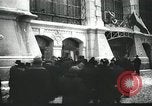
Czechoslovak coup with Communists coming to power; anti-Communist demonstrations in various European nations over 10 years
U.S. propaganda piece about threats by communists against various European countries. The Czechoslovak coup and demonstrations. Czech citizens moving on a street in Czechoslovakia during a strike forcing conservative elements to resign from the cabinet. Scenes of police brutality and beatings against strikers. Communists take over the police. Czech President Edvard Benes with conservative politicians in a government building. Huge crowd on a street. Police clashing with crowd. Czech Prime Minister Klement Gottwald with officials. President Edvard Benes, facing possible civil war or invasion by the Soviet Union, accepts a Communist cabinet. He is seen signing documents to that effect on February 25, 1948. Other officials beside President Benes during the signing. View of the first President of Czechoslovakia Tomas Masaryk's son, Jan Masaryk, who remained the Foreign Minister, and did not agree to the new government. Two days later Jan Masaryk is discovered dead. The body of Jan Masaryk in a coffin. Edvard Benes, who resigned in June 1948 after refusing to sign the communist constitution, is seen walking slowly outside the Parliament using a cane. A guard saluting Benes. View of the body of Edvard Benes, who died in September 1948, laying in a coffin. Mourning citizens offering flowers and cry. Officials bearing the coffin. Shift several years later to street strikes in East Germany in 1953. People during a strike and riot in Poland in 1956. Russian tanks moving on a street and Soviet soldiers are seen. Elevated view of panic and Polish citizens fleeing soldiers. October 1956: Student demonstrators on street in Budapest Hungary during the Hungarian Uprising of 1956. Soviet Russian red star is toppled by crowds from a building roof in a sign of defiance. Russian troops respond with tanks on the streets in Hungary. Crowd fights back. Russians retreat. Crowd overwhelms local police. Imre Nagy, Prime Minister of Hungary, ascends steps. Hungarian crowd on streets burn communist books and papers. Russian tanks invade Hungary to crush revolt. Tanks fire guns on Hungarian street. Imre Nagy's execution announced June 17, 1958.
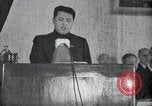
North Korean Assembly Meeting to draft Constitution.
Shows Prime Minister Kim II Sung speaking on the podium at the North Korean Assembly held to draft Constitution in North Korea. Several dignitaries,reporters and press officials present at the event. Flags of South Korea and Soviet Union can be seen in the backdrop. Other dignitaries take the microphone to make their speeches. Reporters take down the speeches on their notepads.1948.
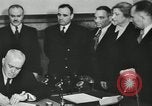
Treaty signing between Romania and Soviet Union. Petru Groza, Vyachesla Molotov, Ana Pauker, Gheorghe Gheorghiu-Dej and Joseph Stalin in Moscow
Signing of a twenty year Treaty of Friendship, Cooperation, and Mutual Assistance between the Soviet Union and Romanian Peoples Republic. Dr. Petru Groza, signs for the Romanian Peoples Republic, making Romania the first People's Republic to sign such an agreement with the Soviet Union. Among those present are: Soviet dictator, Joseph Stalin, Soviet foreign minister Vyacheslav Mikhailovich Molotov, Romanian foreign minister Ana Pauker, Romanian Communist leader Gheorghe Gheorghiu-Dej, and Joseph Stalin, General Secretary of the Communist Party of the Soviet Union's Central Committee. The official keeps a pen in a stand. The dignitaries move out of the room.
Life of U.S. President Dwight Eisenhower after World War 2; NATO; Columbia University; U.S. President; advisor to Presidents
Dwight D. Eisenhower during presidency of the Columbia University in 1948. Eisenhower walking at a Columbia University graduation ceremony in New York City and speaking to the group assembled. Two years later, views of Eisenhower as NATO supreme commander in Europe. Eisenhower seated in NATO Conference. Citizens in United States prepare signs and urge Eisenhower to run for President. He salutes a parade in 1952 as he begins a run for the Presidency. Pamphlets and posters read 'we need Eisenhower'. An animated cartoon shows a smiling and marching Uncle Sam with an "Ike for President" jingle song playing. Cartoon shows animated citizens and an elephant supporting Eisenhower. Scenes from Republican National Convention, and Nixon and Eisenhower holding their arms up together. Citizens voting, using ballot boxes, and voting machines. A nun votes. Eisenhower casts his vote. People hold U.S. flags and cheer. Signboards and neon lighting on a building track vote tally and proclaim Eisenhower victory in 1952 presidential election. Eisenhower in Korea after the election. He meets and eats with American troops in the field and studies the war effort. South Koreans wave flags on announcement of truce (cease-fire armistice) in Korean War Eisenhower takes presidential oath of office in Washington DC. He signs document for Civil Rights Act of 1957 (voting right act). View of African American students of the "Little Rock Nine" entering a military station wagon under armed troop escort during integration of Little Rock Central High School in Little Rock Arkansas. U.S. Army troops escort the African American students into school. Exterior view of United Nations building in New York. Eisenhower delivers speech on Atoms For Peace. Winston Churchill of Britain and Nikita Khrushchev of the Soviet Union visit Eisenhower in America. Scenes of John F Kennedy inauguration in 1961. Eisenhower with Kennedy and later with President Johnson. In 1968 address to Republican Convention Eisenhower notes risk of growth of Communism.