


 Francais
 Deutsch
 Italiano
Refine Your Search
+"United Kingdom" +1942 stock footage and images
- Showing 31 to 36 of 70 results more
more Hide
Hide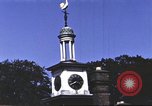
303rd Bomb Group personnel read magazines and play croquet in England.
Recreational activities of U.S. Army Air Force 303rd Bomb Group in England during World War II. Building of 'Headquarters COPC'. 303rd Bomb Group personnel read magazines in a lawn in front of the building. Personnel play croquet. Hut type structures. United States Army Air Force Boeing B-17 Flying Fortress on the ground.
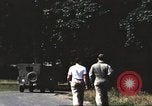
Army motor cars, quonset huts and various buildings in England.
U.S. Army Air Force 303rd Bomb Group in England during World War II. The U.S. flag at mast. A road with grasslands on both side. A building. Two people walking. Army motor cars. Ducks swim in the water. A military personnel goes toward a house. Quonset huts. Various buildings seen.
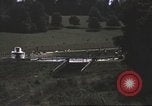
303rd Bomb Group personnel swim in a swimming pool and various buildings in England.
Recreational activities of U.S. Army Air Force 303rd Bomb Group in England during World War II. A fountain seen. Personnel swim in a swimming pool. Several personnel rest beside the pool. The personnel climb up a diving ramp. Various buildings and housing facilities.
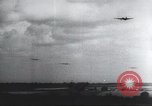
U.S. 8th Air Forces B-17s return to England after bombing Rouen, France during World War II.
U.S. Army Air Forces B-17s of the 8th Air Force, return after the first raid on Rouen, France during World War 2. Several U.S. Army Air Forces B-17 aircraft are seen coming in to land at an airfield in England. Brigadier General Ira Eaker who personally flew the B-17 "Yankee Doodle," to lead this mission, jumps from the aircraft and shakes hands with Major General Carl Spaatz, Commander of the 8th Air Force. (Other crew members of the B-17 "Yankee Doodle" are seen quietly leaving their aircraft.) Later, Eaker, smoking a cigar, is interviewed by a group of civilian and U.S. Army reporters.
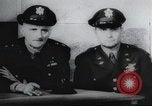
U.S. General Ira Eaker discusses the air raid after bombing Rouen, France during World War II.
Discussion of the first B-17 raid in the European theater (on Rouen, France) during World War II. Major General Carl Spaatz, Commander of the U.S. 8th Air Force, comments about this first such use of American heavy bombers against German targets in World War 2. He notes that this raid was led by Brigadier Ira Eaker, head of U.S. Bomber Command. He invites Eaker to comment on the raid. General Eaker reports that pilots maintained good formations and gunners caused German fighters to back away. He states that the main targets during the air raid were marshalling yards and a Locomotive repair facility. An intelligence officer debriefs two members of a flight crew, following a mission. They answer questions. One of the crew members points out their target on a map, and reports success at hitting their targets..
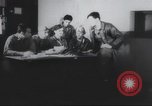
B-17 crew of the U.S. 8th Air Force is debriefed by intelligence officer upon return from a bombing mission.
A U.S. intelligence officer interviews members of a flight crew upon their return from a bombing mission in World War 2. Pilot of the aircraft says that as the B-17 aircraft approached the target over the river, they were hit by Flak in the left wing and tail surface. The Pilot says they dropped their bombs effectively and were attacked by "109s or 190s" (Messerschmitt Bf 109s or Focke-Wulf FW-190s) that dove down on them and swooped up underneath. He refers to his ball turret gunner sitting next to him and says he knocked off one of them. The gunner says he saw the German plane when it came down from the tail, dove under, and started coming up. When asked, the gunner says the German plane was about 900 feet away when it was hit by his machine gun fire. He also noted they were the last ship in the bomb run. Next, after questioning the tail gunner, the intelligence officer asks the Bombardier about his actions. He explains that after releasing his bombs, he began to plot their positions as they exploded on the ground. He notes they got good bursts on the engine sheds, on the concentrations of box cars in the center of the marshalling yards, and on the viaducts leading to the center of the bridge. He notes that all the bombers ahead of them hit some part of the target, with most dropping their bombs right where they were supposed to. (World War II; WW II; World War 2; World War Two)