


 Francais
 Deutsch
 Italiano

Refine Your Search
+"United Kingdom" +1942 stock footage and images
- Showing 37 to 42 of 70 results more
 Hide
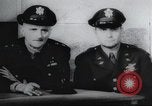
U.S. General Ira Eaker discusses the air raid after bombing Rouen, France during World War II.
Discussion of the first B-17 raid in the European theater (on Rouen, France) during World War II. Major General Carl Spaatz, Commander of the U.S. 8th Air Force, comments about this first such use of American heavy bombers against German targets in World War 2. He notes that this raid was led by Brigadier Ira Eaker, head of U.S. Bomber Command. He invites Eaker to comment on the raid. General Eaker reports that pilots maintained good formations and gunners caused German fighters to back away. He states that the main targets during the air raid were marshalling yards and a Locomotive repair facility. An intelligence officer debriefs two members of a flight crew, following a mission. They answer questions. One of the crew members points out their target on a map, and reports success at hitting their targets..
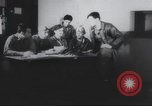
B-17 crew of the U.S. 8th Air Force is debriefed by intelligence officer upon return from a bombing mission.
A U.S. intelligence officer interviews members of a flight crew upon their return from a bombing mission in World War 2. Pilot of the aircraft says that as the B-17 aircraft approached the target over the river, they were hit by Flak in the left wing and tail surface. The Pilot says they dropped their bombs effectively and were attacked by "109s or 190s" (Messerschmitt Bf 109s or Focke-Wulf FW-190s) that dove down on them and swooped up underneath. He refers to his ball turret gunner sitting next to him and says he knocked off one of them. The gunner says he saw the German plane when it came down from the tail, dove under, and started coming up. When asked, the gunner says the German plane was about 900 feet away when it was hit by his machine gun fire. He also noted they were the last ship in the bomb run. Next, after questioning the tail gunner, the intelligence officer asks the Bombardier about his actions. He explains that after releasing his bombs, he began to plot their positions as they exploded on the ground. He notes they got good bursts on the engine sheds, on the concentrations of box cars in the center of the marshalling yards, and on the viaducts leading to the center of the bridge. He notes that all the bombers ahead of them hit some part of the target, with most dropping their bombs right where they were supposed to. (World War II; WW II; World War 2; World War Two)

Workers in UK and U.S. producing war material and weapons during battle against Germans in Egypt, North Africa (WW2)
Preparation undertaken in factories of Britain for producing war material and weapons for British Infantry fighting against German forces in El Alamein, Egypt during World War II. Women and men war production workers busy in a factory. Workers at aircraft assembly lines operate various machines. Scene changes to the United States, where war production workers are seen assembling M4 Sherman tanks in a U.S. factory. Production of M4 tanks for Allies. Completed tanks at the end of an assembly line, and elevated wide views of factory floor producing tanks.

Memphis Belle and other B-17 aircraft taxi and take off from airfield in England.
Outtakes from the Memphis Belle documentary movie. A number of B-17 aircraft on a field in England. Among them, the Memphis Belle B-17 aircraft. Pilot's compartment of B-17. B-17 taxis on runway. Nose of B-17 stationary. Propellers turn. B-17s take off from airfield. View of the Memphis Belle as it taxis and then takes off. Two other B-17s take off.
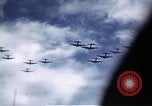
U.S. Army Air Force B-17 planes relax on way home from combat missions in France.
Outtakes from the Memphis Belle documentary movie. B-17 planes returns after conducting combat missions in France. Large formation of B-17s in sky. Various crew members relax on way home from mission. B-17 taxis on airfield in England. Tower operator operates flash signal gun. B-17s taxis on runway.

Tail guns, wing engines, and bombardier of U.S. Army Air Force B-17 plane.
Outtakes from the Memphis Belle documentary movie. B-17 plane on airfield in England. B-17 plane taxis on airfield. Tail guns of B-17. Right wing engines of B-17 in flight. Bombardier in plane.