


 Francais
 Deutsch
 Italiano

Refine Your Search
+"United States" +1945 stock footage and images
- Showing 625 to 630 of 4253 results more
 Hide
Color Sound
General MacArthur leads U.S. forces to a victory in the Philippines (WW2)
World War II events leading up to the independence of the Philippines. Filipino guerrillas march and line up as they prepare to fight against Japanese soldiers. A Filipino guerrilla of European descent and Chinese Filipino guerrilla are seen. U.S. officers seated in a camp. A newspaper headline reads 'MacArthur invades Philippines'. U.S. Army General Douglas MacArthur and other officers land at Leyte in the Philippines. Filipino guerrillas receive rifles. U.S. and Filipino soldiers fire artillery and tanks roll across a field. A tank named “Luzon Liberator”. U.S. forces march through a city in the Philippines. General MacArthur gets off a car. A sign reads 'Victory Festival'. Filipino civilians cheer for American soldiers. Decorated floats at a parade to mark the end of Japanese occupation. Signs read ‘Mabuhay America & Filipinas’, 'Long live Philippines', ‘Mabuhay President Truman’ and 'Thanks Uncle Sam'.
United States Marines in mopping up operations on Iwo Jima, during World War II
4th Division U.S. Marines in final phases of the battle for Iwo Jima, in World War 2. U.S. marine walks across rocks with destroyed vegetation behind him. A demolition charge explodes in the rocks and several Japanese soldiers emerge to surrender. Scene shifts to a Japanese stronghold in a cave. A Japanese officer stands with a U.S. marine outside the cave. A Japanese defender emerges and talks with the Japanese officer, who then tells the marine there are two more Japanese soldiers in the cave. The marine helps the Japanese soldier out of the cave. Scene changes to another Japanese stronghold, where a marine throws a line up to another marine standing atop the rocky outcropping. Next scene shows a demolition charge exploding at the site. In a new sequence, four U.S. marines carry a wounded comrade and place his litter on the ground where another team picks it up and carries it. View from high ground of Mount Suribachi, seen above mist, on distant end of the island. A truck moving rapidly over a dirt road on the island.

United States Marines find Japanese rocket bombs and launching ramps on Iwo Jima in World war II
Marines of the U.S. 4th Division in final phase of the battle for Iwo Jima in World War 2. Several U.S. supply ships off the coast. A U.S. C-47 transport airplane in flight overhead. U.S. marine with flame thrower strapped to his back, walking across rocky terrain. Closeup of Japanese 20cm rocket bombs; remains of primitive wooden launch trough; a threaded fuse; and a mortar shell with fins.
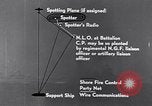
Coordinating naval gunfire during U.S. invasion of Okinawa in World War II. Destroying enemy caves and hideouts
Animation graphic describing how land sea and air information was coordinated to enable precise targeting of enemy positions by naval gunfire during the U.S. invasion of Okinawa, Japan in World War 2. U.S. minesweepers enable capital ships with heavy guns to safely operate close to enemy targets. Views of heavy naval gunfire. Advance of the Marine 3rd Amphibious Corps. U.S. troops, advancing slowly, routing out Japanese defenders dug in to caves and holes throughout Okinawa. Naval heavy guns were called upon to destroy these caves. Detailed live images include: Mine sweepers off Okinawa, sweeping for mines; heavy cruiser USS San Francisco, CA-38, under a head of steam and using signal lights; battleships fire at Okinawa; A bow view of a Tennessee Class battleship; battleship USS Nevada, BB-36, fires its main battery; closeup of a Cleveland Class light cruiser's main aft battery firing at Okinawa; stern view of the heavy cruiser USS Pensacola, CA-24, fires her aft main 8-inch/55 main battery; U.S. Marines on the march and blowing up caves; battleship USS New York, BB-34, fires her main battery; time 03:36 shows a Cleveland Class light cruiser firing its forward main 6-inch battery; time 03:30 shows the USS New York, BB-34, again; various naval guns fire and explosions on Okinawa are shown; time 04:08 shows the forward main deck, looking aft, of the USS Nevada, BB-36, with a Tennessee Class battleship in the background.
Soldiers of the U.S. 1st Infantry Division during the Battle of Bulge and Germany, in World War Two.
U.S. 1st Infantry Division during the Battle of Bulge in the Western Front of World War 2. A map points Belgium, Germany and France. United States Army soldiers move forward in snow on the front. They pass through the Ardennes. Scenes of U.S. and German soldiers. Snow and ice covered forest. American soldiers on tanks and half-track vehicles. U.S. troops cross the Rhine River over a captured bridge at Remagen. The 1st. Division continues to move through Germany all the way to Czechoslovakia. German soldiers load up into trucks at war's end. Soldiers smoke, talk and rest. A soldier talks on phone. Quick scene from Nuremberg trials.
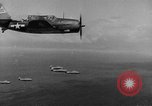
U.S. aircraft make difficult landings on a carrier and gunners undergo training at a deck in the Pacific Ocean.
A typical day in an aircraft carrier task force of the U.S. Navy during a mission of finding Japanese invaders in the Pacific Ocean during World War II. U.S. aircraft return to carriers and make difficult landings. An aircraft carrier task force personnel signals to a pilot for landing. The aircraft lands at the carrier. The pilot gets injured due to the rough landing. Difficult landing of the aircraft at the carrier. Commander David Mocambo of the U.S. Navy disembarks from an aircraft and talks with carrier task force personnel. One personnel sticks a Japanese flag sticker on the aircraft. Services held on the flight deck. Gunners stand at the deck and go for a training. The U.S. Navy aircraft carrier at sea with a mission of finding and killing the Japanese.
CRITICALPAST.COM: About Us | Contact Us | FAQs - How to Order | License Agreement | My Account | My Lightboxes | Shopping Cart | Advanced Search | Featured Collections | Website Terms & Conditions | Privacy Policy ©2026 CriticalPast LLC.
License Agreement |
Terms & Conditions |
Privacy Policy
©2026 CriticalPast LLC.