


 Francais
 Deutsch
 Italiano

Refine Your Search
+"United States" +1945 stock footage and images
- Showing 637 to 642 of 4253 results more
 Hide
Color Sound
U.S. soldiers use natural vegetation to camouflage artillery and hide vehicles behind bare trees in Italy during World War II.
A film underlines the importance of tactical exploitation and counteraction of shadows and use of nets, underbrush and other camouflage during World War II. U.S. soldiers land on an island in Guadalcanal, Solomon Islands. The soldiers try to eliminate the black hole made by a tent opening by using a blanket. U.S. 5th Army in Italy. To remove shadows of oil tanks, engineers use steel wool on chicken wire. Soldiers use natural vegetation to camouflage artillery in Anzio, Italy. In Casino, U.S. soldiers use bare trees to hide vehicles. U.S. soldiers in Sicily. A garnished fish net is draped over a tank to hide it. At Anzio beach troops dig a trench to hide a tank and then cover it with hay. Soldiers try to camouflage a jeep.

United States B-29s bomb Japan; Admiral Halsey and fleet near Japan; dropping of atomic bomb on Hiroshima during World War II.
United States attacks Japan during World War II. U.S. Army Air Forces B-29 aircraft parked on an airfield. B-29s fly in formation and bomb Japan. View of U.S. Navy fleet in waters nearing Japan. Close-up of Admiral Halsey. A U.S. Navy SB2C Helldiver aircraft, displaying tail code RR, from the USS Yorktown (CV-10), is seen in flight. The Navy bombards Hokkaido. Aerial view of the target area. The atomic bomb dropped on Hiroshima and then Nagasaki.
United States troops take over Tokashiki and Geruama Island prior to invasion of Okinawa.
Invasion of Okinawa. U.S. naval bombardment and shelling on island of Kerama Group. Landing crafts approach beach. LVT (Landing Vechicle, Tracked) move up on beaches of Okinawa. Infantry and armored units of 3rd Battalion, 305th Regimental Combat Team takes immediate control of beach. Japanese caves shelled by howitzers. Troops move inland and further. Japanese suicide boats along caves on shores destroyed by bombs. Japanese interpreter of U.S. 3rd Battalion asks a Korean prisoner in fields to go up hill and persuade Japanese for surrender. Korean prisoner goes towards hill with truce flag. Japanese come down hill. Surrendered Japanese Lieutenant sits with other men. American forces land on another island on Kerama Group where no civilian or military resistance is encountered. Flag rose at captured island. Troops plan invasion of another Kerama Group island aboard ship. Invasion of Tokashiki by U.S. troops. U.S. troops move inland. Troops march along trails on hill. Wrecked houses in town. Officer looks through binocular from observation post. American flag behind officer. Artillery fire shelling Tokashiki Island. (World War II period).
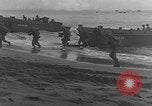
Southwest coast beachhead established by U.S. 19th Army and Marine units, 24th Army Corps advance in Okinawa in World War II.
U.S. troops advance on Okinawa. Beachhead established by 10th Army. U.S. landing crafts on South West coast of Okinawa. Warships at the coast. Small landing crafts and DUKW (Six wheel drive amphibious trucks) move in water carrying supplies. Troops and trucks move along road on island. Marine units move toward north, while 24th Army Corps move toward south for Naha. Aerial view of seized airfield on Okinawa. Countryside shows farms and open lands. Army advances towards Japanese emplacements on hillside. Troops attack Japanese caves on hillside. U.S. marines clear caves with grenades. A U.S. soldier drags a dead Japanese soldier out of a cave. Other Japanese soldiers are shown surrendering and being led away from caves with hands raised. Native civilians are evacuated. They cooperate with troops. Women and children walk along pathway. A civilian woman and young boy child smile.

United States 63rd Regiment troops battle on foothills in Manila.
U.S. troops fight the enemy in Manila, Philippines. U.S. 63rd Regiment troops battle toward Manila. Tanks fire on foothills in Manila. Troops advance through tall grass. Troops run in wooded area. Casualties' area treated. Mortar crew fires on enemy positions from top of hill. Troops advance behind tank in wooded area. Troopers fire rifles. Artillery shells bursts on hill. Trooper throws grenade on enemy position. U.S. 592nd Amphibious Engineers land on Carabao Island on April 16. Troops disembark from landing craft. Troops move along mountain road. Troops advance under cover of machine guns on mountain. Japanese caves blasted with TNT charges. Explosions on mountainside throw billows of smoke in air. U.S. 38th Division troops land at heavily fortified island of Fort Drum. (World War II; WWII;World War 2; WW2)

King Ibn Saud and Colonel William A. Eddy, USMC, on the U.S. Destroyer Murphy, at the Great Bitter Lake in the Suez Canal.
King Ibn Saud of Saudi Arabia (also called King Abdulaziz) and Royal party enroute from Jidda, on the U.S. Destroyer Murphy (DD 603) late in World War 2. The Great Bitter Lake in the Suez Canal. King Faisal with U.S. interpreter, Colonel William Alfred "Bill" Eddy, a U.S. marine officer,sipping tea or coffee with the king. Arab dignitaries seated on the deck. Carpets are seen spread on the ships deck for the king to walk upon. Live sheep are penned up in box on deck, as provisions for the King and Royal party. Views of the American Cruiser, USS Quincy , as the Murphy approaches. Guns on the deck. A flag of the United States. King Saud and his party descend a gangplank to the deck of the Quincy, while a band plays and sailors and officers salute. The Quincy then proceeds towards Alexandria, Egypt. Sandy banks of Suez Canal.
CRITICALPAST.COM: About Us | Contact Us | FAQs - How to Order | License Agreement | My Account | My Lightboxes | Shopping Cart | Advanced Search | Featured Collections | Website Terms & Conditions | Privacy Policy ©2026 CriticalPast LLC.
License Agreement |
Terms & Conditions |
Privacy Policy
©2026 CriticalPast LLC.