


 Francais
 Deutsch
 Italiano
Refine Your Search
+"United States" +1945 stock footage and images
- Showing 67 to 72 of 2149 results more
more Hide
Hide
Eisenhower as the Supreme Commander of the North Atlantic Treaty Organization (NATO) and as the President of the Columbia University
Highlights the military career of U.S. General Dwight D Eisenhower from 1945 to 1952. Depicts notable World War II scenes and events starting on D-Day as Allied Forces invade France. Allied planes drop bombs on the enemy positions. Allied troops in Higgins boats land on the beaches of Normandy France. U.S. tanks move forward. Allied soldiers advance towards Saint Lo. Battle in St Lo area. General Patton Forces move forward. French troops and the soldiers of the U.S. 5th Corps march through Paris. The civilians cheer. Allied soldiers move towards the German border fighting on their way. Battle of the Bulge - when the Germans turned counter offensive. The bridge at Remagen on the river Rhine. Allied troops cross the bridge. Allied troops on the offensive, west of the Rhine. The enemy surrenders. Rubble on the streets. General Eisenhower with the troops. Military officers sign documents of German surrender on May 7 1945 in Reims at SHAEF headquarters. Eisenhower makes a speech at the end of the war. Eisenhower, in Paris, waves at the people from an open carriage. People welcome him in his homeland with a ticker tape parade in New York City. Eisenhower waves at the people gathered at the side of the streets from an open car of a motorcade. Eisenhower swears in as the 1st post war Chief of Staff of the U.S. Army. He visited troops in various parts of the world. He salutes and moves towards a car with his wife as he leaves active military life. Pictures of Eisenhower as he becomes the president of the Columbia University. He reviews the troops as he becomes the Supreme Commander of the North Atlantic Treaty Organization (NATO). Eisenhower on European soil. He enters a car. He assumes supreme command of the land, the sea and the air force. Against the threat from the USSR he prepares the European Armies. Soldiers enter into a train. He reviews troops. General Eisenhower and General Matthew Ridgway salute. He enters into a plane with his wife. Painting of Eisenhower being sworn in as President of the United States. Eisenhower Library in Abilene, Kansas, two boys leaving the Library.
U.S. Marine Corps raise American flag on Mount Suribachi in Iwo Jima during World War II; and original statue unveiling at Quantico in 1951.
A film titled 'Uncommon Valor' about the raising of the U.S. flag by U.S. Marines on Iwo Jima, Japan during World War II. United States naval fleet underway off the coast of Iwo Jima. U.S. Army Air Forces aircraft in flight. U.S. 4th and 5th Division Marines disembark from a ship and get onto landing crafts as they head towards the Iwo Jima shoreline. Marines land ashore and advance inland. They raise the American flag on Mount Suribachi. A newspaper boy sells newspapers on a street in the United States. A picture of the raising of the flag on Mount Suribachi. View of sculptor Felix De Weldon as he carves a sculpture of the flag raising event. Scenes from the unveiling and dedication ceremony of the original limestone statue on November 10, 1951, at the Marine Corps base in Quantico, Virginia, for the 176th anniversary of the founding of the Marine Corps. (The version of the statue seen in this footage had been placed in front of the Navy Department Building at the intersection of Constitution Avenue and 19th Street Northwest, Washington, D.C on 10 November 1945. It features 9 foot figures at 1.5 times life size scale. This sculpture was moved to Quantico Marine Base on 17 November 1947. It had been originally constructed by De Weldon of Indiana limestone, cement, and sand due to a lack of bronze during the war. At the time of its move to Quantico in 1947, the statue had deteriorated due to weather. Also, coats of paint to give the look of bronze had hidden much of the detail and had to be removed. Felix de Weldon supervised the repairs at Quantico before the statue was officially dedicated at the main entrance of Quantico on 10 November 1951, as seen in this ceremony). Officers lined up at the ceremony and many guests in the audience. A parking lot seen in the distance behind the assembled crowd. Cover sheets being removed as the war memorial is unveiled at Quantico.
Montage of World War II scenes, encompassing the allied Pacific campaigns and Big Three wartime meetings.
Allied campaigns against Imperial Japan during World War II. Animated map depicts Allied victories in various Pacific islands like Guadalcanal, Palau, and the Mariana Islands. A map of the Philippines. United States troops invade the Philippines. Naval guns fire at a shore and flak bursts are seen. Dramatic shot of a Japanese Zero aircraft approaching United States Navy ships that are firing guns. The Japanese aircraft is hit at close range to the ship, a wing ruptures, it is consumed in fire and crashes with explosion in the sea beside the ship. Many landing craft with U.S. Army forces landing at beach on Leyte. Soldiers land and advance inland. United States Army General Douglas MacArthur and President Sergio Osmeña of the Philippines wade ashore. Filipino women and children on the island are assisted by U.S. forces and provided with food and protection. Following are meetings of wartime Allied leaders, shown briefly in the ending of the film: Prime Minister Winston Churchill meeting President Franklin D. Roosevelt on the battleship, USS Augusta, at Newfoundland, during the Atlantic Conference, 1941. Roosevelt stands at the railing, assisted by his son, Army Captain Elliot Roosevelt. Roosevelt and Churchill meeting with Generalissimo Chiang Kai-Shek, at the Cairo conference, in 1943. Joseph Stalin, Roosevelt, and Churchill pose outside the Livadia Palace (Baturyna St, 44-а, Livadiya, 98655) during the Yalta conference in 1945. Soviet Foreign Minister Molotov, American Ambassador Harriman, British Foreign Minister, Anthony Eden, and Churchill's daughter, Sarah, in uniform, are among those standing behind the seated Big Three. Delegates from 51 Nations gathered for the first meeting of the UN General Assembly, in Westminster Central Hall, London, England, in 1946.
Surrender of Japan, ending World War II; imprisoned Japanese officials; German concentration camp scenes
View of first atomic explosion (Trinity) on July 16, 1945, at New Mexico, United States. View of the battleship, USS Missouri, in Tokyo Bay, Japan, with entire ship's company on deck in dress whites, Japanese military high command and several formally dressed Japanese diplomats standing on the ship's deck. Brief closeup of General Douglas MacArthur. Japanese foreign minister, Mamoru Shigemitsu, bending to sign the instrument of surrender ending World War 2, on September 2, 1945. Supreme Commander, General Douglas MacArthur, seated, signing the document. Lieutenant General Jonathan M. Wainwright and British Lieutenant-General Arthur Ernest Percival stand behind MacArthur. General Hsu Yung-chang signs for China. View of sailors observing the historic moment from every possible place aboard the ship. Large numbers of aircraft flying over the ship. Scene shifts in flashback to Manila, Philippines, where dead bodies of civilians litter the streets in silent witness of Japanese wartime atrocities. Some have hands tied behind their backs. Views of destitute Filipino mothers and children wandering through the rubble. A sign identifies the 98th Evacuation Hospital. Inside, a doctor and a nurse stand over the bed of Japanese Prime Minister, Hideki Tōjō, who attempted suicide by pistol, when apprehended, but was taken for treatment and is seen resting in his bed. View of Japanese Adrmiral Shigetarō Shimada, Minister of the Navy, behind bars in prison. Also seen in prison are Japanese general of the Japanese Imperial Army and Governor-General of the Philippines, Shigenori Kuroda;. General Masaharu Homma; and militarist Colonel Kingoro Hashimoto. Scene shifts to bodies of numerous victims of German death camps. American Army medics attend to some survivors rescued from the camps.
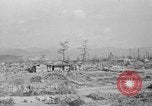
Devastation in Hiroshima and Nagasaki following atomic bomb attacks in World War 2, and view of atomic bomb blast over Nagasaki
Devastated area in north eastern Hiroshima following August 6, 1945 atomic bomb attack in World War 2. Simple shacks and buildings are being built using rubble material after the devastation of Hiroshima. Damage at Higashi station. Newspaper headlines about the atomic bomb attack on Hiroshima, and the warning to Japan by the President of the United States. A map of Japan shows the location of Nagasaki. Scenes of Japanese workers in arms factories building torpedoes and munitions, some wearing kokumin-fuku worker uniform. Workers in an assembly line munitions factory of Mitsubishi. A map shows a torpedo plant in the north and a steel and an arms plant in the south, then plots the center point between them as the U.S. target for the "Fat Man" atomic bomb attack. View of the atomic bomb explosion over Nagasaki on August 9, 1945, as seen from the B-29 bomber "Bockscar" (sometime called Bock's Car or Bocks Car). Mushroom cloud rises up to the sky. Wing of the B-29 bomber in the foreground. An aerial view of rubble and destroyed buildings in Nagasaki following the atomic bomb attack. Destroyed Mitsubishi steel plants beside the sea.
U.S. Navy Fleet Admiral Chester William Nimitz presenting awards to officers and sailors aboard USS Bowfin in Guam, during World War II
United States Navy Fleet Admiral Chester William Nimitz, aboard the USS Bowfin (SS-287) in Apra Harbor, Guam, during World War 2. He is there to decorate the Captain and crew of the boat. Admiral Nimitz is seen at a microphone, addressing officers and sailors. Cameramen taking the photographs of the event. Navy band playing in the background. Admiral Nimitz presents the Navy Cross to Commander Alexander Kelly Tyree, for extraordinary heroism in the line of his profession as Commanding Officer of the U.S.S. Bowfin (SS-287), on the Seventh War Patrol of that submarine during the period 25 January 1945 to 25 March 1945. Admiral Nimitz then proceeds to decorate more officers and sailors from the crew. Nimitz returns to the microphone, reads a citation, and decorates several more crew members. He and other officers hold long hand salutes as the ceremony is concluding. Admiral Nimitz then announces the end of the ceremony and walks away. Camera focuses on a sailor with medal pinned on his shirt.