


 Francais
 Deutsch
 Italiano
Refine Your Search
+"United States" +1945 stock footage and images
- Showing 73 to 78 of 2149 results more
more Hide
Hide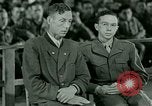
Testimony of Franz Strasser, questioning by prosecutor, and sentence given during military commission trial in Dachau, Germany.
Nazi Kreisleiter Franz Strasser on trial in Dachau, Germany, before a U.S. Army military commission, for the shooting of unarmed United States Army Air Force flyer prisoners on December 9, 1945. Other officers and soldiers in the courtroom. Defendant Franz Strasser is questioned about landing of an American plane, call to the police, the American flyers in custody of Police Chief Lindemeyer, and Strasser's knowledge of whether the flyers were unarmed. Frans Strasser answers the questions through an interpreter. Commission officers and United States flag seen on stage. U.S. Army commission judge delivers the commission verdict of guilty, and states that Strasser is sentenced to death by hanging. The interpreter reads aloud in German the verdict and sentence to Strasser. (World War II period).
The U.S. President Franklin Roosevelt takes the oath of office at the White House, Washington DC (WW2)
United States President Franklin Roosevelt takes the oath of office and delivers the inaugural address at the White House, Washington DC during World War II. 7000 guests arrive for the 1945 inauguration. Snow covered land. Wounded soldiers from the nearby hospital are invited as guests. Crowd lines up in the backyard of White House. President Roosevelt's grandchildren stand at stairs with Harry Hopkins. Secretary of War Henry Stimson and Mrs Stimson, Secretary of Navy James Forrestal and Mrs Forrestal, Secretary Harold Ickes, Chief Justice of United States Harlan Stones, Admiral of fleet Ernst King, General George Marshall and Mrs. Marshall, Secretary of State Edward Stettinius and his wife among the guests. Vice President Wallace swears Harry Truman. President Roosevelt states in his inaugural address that they will get victory in war.
Reinforcements for U.S. 35th Infantry Division are briefed. U.S. troops occupy Houffalize, Belgium during World War 2
The United States Army on the Western Front during World War II. A map depicts Allied offensives at Malmedy, Houffalize and Bastogne. New reinforcements for the 134th Infantry Regiment of the U.S. 35th Infantry Division are briefed by an officer near Bastogne, Belgium, on January 10, 1945. Aerial view of tanks and infantry of the U.S. 6th Armored Division moving across a snow-covered barren landscape as they attack German troops in Belgium West of the Luxembourg border. Officers observe through binoculars. U.S. patrols of 1st and 3rd United States Armies meet on January 16 as they capture Houffalize. View of bombed out buildings in Houffalize on January 18.. U.S. troops occupy Houfflaize. A damaged German Pz.III tank on a street and an overturned Panther tank with a hole in its underside in a river. The troops walk along bombed out buildings in Houffalize.
General Jacob Devers and other U.S. Generals seated with German delegates at a surrender conference in Haar Germany.
German Surrender Delegation conference at the Thorak Estate in Haar, Germany, to accept the surrender of German Army Group G, towards the end of World War II. United States Army officers at the surrender conference include General Jacob "Jake" Loucks Devers of United States Sixth Army, who says "This is an unconditional surrender" while seated at a table with German and U.S. officers. Other U.S. Generals included in the delegation are: General Alexander McCarrell "Sandy" Patch; Lieutenant General Wade Hampton Haislip; Major General John W. "Iron Mike" O'Daniel; Brigadier General Reuben E Jenkins; Brigadier General William S Ott; Brigadier General Pearson Menoher. German delegation includes: Delegation head, Lieutenant General Hermann Foertsch, Commander of the 1st German Army; Colonel Hermann Zolling; Major Foeker; Major Coelle; Major Murray; Captain Behrendt; Captain Cartellieri and 1st Lieutenant Von Weber. Lt. General Foertsch signed the surrender document, effective 12:00 the next day (May 6, 1945). U.S. Army First Lieutenant John H. Brunswick is seated left of Foertsch. Lt. Brunswick translated General Dever's terms and statements, including "unconditional surrender," into German.
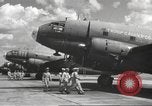
Chinese airmen board a U.S. troop carrier aircraft at Austin, Texas
United States and Chinese airmen at Bergstrom Field, Austin, Texas July 1946. The Neo-Classical building is the Texas State Capital at Austin, Texas and Austin Texas is noted on the graduate’s diploma “Bergstrom Field, Austin, Texas”. At this time the 349th Troop Carrier Group was based at Bergstrom and assigned to the Third Air Force, Tactical Air Command as noted on the diploma. Also “Air Force Combat Units of World War II” Edited by Maurer Maurer states this unit trained Chinese crews to operate C-46 aircraft. Film is very interesting in that it visually shows the transition from “Army brown to Air Force Blue” for the C-46s still carry the I TROOP CARRIER COMMAND insigne on the nose, with was disbanded on 4 Nov 1945 but they have the new AAF wide "Buzz Numbers" for all aircraft operating solely within the continental USA, by T.O. 07-1-1 of November 1945 and the graduate’s diploma is notating the new post-war air force type command reorganization of March 1946.
Effects of the atomic bombing of Hiroshima, Japan, in World War II, and early international efforts to control atomic weapons
Film showing city of Hiroshima, Japan, before and after the August 6, 1945 dropping of the atomic bomb over the city in World War 2. Sequence opens on what the narrator says is August 5, 1945, the day before the event (but the footage is likely from before that date). Camera pans over the city of Hiroshima before the atomic bomb destroyed the city. Japanese air raid lookouts are seen on watch for allied bombers. View of atomic bomb detonation as seen from aircraft high overhead (this is actually a view of the Nagasaki blast, not the Hiroshima blast despite narrator's comments). Next, the complete destruction of the city of Hiroshima is seen from camera at low altitude showing the four and one half square miles of the city flattened and burned. A Japanese hospital still functioning, with red cross flag on it. Hospital workers retrieving wounded victims of the bombing. Ambulatory victims clustered in doorways and halls. Shadow image of a large industrial valve wheel burned onto wall behind it. Similar image of a ladder burned onto a wall. The decorative pattern on a woman's dress burned onto skin of her back. Japanese physicians treating victims of thermal and radiation burns. Views of various victims, including some children, and their respective injuries. Scene shifts forward one year, to August 6, 1946. Children are lined up outside a school building, and then seen inside their classroom. Disfiguration and wounds on children resulting from injuries are still evident on the children at their desks. Sequence shifts again, this time to an early United Nations meeting with delegates grappling with the issue of controlling nuclear power and atomic weapons. Closeup view of American delegates, including James F. Byrnes (Secretary of State)and James B. Conant, President of Harvard University in the assembly. Closeups of representatives from South Asian nations. Closeup of USSR delegation, headed by Foreign Minister, Vyacheslav Molotov. Signs identifying delegates from Colombia, Egypt, Iraq, Bolivia, China. Final sequence shows several U.S. atomic scientists in their respective laboratories, including Enrico Fermi and Vannevar Bush. United States representative to the UN, Warren Austin, speaking about the so-called Baruch Plan, for international control of atomic weapons. (Principal author, Bernard Baruch, is standing behind speaker's left shoulder.) USSR delegation, headed by permanent representative, Andrei Gromyko, who is seen presenting the Soviet plan. View of explosion and mushroom cloud during U.S. Operation Crossroads atomic bomb test in the Pacific.