


 Francais
 Deutsch
 Italiano

Refine Your Search
+"United States" +1945 stock footage and images
- Showing 85 to 90 of 4253 results more
 Hide
Color Sound
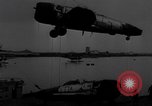
Montage of scenes from the air war between U.S. and German warplanes during World war 2
Montage of scenes from air war in Europe, covering period from about 1943 through 1945 during World War Two. U.S. P-47 and P-38 fighter aircraft being unloaded from a ship at a port in Europe during the Second World War. A line of P-47s on an airfield. German aircraft taking off and inflight, including: Me-109; He-111 bombers; Me-110 fighters; and Fw-190 fighters. U.S. P-51s firing at and destroying German aircraft. Multiple aerial dogfight scenes with gun camera footage showing dramatic mid air explosions of various enemy German aircraft. U.S. B-17s flying to Berlin and back again, with P-51 fighter escorts. P-38 aircraft flying in formation and returning from escort duty, seeking targets of opportunity, strafe German airfields, and fire on German aerodromes and parked aircraft, destroying many airplanes.
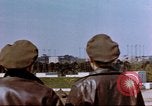
United States Airmen visit the Zeppelinfeld and Zeppelintribüne in Nuremberg, Germany
Activities of United States Airmen in Germany very soon after end of World War II in Europe. United States Army Air Forces Lieutenants visiting the war-damaged Zeppelintribüne, at the zeppelinfeld, in Nuremberg, Germany, 1945. They climb the stairs of the Zeppelintribüne grandstand. Later, the American soldiers look at the remains of the Swastika and Eagle that formerly adorned the Zeppelintribüne, and was blown up by the U.S. Army. One tries to pick up a piece of it. Airmen stand and chat. One Lieutenant helps another to lit up a cigarette. They smoke cigarettes, and pose for a photograph on the field.
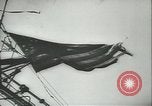
USS Franklin heads towards the United States after facing a Japanese attack during World War II.
United States aircraft carrier USS Franklin after being attacked by a Japanese bomber in the Pacific Ocean on March 19, 1945, during World War II. The U.S. flag flies from USS Franklin while on its way to the United States. A chaplain conducts a religious service on the deck of the aircraft carrier. The ship enters the Panama Canal. The men who faced the Japanese attack on USS Franklin being decorated. Men lined up with medals on their uniforms. Crew members smile after being decorated. The ship enters New York Harbor with the Statue of Liberty in the background.
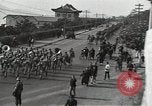
U.S. 6th Marine Division marching into Tsingtao, China, after Japan's surrender ending World War II
Following the Japanese surrender, ending World War 2, on September 2, 1945, U.S. Marines were sent into China to help the Nationalist Chinese Government with the surrender of Japanese forces occupying parts of China. This film shows Marines of the 6th Marine Division marching into Tsingtao (aka Qingdao) China on that mission. Headed by a brass band, they march along an avenue in the city. A number of Chinese civilians walk alongside them. A man riding an empty rickshaw, is seen on the sidewalk. A U.S. military policemen stands guard along the line of march. Some Chinese enter the roadway to follow the band, walking, riding bicycles, and several on a horse-drawn wagon. They have to move aside to avoid interfering with the first contingent of marching Marines following the band. Next a squad of Marines is seen marching onto a dirt field. Many Marines are assembled in another field across the road in the background, where a U.S. M4 Sherman tank and other armor are also seen. The squad is followed by a larger group of Marines. Shift in scene shows Marines marching past a building displaying the Nationalist Chinese (Republic of China) flag.

U.S. Army soldiers guard German SS-Totenkopfverbände (SS-TV) prisoners of war being held near a village.
United States Army soldiers guarding a group of German SS prisoners of war who are being held near a village. Cameraman slate indicates location of "Wittring" (presumably Wittring France, just outside the German border, in the Moselle region), but U.S. government record accompanying the film indicates "Wittring, (?) Germany" (sic). A wheel cart is seen on the street. The German prisoners of war have SS markings on their right lapel and also the SS skull insignia on the cap, identifying them most likely as part of the SS-Totenkopfverbände or SS-TV; also called Death's Head units. (Theories on these captured soldiers include: 1) SS-TV units were primarily in charge of administering the Nazi Concentration Camps in World War II. Hinzert Concentration Camp was possibly the closest camp to Wittring. Perhaps these soldiers came from it or another camp; 2) They may have been part of the 3rd SS Panzer Division. Reportedly, whole platoons and elements of the 3rd SS Panzer division were not following orders and were giving up prior to the Budapest and Vienna battles to avoid Soviet captivity, as early as Jan 1945). Prisoners rub their hands to warm them in the cold. Camera shows a close-up view of one of the prisoners, as an American soldier attaches a Prisoner of War identification tag over around the neck of the prisoner.
U.S. and Russian soldiers gather round a fellow soldier who plays a guitar.
Shows a group of U.S. and Russian soldiers showing snapshots to one another at the US-Russian Outpost at the 38th Parallel in Kaesong. U.S. and Russian soldiers gather around a Russian soldier who plays a guitar and entertains all.25 September 1945. (World War II period).
CRITICALPAST.COM: About Us | Contact Us | FAQs - How to Order | License Agreement | My Account | My Lightboxes | Shopping Cart | Advanced Search | Featured Collections | Website Terms & Conditions | Privacy Policy ©2026 CriticalPast LLC.
License Agreement |
Terms & Conditions |
Privacy Policy
©2026 CriticalPast LLC.