


 Francais
 Deutsch
 Italiano
Refine Your Search
+"United States" +1945 stock footage and images
- Showing 91 to 96 of 2149 results more
more Hide
Hide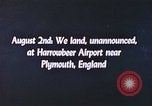
President Truman and his party at RAF Station Harrowbeer near Plymouth, England during World War II.
United States President Harry S. Truman, and his party, make unplanned stop at RAF Station Harrowbeer during return from the last 4-Power meeting of World War 2, held at Berlin in July, 1945. (Their planned destination, RAF Station St Mawgan, was fogged in. So the President instructed his pilot, Lieutenant Colonel Henry T. Myers, to land at Harrowbeer, when they saw it was clear.) Truman descends steps from the Presidential Airplane (Douglas VC-54C named the "Sacred Cow," used by Presidents Roosevelt, and Truman). Two other C-54 aircraft have also arrived (unseen). One carried Secretary of State, James F. Byrnes, who poses with the President and three members of the British WAAF (Women's Auxiliary Air Force) identified as: Section Officer Eira Buckland Jones, Corporal Clarice Turner, and Leading Aircraft Woman Audley Bartlett. Views from inside car taking members of Presidential party to Plymouth Harbor. Groups of local people wave as the car passes through the English countryside. Larger numbers of spectators line the streets of the city of Plymouth. View of Plymouth Harbor from launch taking members of President's party out to the USS Augusta, anchored in Plymouth Sound (not seen).
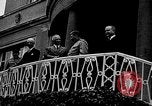
Allied National Leaders hold numerous conferences to plan and coordinate their efforts during World War II
First scene shows President Harry Truman shaking hands with Joseph Stalin on a porch of the Cecilienhof ( home of Crown Prince Wilhelm) in Potsdam, Germany. The two leaders are accompanied by their respective foreign ministers, James F. Byrnes, U.S. Secretary of State, and Soviet Minister of Foreign Affairs, Vyacheslav Molotov. Stalin descends steps from the building followed by Truman. View of the back lawn at Cecilienhof. View of its front entrance. Various views of the house and grounds. American, Soviet, and British flags flying from the building. Cars carrying the leaders on road to the Cecilienhof. President Truman and James Byrnes entering outside gate, followed by other attendees. Then Stalin is seen entering followed by Soviet officers and officials. U.S. General Dwight D. Eisenhower, Supreme Commander Allied Expeditionary Force (SCAEF) in Europea and U.S. Army Chief of Staff. George Marshall are seen walking together in a wooded glade on the meeting grounds. British Field Marshal Bernard Law Montgomery, entering the grounds for the meeting. British Prime Minister Winston Churchill, President Harry Truman, and Joseph Stalin stand on a step before an entrance to Cecilienhof. Truman places their hands together in a mutual handshake, at which Churchill and Stalin laugh. Views of the Kremlin and St. Basil's Cathedral, in Red Square, Moscow, Russia where foreign minsters of the United States, Britain, and the Soviet Union are seen meeting meeting in conference at the Spiridonovka Palace in October, 1943. Closeup of Soviet Prime Minister Vyacheslav Molotov, British Prime Minister, Anthony Eden, and U.S. Secretary of State, Warren Hull, successively signing a document. Scene shifts, to a C-47 transport aircraft flying over great pyramid of Giza in Cairo, Egypt. Next, the front of the Soviet Embassy in Teheran, Iran, is shown. The "Big Three" (Stalin, Roosevelt, and Churchill) sit on the porch of the building. Military officers from their countries stand behind them. Narrator (Franklin D. Roosevelt) says they agreed to launch a gigantic attack on Germany. Scene shifts to Germany, where German military is paraded on public display, showing artillery, Panzer I tanks carried aboard army trucks, Heinkel He 111 bombers in formation overhead, and marching troops giving Nazi salute silhouetted against bright pavement. View shifts to the Livadia Palace, in Yalta, Crimea, Russia. Brief view of the "Big Three" and their staffs sitting around a conference table. Change of location to San Francisco, California, where flags of many nations are displayed along with a United Nations Logo. Representatives of the many nations sign the Charter of the United Nations, founding the U.N. organization on 26 June 1945. Film shifts to Germany where victorious American, British and Soviet troops shake hands and celebrate victory. They share drinks and toast victory.
Gun crew operates 5" gun on shipboard and cargo ships underway off the shore of Iwo Jima, Japan during World War II.
Invasion fleet off the shore of Iwo Jima during the Battle of Iwo Jima of World War II. United States gun crew operates 5" gun on shipboard. Evening scenes: AK(cargo ships) underway. Rigging of USS Bayfield in the foreground. On January 29, 1945, General convoy of AKs (Cargo Ships) in column while underway at sea.
Japanese delegates reach Ie Shima, Ryukyu Islands and then advance towards Manila, Philippine Islands in the South East Asia.
Japanese surrender in Southeast Asia during World War II. Airplanes in formation flight. Two Japanese Mitsubishi G4M-1 'Betty' twin-engine bombers painted white with green crosses on their wings, fuselage and tail land at Ie Shima Ryukyu Islands near Okinawa carrying Japanese delegates. The planes land at Nichols Field at 1813 hours. The planes are dubbed 'Bataan number 1' and 'Bataan number 2.' Lt. Gen. Torasirou Kawabe, the vice chief of the Japanese Army's General Staff and his surrender party disembark from the airplanes. Members of the surrender party include Rear Admiral Ichiro Yokoyama Representative, Imperial Japanese Navy Staff., Colonel Yashima Terai General Staff, Colonel Orato Yamoto General Staff, Mr. Morio Yakawa Secretary, Japanese foreign office. Kawabe leads the surrender party. Army C-54 transport airplanes parked. Japanese surrender delegates board the airplanes which take off for Manila, Philippines. United States Army General Douglas MacArthur speaks to his troops from a balcony at the war damaged Manila City Hall (Padre Burgos Ave, Ermita, Manila, 1000 Metro Manila) on 20 August 1945. He notes that he is hopeful that they will all be able to return home soon.
U.S. soldiers watch German civilians disinterring bodies at Arnstadt Concentration Camp in Germany (WW2)
Arnstadt Concentration Camp in Germany captured by American forces in April, 1945 near the end of World War II. Prisoners were mainly Poles and Russians. View from the camp gate to tents which were used to house prisoners. Dogs were used to guard the prisoners. Shown is A dog kennel for a watch dog. Local German citizens had exhumed he bodies of concentration camp victims from their original mass grave, and reburied them in a trench further away from the town because of the stench. Now they were disinterring them again under supervision of United States Army soldiers. A corpse with crushed head. Corpses lying outside the graves from which they have just been exhumed. Bodies laid out on the ground are viewed by several U.S. soldiers
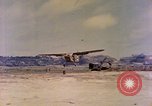
Wounded U.S. Marine being loaded aboard Stinson L-5B aircraft in Okinawa, Japan during World War II.
Air evacuation of wounded United States Marines on Okinawa in June, 1945. U.S. Army Air Forces Stinson L-5B Sentinel ambulance aircraft of the 163rd Liaison Squadron landing in front of camera as signalman waves flags. Identifiable aircraft serial numbers are: 44-17001, 44-17308, 44-17005. An ambulance pulls up on the field in front of a Red Cross tent and men carry a woundedsoldier on a stretcher towards L-5B aircraft. Another Marine on litter being loaded aboard an aircraft. More L-5B's taxi into position and take off. Identifiable tail numbers 44-17320, 44-16938. One aircraft, only identifiable with the number '80' on the tail is a Marine Corps OY-1 (L-5B).