


 Francais
 Deutsch
 Italiano

Refine Your Search
+"United States" +1945 stock footage and images
- Showing 247 to 252 of 4253 results more
 Hide
Color Sound
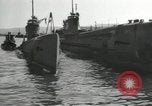
Operation Road's End, preparing to destroy Japan's submarine fleet. Crews decorate their submarines with cherry blossoms
Operation Road's End. Inspection of Japanese submarines,moored in Sasebo Bay, Japan, that are scheduled for destruction, after World War 2. View from a boat passing several of these submarines. One has a group of U.S. Naval officers and others on its deck. View of Japanese submarines I-366 and Number 107. Japanese sailors are decorating the submarines with branches of cherry blossoms. A Japanese officer looking down from boat I-402, as the camera passes below. Closeup of him posing on his boat for the camera.. Captain Atogi Nakamura, Lt. Tashio Tanaka and crew members posing aboard Japanese submarine I-58 (that sank the USS Indianapolis on July 30, 1945 with torpedos fired by Lt. Tanaka).

Devastation from atomic bomb dropped on Hiroshima Japan in World War II
U.S. War Department film showing devastation from atomic bomb dropped on Hiroshima, Japan, during World War 2. Opening scene is darkness of predawn in Alamogordo, New Mexico, on 16, July, 1945, at 5:29:45 AM. Suddenly, a huge explosion lights up the sky. A fireball and mushroom shaped cloud form. Closer view of the explosion from another camera. Following the initial explosion, the ensuing sound is a continuous roar. Another view is shown, from a third camera location. It highlights the boiling fire and smoke of the explosion. These scenes document the first successful test of a nuclear weapon, code named "Trinity". Change of scene shows glimpse of the Manhattan Project B Reactor site at Hanford, Washington, as viewed from a car driving past. Closeup of the facility, from right up against a boundary fence. Glimpses of other Manhattan Project facilities in New Mexico, Oak Ridge, Tennessee, and another view of the Hanford, Washington facility. Next, a rough topographical map of Japan is shown. Closeup of elevated railroad train traveling in Hiroshima, Japan. Imperial Japanese Army motorized vehicles are shown on parade, including fully tracked open personnel carriers with soldiers aboard and Type 94 Tankettes being driven by individual soldiers. Japanese infantry marching in full field gear including shouldered rifles with fixed bayonets. Closeup of a Japanese Army officer. Glimpse of Japanese support troops, such as quartermaster elements, in black uniforms. Japanese technicians in white lab coats at a wartime facility. Japanese Navy Warships being launched from Hiroshima ship yards. A lone B-29 bomber seen in flight over clouds. Its tail number, 42-63735 is clearly seen. It displays a large "05" on it upper tail. (This is not the "Enola Gay" whose tail number was 44-86292.) Closeup of one of the aircraft's engines with propeller turning. Glimpse upward from interior of the aircraft. Scene shifts to aerial photograph of Hiroshima with overlay depicting the bomb strike zone. Animated map showing explosion and precise point ot detonation above the junction of the Motoyasu and Ota Rivers. A view at the ground of destruction from the atomic explosion. An American soldier stands in the midst of the destruction. Slabs of heavy concrete are destroyed. View looking East from ground zero, past a burned tree trunk in the foreground, where the shells of several stronger buildings still stand amidst a sea of rubble. To the South, hardly anything is left standing. Looking West, everything is essentially leveled.
B-29 "Dave's Dream" returns to airfield in Marshall Islands after Test Able atomic bomb drop on Bikini Atoll
The B-29 "Dave's Dream" returns to airfield in Marshall Islands, after dropping atomic bomb on Bikini Atoll, in Test Able of Operation Crossroads, on July 1st, 1946, during U.S. nuclear testing. The B-29 lands and taxis to a parking place on the ramp. The area around the aircraft is cordoned off and the crew is confined therein as they deplane. Navy photographers take photos. An interviewer talks to crew members. The crew walks away from the aircraft along a cordoned pathway between numerous military personnel on hand to greet them on this historic occasion. The aircraft, number 44-27354, was actually participating in its second atomic mission. It also served as a photographic platform for the mission to Nagasaki on August 9, 1945, when it was named "Big Stink.". Pilot for the Bikini mission was Major Woodrow Swancutt of Wisconsin Rapids, WI. The aircraft was renamed "Dave's Dream" in honor of Captain David Semple, a bombardier killed during the crash of another B-29 on March 7, 1946, near Albuquerque, New Mexico. (World War II period).
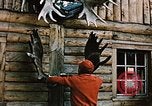
Man placing moose antlers on log cabin in Alaska.
Man securing Moose antlers for display on a former homsteader's log cabin, maintained for airmen's recreational use at Elmendorf Air Force Base (now Joint Base Elmendorf-Richardson, Alaska). He fastens the antlers below another set fastened near the cabin roof. Another take of the same event. Snow visible on roof of the cabin. (Note:The land for Fort Richardson and Elmendorf was purchased by the U.S. Federal Government, from private landowners and homesteaders during 1939 through 1945.)
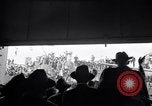
Steamship passengers, including many Displaced Persons and former prisoners of Nazi concentration camps, arrive in New York
The steamship, "SS Marine Flasher," arrives in the port of New York, after steaming from Bremen, Germany. In addition to U.S. citizens, her passengers include many refugees, and former prisoners of Nazi concentration camps, who benefited from President Truman's directive of December 22, 1945, giving preference to Displaced Persons in obtaining visas. Views among the crowds gathered at the dock to welcome loved ones. People waving and smiling. One woman angrily shouting at a guard. Men, women, and children aboard the ship, many wearing identification ribbons. Passengers enter the dock area. Their relatives and friends greet them warmly. A man kisses a woman and weeps. Two men embrace. (World War II period).
Judge Louis E. Goodman dismisses Justice Department's civil action to denaturalize ILWU President, Harry Bridgers.
Opening scene shows dimly lit hallway of Federal District Court building in San Francisco. Camera focuses on a courtroom door inscribed as " U.S. District Court, 258, Louis E. Goodman." Officials are seen escorting International Longshoreman's Union (ILWU) President, Harry Bridgers, along a hallway, accompanied by many photographers. Bridger's lawyer, Carol Weiss King and her co-counsel, wearing dark rimmed glasses, are seen standing in the hallway. Closeup of them. He holds up a copy of legal papers. View from further down the hall as Bridgers stops briefly to converse with them. Another closeup of Bridger's lawyers. (Note: Harry Bridgers was prosecuted for his labor organizing and supposed subversive status by the Justice Department in the 1930s, 1940s, and 1950s, with the goal of deportation. This was never achieved. Bridges became a naturalized citizen in 1945. A final effort by the Justice Dept. to deport Bridges ended in 1955 when Judge Louis E. Goodman dismissed the department's civil action to denaturalize him)
CRITICALPAST.COM: About Us | Contact Us | FAQs - How to Order | License Agreement | My Account | My Lightboxes | Shopping Cart | Advanced Search | Featured Collections | Website Terms & Conditions | Privacy Policy ©2026 CriticalPast LLC.
License Agreement |
Terms & Conditions |
Privacy Policy
©2026 CriticalPast LLC.