


 Francais
 Deutsch
 Italiano

Refine Your Search
+"United States" +1945 stock footage and images
- Showing 253 to 258 of 4253 results more
 Hide
USAAF XX Bomber Command B-29s attack Japanese positions on Formosa in World War II
U.S. Army Air Forces XX Bomber Command Operations during World War 2. A Boeing B-29-10-BW Superfortress, number 42-6347, named "King Size," of the 462nd Bombardment Group, 769th Bombardment Squadron. It is seen here, at their forward operating base on Kiunglai Airfield, China. Tents are seen near the flight line. Numerous bombs are lined up on the ground ready to be loaded aboard the bomber. A B-29 taking off at nightfall. A formation of B-29s in flight. Bombs being dropped over Japanese installations at Hatto, Formosa (aka Taiwan). View of B-29 landing after the mission. (Note. Formosa was a Japanese colonial territory from 1895 to 1945.)
German prisoner, Otto Richard Struller, is transferred by jeep from Béverce near Malmedy, Belgium during World War II.
A U.S. Military policeman leans against his jeep in front of a small building in Béverce near Malmedy, Belgium during World War 2. Two German prisoners emerge from the building escorted by an armed American soldier. A military photographer passes to the left, in front of them, as two American military policemen escort another German prisoner (Otto Richard Struller) from the building. They each hold one of his arms. The prisoner is bareheaded. They pause and pose for a photographer (unseen). Closeup of the prisoner with MPs at his sides. Camera zooms in on prisoner, Struller. The MPs direct him to a waiting jeep. They all get in and drive away. Closeup of the jeep passing the camera. It drives away along a muddy road, past an overturned vehicle. (Note: The principal prisoner in this film, is Otto Richard Struller, a ballet dancer, who during the war served as a corporal with Panzerbrigade 150 unit Stielau/Stab solar, where he masqueraded as an American soldier behind the lines. He was executed, as a spy, on January 13, 1945 at the Palace of Justice in Huy, Belgium)
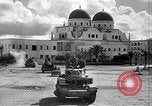
UN Commissioner Adrian Pelt and members of an Advisory Council meet people and the Emir of Cyrenaica in Libya.
A film depicts steps in Libyan independence. Allied soldiers on tanks during World War II. A tank goes past a ruined building. People gathered look as the Union Jack is unfurled. People read a proclamation pasted on a wall. Ruins of World War II. A meeting in the United Nations in 1945 where it is suggested that Libya be placed under temporary UN trusteeship. A resolution in the UN on 21st November, 1949 to create an independent Libya. The Russian delegate to the UN states his disagreement. The United Kingdom delegate speaks in favor of the resolution. A UN aircraft lands and taxis in Libya. Advisory Council members, led by Mustafa Qasim Mizran, who is first to exit the plane and is head of the National Party and Director of the School of Arts and Trades in Tripoli, are joined by UN Commissioner in Libya Adrian Pelt as they are greeted by dignitaries. The headquarters of the Commissioner and the Advisory Council in Tripoli. A sign reads 'Office of the United Nations Commissioner in Libya'. Members of the Advisory Council include representatives from Tripolitania, Cyrenaica, Fezzan, Egypt, France, Italy, Pakistan, the United Kingdom, the United States and a minority group delegate. Cars carrying the representatives drive out of the gates of the headquarters. They meet people to become aware of their problems. People greet the UN Commissioner and the members of the Advisory Council. A visit to Benghazi where they meet the Emir of Cyrenaica. People holding placards in front of the Emir's palace to greet the Advisory Council. They meet the Emir, who is the religious Muslim leader, in his place. The headquarters of the Commissioner and the Advisory Council, where Mustafa Qasim Mizran is seen touching his face, as he stands behind king Idris,

Japanese bombers bomb a Chinese cities, including Shanghai, and infantry advance during Second Sino-Japanese War (WW2)
A 1945 film titled 'The Enemy Japan Dream of Empire' details Japanese conquests starting with China during Second Sino-Japanese War in 1937. United States Ambassador to Japan Joseph C. Grew speaks about the ruthless nature of Japanese. Wall maps in the background. Aerial formation of Japanese bombers over a Chinese city, possibly Shanghai, during Second Sino-Japanese War (World War II), 1937. Smoke billows up from bomb bursts. Dead bodies of civilians on bombed streets. View of damaged Palace Hotel in Shanghai. Japanese infantry and horse-drawn munitions carts advance into the city. Car pulls up in front of building in Japan and a guard opens door. Japanese military leaders exit car. View of many tall banners with Japanese rising sun symbol hanging from ceiling. Japanese statesmen and army Generals confer in Japan.
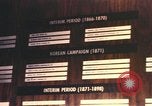
Hall of Heroes at the Pentagon showing hero names from Korean Campaign to the Vietnam War
View of the Hall of Heroes at the Pentagon, in the United States, during the Vietnam War. Names of the war heroes in the hall. Nameplates of the war heroes of each historical conflict on the wall. Names of the soldiers and officers who served the best in the wars. Names under the nameplates reading: 'Interim Period (1866-1870)', 'Korean Campaign (1871)', 'Interim Period (1871-1898)'. Other nameplates read: 'War with Spain (1898)', 'Philippine insurrection (1899-1913)', 'China Relief Expedition-Boxer Rebellion (1900)'. Several other conflicts mentioned in the hall. Other nameplates read: 'World War I (1917-1918)', 'Haitian Campaign (1919-1920), 'Second Nicaraguan Campaign (1925)', 'Word War II (1941-1945) and 'Vietnam (1964-Present).
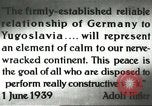
Tripartite Pact signed by Germany, Italy and Japan in Berlin, Germany. Ensuing attacks by Germany and Japan in World War II
This film is a scattering montage of World War 2 scenes from 1939 through 1945. Part of an agreement between Nazi Germany and Yugoslavia is shown in English. It is dated June 1, 1939 and ostensibly signed by Adolf Hitler. Next, German Ju 87, Stuka dive bomber aircraft are shown peeling off from formation, on April 6, 1941, to attack Yugoslavia. Bombs bursting on the ground. Closeup of a Stuka airplane in a dive, making its characteristic whine, and dropping bombs. Bombs exploding just outside some concrete walls. German infantry running along railroad tracks and entering backyard of house in a village. German soldiers observing from overlooking hill; climbing over rubble; and marching along a road toward a village. Animated map showing German invasion areas early in World War II, extending through most of Europe and into Norway, by 1941. Animated map shows further invasions into France, Belgium, low countries, the Balkans, and Eastern front towards the Soviet Union. Map highlights Tokyo, Rome, and Berlin. Delegations walking in hall of Reich Chancellery in Berlin, to sign Tripartite pact, on September 27, 1940. The group is led by by Count Galeazzo Ciano (Italian Foreign Minister, and Mussolini's son-in-law); Joachim von Ribbentrop, Germany's Foreign Minister and Japan’s Ambassador Saburō Kurusu. The diplomats are seen, next, standing near a table as Adolf Hitler enters rendering Nazi salute. He shakes hands with Count Ciano and Ambassador Kurusu. Hitler is seated to watch the proceedings. Von Ribbontrop is seen signing for Germany. Next scenes show German armored units heading East in Operation Barbarossa (June of 1941). A sign identifies the town of Eydtkau (Eydtkuhnen) on the German-Lithuanian border. German armor and artillery moving eastward. German troops destroying international crossing barriers. German troops firing siege guns. Montage with glimpses of German battle scenes showing tanks, guns, rockets in action with attendant explosions, fires, and destruction. Formations of German warplanes in flight, including Junkers Ju-52s that carry troops, including paratroops. View from above of Junkers Ju-87 Stuka dive bombers in formation. Battle of Britain scenes, with view of St. Paul's Cathedral in London, England (which miraculously survived the Blitz). The Tower Bridge in London, seen through a haze following blitzkrieg. German Junkers 87 Stuka dive bombers peeling off from formation to attack. British anti-aircraft searchlights shining beams skyward. Diving bombers illuminated by the lights. Anti-aircraft guns firing. Nighttime scenes showing gunfire flashes, explosions, tracer bullets and fires in London. British fire brigades fighting fires in London buildings as some collapse from the German bombing during the so-called "Blitz." Scene shifts to Pearl Harbor, December 7, 1941, as a Japanese bomb explodes on a U.S. Navy warship. The USS Arizona billowing smoke and listing as it succumbs to Japanese bombing. Another view of the Arizona sinking. Smoke rising from Battleship Row, at Pearl Harbor. Glimpse of postwar Nuremberg trial.