


 Francais
 Deutsch
 Italiano

Refine Your Search
+"United States" +1945 stock footage and images
- Showing 301 to 306 of 4253 results more
 Hide
Color Sound
Training Movie about U.S. Navy air crewmen and gunners of TBF Avenger aircraft.
U.S. Navy Training film' Air Crewmen of the Navy'. A U.S. Navy pilot named Lieutenant Grant Evans, played by Hollywood actor Robert Stack, enters a building. 'KTWM' written on the building. He is interviewed. Both men sit across the table. He talks about air crew of the U.S. Navy. He describes his work. A Navy Grumman TBF Avenger aircraft is inspected. The Navy pilot meets his crew members. Other planes in the background. The men talk to each other. The air crew climbs the plane and takes off. The pilot reaches the 'Naval Air Gunners School'. The gunners are trained. U.S. Navy Captain presents U.S. Navy aircrew wings to the trainees. Planes in flight. Planes land on flight deck.
United States Army soldiers use sound deception to deceive the German in Film 'Sonic Deception'.
Film 'Sonic Deception' shows the use of sounds to deceive the enemy (sometimes described as the "Ghost Army" in World War 2). Dramatization shows United States troops crossing river in small boats and arriving on beach. They establish beachhead on river bank and defeat German troops located there, having arrived by suprise. Film recounts through actors how a German spy at a German army corps headquarters informs about the presence of United States tanks and trucks. Film demonstrates how sound recordings were used by U.S. soldiers to create false impression of troop activities including bridge building and tank and vehicle movements, in order to serve as a decoy and mislead Germany enemy forces about U.S. Army activities. Dramatization shows German officials consulting and looking at maps. German soldier looks through binoculars and informs officials through phone. Tanks cross a bridge and artillery on field. Actual scenes of front gate of Army Experimental Center station headquarters at Pine Camp in Great Bend, New York (upper New York State). U.S. Army soldiers are shown recording via microphone the sounds of actual bridge construction at the center. The microphone routes to a recording truck where a turntable for pressing recordings is running, creating a phonograph recording of the bridge building decoy sounds. Recording of other sounds is shown, including sound of a bulldozer at work, sounds of men unloading trucks, and sounds of tanks crossing a bridge. Soldier is seen selecting a phonograph record from the Army Experimental Station Library.
Career of U.S. Air Force General Henry, "Hap", Arnold. The final years.
U.S. Air Force General Hap Arnold meeting with other allied military chiefs at the Potsdam conference, following the end of World War II, in Europe. General Arnold gives a speech during the 38th Anniversary of air power in the United States. Military band plays during the ceremony. General Henry steps from airplane and shakes hands with some of his Air Force Commanders in the Pacific theater. B-29 Super fortresses bombing Japan.Bombardier seen inside B-29 Super fortress. View of General of the Army, Henry (Hap) Arnold. Aircraft of the Air Force demonstration team, The Thunderbirds, in flight. September 18, 1947, formation of the United States Air Force as a separate service. January, 1950, the funeral of General Arnold at Arlington Cemetery, Virginia. Arnold Engineering Development Center building in Tullahoma, Tennessee. President Harry Truman dedicates the Center. B-47 and B-52 bombers taking off. Various Air Force aircraft seen taking off. Views of the United States Air Force Academy, Colorado Springs, Colorado.
Private Wilmer being treated in Italy and in United States after receiving a head injury during World War II.
A U.S. Navy training film titled 'Medicine in action: Head injury of a battle casualty' about the treatment and recovery of a soldier wounded during World War II. Private Wilmer of the U.S. 6th Army. A map of Casino Italy where Wilmer was injured during the battle of World War II. Aerial views of an evacuation hospital where Wilmer was given initial medical assistance after being injured. Wilmer with bandage on his scalp at a general hospital in Italy. Doctors clean the wound on the scalp. They try to control the bleeding. Blood clot being removed and wound being checked for infection. Bone fragments being removed from the wound. Wound being stitched. After six days wound being examined. Private Wilmer arrives in Naples in an ambulance. He boards a hospital ship in England and leaves for North Africa. At a camp he talks to other injured patients. Private Wilmer gets off a jeep and boards U.S. Army hospital ship Acadia to leave for United States. At Walter Ridge hospital he moves his hands and legs to demonstrate physical normality after being injured. Doctors administer anesthesia on his scalp and work on the wound. After treating the wound the scalp being closed and bandaged. Private Wilmer after recovering from the injury. He walks out of the hospital after being discharged.
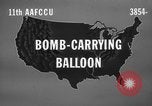
Japanese bomb balloons bound for the United States are shot down; examination of parachute and bomb apparatus
Evaluation of Japanese bomb-carrying balloons sent across the Pacific to the United States by Japan during World War 2. Gun camera footage of American fighter planes from Aleutian Island bases firing at Japanese balloons en route to the Pacific coast of the United States. A balloon bomb which reached the shores of the United States. but did not explode is examined by United States Army soldiers. They unfold the rice paper parachute portion of the balloon and examine its construction. Close-up views of the balloon control mechanism are shown, including a circular frame that would hold anti-personnel and incendiary bombs. Details of the wet cell battery and ballast weights are shown, including barometric aneroid switches which would operate to release ballast from simple hooks, as needed, to control balloon altitude. Narrator indicates it is believed the main purpose of the bombs was to start brush and forest fires.
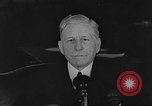
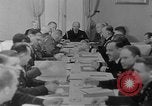
Patrick J. Hurley talks about the U.S. policy towards China and American support of the Nationalist Republic of China government (WW2)
Meeting of a committee in the United States. Officials seated inside a building. U.S. Secretary of War Patrick J. Hurley addressing the officials. He talks about the United States policy towards China during World War II. Discussion about the mutual aid pact with China. He states that the U.S. always want the unity and democracy of the Chinese people. He declares support for a democratic China under the national government of the Republic of China, and Chiang Kai-shek.
CRITICALPAST.COM: About Us | Contact Us | FAQs - How to Order | License Agreement | My Account | My Lightboxes | Shopping Cart | Advanced Search | Featured Collections | Website Terms & Conditions | Privacy Policy ©2026 CriticalPast LLC.
License Agreement |
Terms & Conditions |
Privacy Policy
©2026 CriticalPast LLC.