


 Francais
 Deutsch
 Italiano

Refine Your Search
+"United States" +1945 stock footage and images
- Showing 295 to 300 of 4253 results more
 Hide
Color Sound

United States sailors demobilize and they load in trucks and buses in California,United States.
United States sailors being demobilized at a separation center in California, United States, as soldiers and sailors were being discharged after World War II. A sailor hugs a girl. The sailor picks up his bag and walks along the sidewalk. A large number of sailors gathered outside a building at Treasure Island awaiting discharge. Cars move past the sailors. The sailors load onto a truck. The sailors board buses. Buses pull away.

United States Navy sailors get 'discharged insignia' sewed on their uniforms in California, United States.
United States sailors being demobilized in California, as United States soldiers and sailors were discharged after World War II. Sailors climb up a staircase. The sailors lined up near sewing machines outside a separation center. The sailors hand over their uniforms to get "discharged" insignia sewed onto it. The sailors wait as a man sews each uniform. The Man sews 'insignia' on a uniform with a sewing machine.

U.S. President Harry S. Truman decorates 14 U.S. Marines and sailors in Washington DC, United States.
U.S. President Harry S. Truman decorates men in Washington DC, United States for heroism in World War II. U.S. Marine Corps flying ace Lieutenant Colonel Pappy Boyington with the Medal of Honor. President Truman decorates a group of 14 Marines and Navy men for heroism above and beyond the call of duty. President Truman decorates a group of men including Sergeant Harold Russell, sailor Mate Whalen and Private Lucas. U.S. Army Chief of Staff General George C. Marshal and U.S. Navy Chief of Staff Fleet Admiral Ernest Joseph King congratulate the men who received the honors.
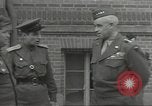
U.S. 2nd Armored Division tanks fire salute during official transfer of U.S. section of Berlin to U.S. towards end of World War II.
United States occupation of Berlin, Germany after World War II. U.S. General Omar Bradley meet and greet Soviet officer and his staff. General Bradley, U.S. Commander-General First Airborne Army of Berlin District Major General Floyd L Parks, Commander-General of French troops in Berlin Major General Duschesne, Deputy Commanding Officer of the Russian troops in Berlin Major General Nicholei Nicholeiovitch Barinov at attention and salute. General Barinov at microphone as he addresses the assemblage. U.S. flag flies from top of a building at Adolf Hitler Barracks. Salute being fired by tanks of the U.S. 2nd Armored Division. Soldiers of Soviet 5th Army lined up.
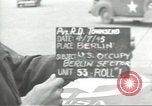
U.S. General Omar Bradley deplanes and greeted by U.S. Major General Floyd Parks in Berlin during U.S. occupation.
United States occupation of Berlin, Germany after World War II. U.S. aircraft taxis at airport in Berlin. U.S. General Omar Bradley deplanes and being greeted by U.S. Commander-General First Airborne Army of Berlin District Major General Floyd Parks and other officers. Generals Parks and Bradley inspect the bomb damage in the city.
The production of war films and other work in the Signal Corps Photographic Center in the United States (WW2)
Soldiers of the U.S. Signal Corps in the European Theater during World War II. Signal Corps cameramen of Army Pictorial Service photograph and film an amphibious landing. The soldiers wade ashore. U.S. soldiers advance on a battlefield, firing rifles. Camera man present. Street fighting on the war front. The wall of a building leans and crashes to the ground as a U.S. Army camera man captures moving image footage on camera. U.S. soldier rips a Nazi German eagle symbol from a building and it crashes to the street. A U.S. Army Air Corps B-17 aircraft in flight , seen from beside and close up from below and beside. View of exterior of Signal Corps Photographic Center building in New York. Men working inside the Signal Corps Photographic Center in the United States. Soldiers at film cutting machines at work, and view of film canisters in storage. The production of films in the center including a segment from "Why We Fight" and one from "The Fighting Men" pictures. Several war related films, and training and orientation films are produced. The foreign version of the films are also made so that they can be seen by other countries. Scene of an American soldier speaking Japanese in a U.S. military created film. Bing Crosby singing "Accentuate the Positive" during a filmed segment for the American G.I. audience at a USO show. Elevated view of war material and equipment stacked in a massive warehouse building, with Signal Corps workers moving about in the building. Men working and placing more equipment in the building. 'MacArthur's Headquarters' written on a wooden shipping crate. Boxes of war materiel being loaded into trucks, railroad train cars, and ships for transport to the war front in World War 2. Views of various kinds of Signal Corps communication equipment, radios, transmitters, cameras, vacuum tubes and other electronic equipment that was innovated during World War II. A moisture-proof switchboard is tested in the field. A U.S. Army Signal Corps soldier holding a phone during the switchboard testing.
CRITICALPAST.COM: About Us | Contact Us | FAQs - How to Order | License Agreement | My Account | My Lightboxes | Shopping Cart | Advanced Search | Featured Collections | Website Terms & Conditions | Privacy Policy ©2026 CriticalPast LLC.
License Agreement |
Terms & Conditions |
Privacy Policy
©2026 CriticalPast LLC.