


 Francais
 Deutsch
 Italiano
Refine Your Search
+"United States USA" +1918 stock footage and images
- Showing 31 to 36 of 232 results more
more Hide
Hide
Movie "The New York Hat".
From " A Short Survey of The Film in America." On screen English text describing advances in film making in the early years of the motion picture. Description of the years 1908-1918 as pivotal years for American film makers DW Griffith, Thomas H. Ince, and Mack Sennett. On screen text describing DW Griffith's work, "The New York Hat." The actual film follows : Small town gossips scandalously link together the names of a minister and a girl when they discover that he has given her an expensive hat from New York. The turmoil abates when the minister produces the will of the girl's mother, in which he has been asked to buy the daughter "bits of finery."
Plan for Peace, 1947. Public information film about U.S. Army Universal Military Training Project
Firing of a V-2 rocket from White Sands, New Mexico. An XP-84 jet aircraft on a test flight in California. Scenes of devastation in Hiroshima and Nagasaki. An atomic bomb test conducted in Bikini Atoll, Marshall Islands. Large smoke cloud rises. Americans expressing disgust with war and confidence in ability to protect against it in future. Newspaper headline about Armistice ending World War I on November 11, 1918. Victory parade in New York City. Close up view of Adolf Hitler as he speaks forcefully to a German audience. V2 rocket being launched in Germany. German Messerschmitt Me 163 Komet rocket plane in flight. Map depicting uranium deposits world wide. An XB-36 bomber in flight with landing gear extended. A huge formation of various warplanes in flight, high overhead. A wartime tank assembly plant. American army troops on parade. A United Nations meeting in session. Peaceful scenes of American soldiers in Hawaii before World War II in the Pacific. Hawaiian Hula dancers. Japanese carrier-based Aichi D3A1 dive bomber in flight during attack on Pearl Harbor, December 7, 1941. Bombed U.S. warships and facilities in Pearl Harbor. American Army officer and civilian discussing wisdom of maintaing large standing army. Army recruits are seen in the U.S. Army Universal Military Training Experimental Unit at Fort Knox, in 1947. They are seen in quarters, studying; taking part in sports (baseball); and attending religious services in a base chapel. Several trainees in a field tent, working with numerous tape decks in some kind of military communications activity.
Men load mail bags on a plane.
Opening slate advertises "National Air Mail Week. May 15-21. The 20th Anniversary of your air mail service!" Men load a DC-3 airplane with mail bags at an airport in the United States. Transport truck brings more mail and men load the bags. 1918 Map of United States showing Air Mail connection between New York and Washington. 1923, 1928, 1933 and 1938 maps show further connections to cities such as Chicago, Salt Lake, San Francisco and other destinations. Brief view of International routes between Asia and the United States, and from the United States to South America. Men load mail bags on a plane. The DC-3 plane takes off. Dirigible in background. Closing slate, "Don't Forget. National Air Mail Week."
Newly drafted American Army soldiers undergo medical examination in United States.
Draft and mobilization activities for U.S. Army soldiers during World War I in 1917-1918. American World War 1 military recruits take a shower and undergo medical examination. Recruits lined up as doctors with stethoscopes perform physical examination. Those who pass the examination are injected by doctors "with 6 million germs" and their finger prints taken. Men and women at Adjutant General's office maintain the records of the recruits. Recruits in new uniforms lined up as officers go through their records to make registration card, qualification card and various other documents. (World War I; World War 1; WWI; WW1)
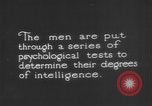
American military recruits for World War I undergo psychological tests in United States.
Draft and mobilization activities for U.S. Army soldiers of World War 1 in 1917-1918. American military recruits undergo psychological and mental acuity tests to determine their intelligence and ability to serve as soldiers. They undergo attention and observation tests. Figures drawn on a board as an instructor guides them, and Army recruits write on papers. Recruits must rapidly pick up their pencils on cue in a test of alertness. Rejected recruits discharged with payment and a discharge letter. The discharged soldiers stand in line at pay window. Close-up view of U.S. Army honorable discharge certificate. Slates indicate that most soldiers participated in the life insurance plan that was offered. Scene of soldiers seated at tables as they write letters home.
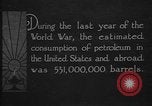
Water flows over the Niagara Falls and a globe with nine circular parallel lines along the equator rotates in the U.S.
The total consumption of petroleum of the U.S. and the world outside of the United States for the year 1918 is compared. Animation is used for this. Per capita consumption is also compared. Water flows over the Niagara Falls. A globe with nine circular parallel lines along the equator rotates. The 9 circular lines denote that if the per capita consumption of petroleum had increased as rapidly abroad as in the U.S. the world's petroleum requirement in 1922 would have been 10 times the actual requirement and if this volume had been loaded into tank cars of the capacity of 10,000 gallons each it would have made a solid train extending around the world at the equator 9 times.